ReplyTürkiye23 Sep 2026 · 01:25 UTC
@TurkishCentury الْحَمْدُ لِلَّهِ
الْحَمْدُ لِلَّهِ عَلَى كُلِّ حَالٍ
الْحَمْدُ لِلَّهِ كَثِيرًا طَيِّبًا مُبَارَكًا فِيهِ
Replying to @TurkishCentury🇵🇰🇹🇷🇸🇦 It's an honor and privilege to have these absolute **HEROES** as our brothers, partners and allies. Alhamdulillah! #PakistanZindabad #MakkahAlliance 🕌⚡️ https://t.co/xKhtFH6vZJ
ReplyAlliancePakistanSaudi ArabiaTürkiyeYemenIran22 Sep 2026 · 06:50 UTC
Saudi Arabia wants the larger war contained and its own territory protected. Pakistan and Türkiye have reasons to stand with Riyadh without being pulled onto the main stage of a conflict they did not start. None of that requires a public quarrel in the hall. It does require the three capitals to keep their August commitment distinct from the speeches about Iran.
The likely course is an alignment. You may hear solidarity with the Kingdom and a preference for de-escalation in the same breath. That is not empty language if the private work matches it. It is empty only if the week ends and the original problem around Saudi airspace and the Red Sea looks unchanged.
#MakkahAlliance
Replying to @trtworldThe US-Israel-Iran conflict is expected to dominate debate at the UN General Assembly, as the Red Cross warns around 130 armed conflicts are taking place worldwide—more than twice the number recorded 15 years ago. https://t.co/A1bRtTOgJH
ReplyAllianceSaudi ArabiaTürkiyeYemen22 Sep 2026 · 04:57 UTC
Fidan’s wording here is careful, and that is the point.
He did not say Türkiye is entering the Yemen war. He said Saudi Arabia may have military needs from the recent attacks, and that Ankara would examine them under the Mecca defence pact. That is a request-and-assessment clause rather than an automatic war clause.
Place it next to what he said later in New York, i.e., a new alliance should not be written off because it has not copied NATO’s one use of Article 5. Fair, as far as it goes. The public will still look for a first deliverable which might be sensors, interceptors, sustainment, or a watch at sea, before the “paper” line fades.
Headquarters and personnel would show the institution is real and a visible contribution would show the crisis clause is real.
Both of them are different proofs.
#MakkahAlliance
Replying to @trtworldTürkiye's Fidan says Saudi Arabia may have certain military needs stemming from recent Houthi attacks, and Ankara would examine them under the Mecca defence pact, and it was unacceptable for Riyadh to be drawn into US-Iran war https://t.co/jHDlEEXEMh
Original postAllianceSaudi ArabiaTürkiyeYemenDiplomacy22 Sep 2026 · 04:54 UTC
Fidan has now answered the “paper pact” charge directly.
In New York he pointed out that NATO’s Article 5 has been invoked once in seven decades, and that it is a poor test to judge a six-week-old arrangement against a ten-year Yemen war. On NTV he said the secretariat and a military headquarters are nearly ready, that personnel are the next step, and that Ankara would look at Saudi military needs arising from the Houthi attacks inside the framework of the agreement.
Take him at his word, and then keep the two files separate.
Building a headquarters is institutionalisation. It is not the same thing as putting a usable asset into this crisis. Examining a request is not the same thing as answering one. The pact can be standing up as an organisation while still sitting at consultation on Yemen.
What would settle the argument is still modest and visible which is warning data, interceptors, logistics, or a maritime watch that can be pointed to. Until that appears, both things can be true at once. The Alliance is being built. It has not yet been shown at work in this fight.
#MakkahAlliance
X ArticleAlliancePakistanSaudi ArabiaTürkiyeYemenIran18 Sep 2026 · 13:02 UTC
The Makkah Alliance May Be Entering a Federated Activation Phase
The first serious crisis is beginning to reveal how the pact may work before its permanent institutions are fully mature. Existing bilateral defence channels can carry immediate functions while the trilateral framework provides political direction, common thresholds and a wider basis for collective deterrence.
For much of the past week, the public debate around the Makkah Joint Defence Agreement has centred on a visible question. Will Pakistani or Turkish forces enter the conflict against the Houthis. That question is understandable, but it may also be increasingly incomplete. The most consequential developments are taking place below the threshold of a declared three-state military intervention.
Pakistan has moved from describing operationalisation as being at an early stage in late August to stating on 17 September that it is committed to implementing the Makkah Joint Defence Agreeme…
Read full article
The first serious crisis is beginning to reveal how the pact may work before its permanent institutions are fully mature. Existing bilateral defence channels can carry immediate functions while the trilateral framework provides political direction, common thresholds and a wider basis for collective deterrence.
For much of the past week, the public debate around the Makkah Joint Defence Agreement has centred on a visible question. Will Pakistani or Turkish forces enter the conflict against the Houthis. That question is understandable, but it may also be increasingly incomplete. The most consequential developments are taking place below the threshold of a declared three-state military intervention.
Pakistan has moved from describing operationalisation as being at an early stage in late August to stating on 17 September that it is committed to implementing the Makkah Joint Defence Agreement while declining to disclose when, where, how or what force might be used because those matters involve operational confidentiality. In the same briefing, Islamabad separately confirmed that its bilateral Strategic Mutual Defence Agreement with Saudi Arabia is already operational and that some force deployments exist under that relationship.
Those statements do not establish that Pakistani forces have begun operations under the trilateral Makkah agreement. They reveal something that may prove more important over time. The founders do not need to wait for a fully developed trilateral military command before the alliance can acquire operational effect.
The alliance already possesses bilateral inheritance
The Makkah Agreement did not join three militaries with no prior relationship. Pakistan and Saudi Arabia entered the pact with decades of defence cooperation and a separate mutual-defence framework. Türkiye and Pakistan already possessed mature military and defence-industrial ties. Türkiye and Saudi Arabia had also expanded defence-industry cooperation before the August agreement. The founding declaration itself explicitly built the new pact upon longstanding strategic ties and defence cooperation among the three states.
This creates an unusual starting point. A conventional alliance normally has to build common institutions before it can translate political commitments into military activity. The Makkah Alliance can potentially move in the opposite direction. Existing bilateral relationships can carry parts of the military burden while the Strategic Political and Defence Committee, Secretariat and future joint bodies gradually connect those activities at the trilateral level.
Makkah Alliance can describe this as bilateral inheritance. It means the new institution inherits capabilities, relationships, agreements and military familiarity that already existed between its members. The task is therefore less about creating every capability from the beginning and more about determining which existing channels should become part of a common defence framework. The present Saudi crisis may be the first time that distinction matters operationally.
Public language is moving closer to implementation
wording used by Pakistani officials has changed materially during the past three weeks. On 27 August, Pakistan's Foreign Ministry described operationalisation of the Makkah Joint Defence Agreement as remaining at an early stage. After the inaugural committee meeting in Istanbul, the emphasis shifted toward institution-building, a Saudi-hosted Secretariat and sequential meetings among the three founders.
By 16 September, Pakistan's military spokesman was describing the agreement as an instrument for collective deterrence and defence while stressing that it had no regional ambitions. Türkiye's foreign minister separately described attacks on Saudi Arabia as unacceptable and linked Turkish solidarity to the new defence agreement. A day later, Pakistan's Foreign Ministry was discussing implementation using operational vocabulary including force, objectives, modes and confidentiality.
There is still no public evidence of a formal trilateral combat operation. There is also no published implementing instrument setting out exactly how the collective-defence obligation is activated. The significance lies in where the discussion has moved. Officials are increasingly addressing the form of implementation rather than only explaining the legal character of the pact.
Scarce capabilities may matter more than visible force
The Saudi military problem is also becoming more specific. Recent reporting indicates that Riyadh has sought air-defence assistance from several partners including Pakistan, Egypt, France and Britain as pressure on interceptor inventories grows. No country had publicly committed combat support at the time of that reporting.
Separate reporting on 18 September describes a more complicated capability problem. Saudi Arabia retains considerable combat-air capacity, yet outside specialists cited by The National identified intelligence, satellite support and electronic collection as important requirements for generating stronger targeting information. Western personnel were reportedly discussing air-defence assistance inside Saudi Arabia while governments remained reluctant to enter the Yemen war directly.
This points toward a form of collective defence that is easy to miss when attention is concentrated on combat deployments. An alliance can change a battlefield without placing another country's fighter aircraft over Yemen. Interceptor replenishment, radar integration, intelligence sharing, electronic surveillance, satellite access, logistics, maintenance, force protection and maritime-domain awareness can increase the defensive capacity of the attacked state while leaving national command intact.
Makkah Alliance's existing Collective-Defence Escalation Ladder places many of these activities within Level 3 material support. The present evidence increasingly makes that level more relevant than it was when the model was first published. The strategic question is becoming one of capability substitution. When a founder begins exhausting a scarce military capability, can another founder replace, reinforce or extend that capability before the shortage becomes a strategic vulnerability. That is a considerably harder test of an alliance than issuing a statement of solidarity.
A federated model may be forming
Pakistan is simultaneously supporting Saudi security and using its relationship with Iran in efforts to restrain further Houthi attacks. Financial Times reporting on 18 September said Pakistani military leadership had pressed Iranian officials over the threat to Saudi Arabia while maintaining the possibility that Islamabad could be required to defend the Kingdom if formally requested.
Türkiye brings a different set of relationships, military capabilities and industrial assets. Saudi Arabia remains the state directly managing the current theatre. Each founder therefore approaches the same crisis from a different position, and uniform action would waste much of that advantage. A more plausible early model is distributed responsibility.
Saudi Arabia retains the primary territorial-defence role. Pakistan can contribute through established military channels, deterrent weight and diplomatic access that Riyadh does not possess in the same form. Türkiye can contribute through political backing, military interoperability and its defence-industrial base. The trilateral institution can connect those contributions without requiring each state to perform the same task.
Makkah Alliance can describe this emerging possibility as federated activation. The term is analytical and does not appear in the published agreement. It describes an alliance in which members retain national command and use different existing channels to deliver different parts of a shared defence requirement. The central measure becomes the combined effect rather than identical participation.
The absence of a joint war does not imply institutional inactivity
Saudi Arabia's confrontation with the Houthis has intensified sharply. The Houthis have expanded their control along Yemen's Red Sea coast, Saudi territory has faced missile and drone attacks, and Saudi authorities say an attempted drone attack toward Makkah was intercepted. The Houthis deny that they targeted the holy city. Fighting inside Yemen has also displaced more than 100,000 people in recent weeks.
At the same time, direct outside military intervention remains limited. The United States has declined a larger role against the Houthis and European governments appear reluctant to commit significant forces.
This combination creates a revealing environment for the Makkah Alliance. The founders are being tested during a period when traditional external security providers are constrained, politically cautious or occupied elsewhere. The need for regional capacity is rising before the new trilateral institution has completed its own development, and that timing may accelerate institutional decisions that would otherwise have taken years.
The first enduring products of the alliance could therefore emerge from present operational shortages. Air and missile defence coordination, intelligence exchange, common logistics, interceptor procurement, maritime surveillance and joint contingency planning all address requirements already visible in the current crisis. These are also areas that correspond closely with the Common Operational Requirements identified by Makkah Alliance across the three founders.
The next test is whether temporary cooperation becomes repeatable
There is a large difference between assistance provided during one emergency and an alliance acquiring permanent military utility. The founders have already created the Strategic Political and Defence Committee and agreed to establish a Secretariat in Saudi Arabia. Pakistan's Foreign Ministry says additional meetings will take place sequentially in Pakistan, Saudi Arabia and Türkiye to deepen the mechanisms created under the agreement.
Those meetings now have a live operational case from which to work. Which intelligence can be shared rapidly, which air-defence assets can be moved, how interceptor shortages are replenished, how national command remains intact during collective support, how a request for assistance is transmitted, how maritime threats at Bab el-Mandeb are connected to attacks on Saudi territory, and how political consultation proceeds when one founder has diplomatic access to an actor another founder is confronting were previously institutional questions. The Saudi crisis is turning them into practical ones.
The future value of the Makkah Alliance may therefore be decided well before anyone sees a common military formation carrying an alliance insignia. Its first durable achievement could be three states learning how to make their existing capabilities function as parts of a shared defence effort.
Makkah Alliance assessment
The available public evidence supports an assessment that the agreement is moving beyond its initial declaratory phase and toward practical implementation discussions. It does not establish that Türkiye or Pakistan have begun combat operations under the trilateral pact. The more consequential development is the interaction between the new trilateral institution and the founders' existing bilateral defence relationships.
If those inherited relationships begin supplying intelligence, air defence, logistics, diplomacy and other specialised functions under common political direction, the Makkah Alliance could develop without first building a centralised military command. That would give the agreement a distinctive operating model, with collective defence delivered through distributed national capabilities, connected by a common political framework and activated according to the requirement of the crisis.
The first serious test of the Makkah Alliance may therefore be producing something more consequential than a decision over whether three states enter the same war. It may be revealing how the alliance intends to function.
ThreadDiplomacy18 Sep 2026 · 12:39 UTC
So where does the watch sit now?
If we step back from the headlines, the picture is fairly clear: the risk of escalation has moved higher, but it has not yet clearly crossed into a new public threshold.
Based on all of the above, our reading today is that the watch has edged upward, but it still sits within Level 2 (Consultation and Backing) rather than clearly breaking beyond it to Level 3 (Material Support). What would materially change that assessment would be a wider disruption to shipping, a deeper strike pattern on critical infrastructure, or visible movement by allied states toward direct operational support.
For now, this is best understood as a phase of mounting pressure, not yet full strategic shift.
Replying to @makkahallianceThe geography of this crisis is becoming less important than the number of pressure points now moving at once.
Fighting in Yemen continues. The Bab al-Mandeb is under greater pressure. Saudi territory is being struck. Critical energy infrastructure has been damaged. Civilian consequences are becoming harder to separate from the military exchange.
Yet another part of the picture deserves equal attention: diplomacy has not stopped.
Washington has held contacts with Houthi representatives in Oman, while Riyadh has turned to Beijing in an effort to have China press Tehran over the Houthis. These are very different channels, but their existence matters when assessing where the confrontation may go next.
So today’s watch is increasingly about two processes happening simultaneously: military pressure expanding, while governments search for ways to contain what that pressure could become.
Hence our next question is to ask if the escalation watch itself moved?
https://t.co/I9SFOFKgpE
#MakkahAlliance #SaudiArabia #Yemen #RedSea #BabAlMandeb
ThreadAllianceSaudi ArabiaYemenIranDiplomacy18 Sep 2026 · 12:37 UTC
The geography of this crisis is becoming less important than the number of pressure points now moving at once.
Fighting in Yemen continues. The Bab al-Mandeb is under greater pressure. Saudi territory is being struck. Critical energy infrastructure has been damaged. Civilian consequences are becoming harder to separate from the military exchange.
Yet another part of the picture deserves equal attention: diplomacy has not stopped.
Washington has held contacts with Houthi representatives in Oman, while Riyadh has turned to Beijing in an effort to have China press Tehran over the Houthis. These are very different channels, but their existence matters when assessing where the confrontation may go next.
So today’s watch is increasingly about two processes happening simultaneously: military pressure expanding, while governments search for ways to contain what that pressure could become.
Hence our next question is to ask if the escalation watch itself moved?
https://t.co/I9SFOFKgpE
#MakkahAlliance #SaudiArabia #Yemen #RedSea #BabAlMandeb
ReplyAlliancePakistanSaudi ArabiaYemenRegional Security18 Sep 2026 · 12:34 UTC
Washington talking about the Makkah Defence Alliance is useful, because it treats the pact as part of the security map.
The risk is to collapse three different things into one which is, Saudi self-defence, the older Pakistan–Saudi military relationship, and the August trilateral text.
They overlap, but a distinction is to be clearly made that they are not identical.
If the Alliance is going to mean something in this crisis, it will not be because a congressman mentions it. It will be because one of the founding partners puts a defensive asset into the Saudi or Red Sea picture and is willing to have that fact known.
And that remains mostly unknown as of today.
#MakkahAlliance
Replying to @AlArabiya_EngIn an exclusive interview with Al Arabiya English, US Congressman Joe Wilson discusses the Mecca Defense Alliance , the Houthi militia and Red Sea security, Iran, Syria and the Russia-Ukraine war.
Watch the key highlights from the interview. https://t.co/7b2m1p3Fsi
ReplyAlliancePakistanSaudi ArabiaRegional Security18 Sep 2026 · 12:30 UTC
This interview is the most important Pakistani statement since the drone was intercepted.
He did three things at once. He put the word “physically” on the record. He said Pakistan is already present. And he tied further action to what Saudi Arabia asks for.
That last point is the one that tends to get lost. It means the gate is still in Riyadh. It also means the army is describing a standing bilateral duty, not publishing a trilateral tasking under the Makkah agreement.
Presence and invocation are not the same. If a new contribution is coming, it will show up as something usable like warning data, interceptors, sustainment, or a watch at sea. Until then the pact has been spoken for more firmly but ot has not yet been shown at work.
#MakkahAlliance
Replying to @arabnewsEXCLUSIVE: Pakistan Army says its support for Saudi Arabia goes beyond diplomacy. “We will go to any extent,” Lt. Gen. Ahmed Sharif Chaudhry tells Arab News https://t.co/694ZY1zd6E https://t.co/5wA7MfCsqU
Original postAlliancePakistanSaudi ArabiaYemenDiplomacy18 Sep 2026 · 12:28 UTC
The military language from Islamabad has moved.
On Wednesday the defence minister said the situation had arrived for the Makkah agreement. Overnight the army spokesman went further. Lt Gen Ahmed Sharif Chaudhry told Arab News that Pakistan stands with Saudi Arabia diplomatically and physically, that Pakistani forces are already there, and that Islamabad will go to any extent required by Riyadh for the security of the Haramain and the Kingdom.
Those sentences should be taken seriously. They should also be read with care. “Already there” is consistent with a long bilateral presence. “As asked and required” still leaves the request with Saudi Arabia. Neither phrase, on its own, tells us that the trilateral pact has been invoked, or that a new defensive task has been assigned under it.
A bilateral commitment can deepen without the August agreement being used. The agreement can be used without anyone announcing a campaign in Yemen. What we have not yet seen is the dull, visible thing that would settle the argument: shared warning, extra interceptors, logistics, or a maritime watch tied to this crisis.
Until that appears, the honest account remains the same. The political ceiling is higher than it was at the start of the week though the operational side of things are not. If attempts near the Haramain continue and nothing practical follows, the paper-pact charge will get louder. If something practical does appear, even quietly, that is the first real step toward the next level.
#MakkahAlliance
ThreadPakistanSaudi ArabiaTürkiyeYemenIran17 Sep 2026 · 13:14 UTC
Saudi Arabia has approached China over Iranian influence on the Houthis, U.S. officials have opened direct contacts with Houthi representatives in Oman, and reports indicate Riyadh is seeking additional air-defence support from partners.
The watchpoint now is whether these channels slow the offensive, or whether external support for Saudi Arabia becomes more operational.
Pakistan, Türkiye and Egypt are therefore increasingly relevant to what happens next.
Replying to @makkahallianceThe battlefield has moved faster than diplomacy. Houthi gains now reach the Bab al-Mandeb, attacks on Saudi territory continue, and Riyadh is widening its external consultations.
Does Level 2 still hold, or are events beginning to test the next threshold?
https://t.co/I9SFOFKgpE
#MakkahAlliance #SaudiArabia #Yemen #RedSea
ThreadAllianceSaudi ArabiaYemenDiplomacy17 Sep 2026 · 13:12 UTC
The battlefield has moved faster than diplomacy. Houthi gains now reach the Bab al-Mandeb, attacks on Saudi territory continue, and Riyadh is widening its external consultations.
Does Level 2 still hold, or are events beginning to test the next threshold?
https://t.co/I9SFOFKgpE
#MakkahAlliance #SaudiArabia #Yemen #RedSea
ReplyAlliancePakistan17 Sep 2026 · 13:08 UTC
Asif’s language is the furthest Islamabad has gone in public this week. It should be recorded as such. It should not be read as proof that the agreement has been invoked.
Per our assessment, the next and important marker will be a partner contribution becoming visible; like sensors, interceptors, sustainment, or a maritime watch. Until then the pact has been spoken for, not used.
#MakkahAlliance
Replying to @AJEnglishBREAKING: Pakistan’s Defence Minister Khawaja Asif says the time has come to implement the Mecca agreement with Saudi Arabia and Turkiye due to recent Houthi attacks.
🔴 LIVE updates: https://t.co/S7oDDFO5fJ https://t.co/hh0ALDOAdi
ThreadPakistanSaudi ArabiaTürkiyeYemen16 Sep 2026 · 13:10 UTC
Another statement from Islamabad or Ankara would not move the ladder. What would move it is something you can actually point to. Shared radar data, extra interceptors, logistics, maritime surveillance, equipment, or some other practical help tied to the Saudi crisis.
That is why we’re still at Level 2, but it is a much more pressured Level 2 than it was a few days ago.
If the attempts around Mecca continue, Saudi Arabia keeps taking hits and nothing practical appears from either partner, the criticism of the pact will become harder to brush aside.
If practical support does start showing up, even quietly and well below the level of entering Yemen, then we have the first real move toward Level 3.
That is the next thing to watch.
Replying to @makkahallianceAnkara has spoken and that matters. But it still does not mean the pact has been used.
Fidan called the attacks on Saudi Arabia unacceptable and said Türkiye is acting in the spirit of the Mecca agreement. He also said the framework is still being finished, and that enlargement is the aim.
So the day now looks like this. Saudi air defence stopped the drone. Pakistan gave political cover. Türkiye has matched that cover. No partner has put a visible defensive asset on the table.
People are asking why there is no war. That is the wrong test. A new alliance does not start with a campaign in Yemen. It starts with radar, interceptors, logistics or a Red Sea watch.
If attempts near the Haramain continue, the pressure for that kind of help will rise. If nothing operational follows Fidan’s words, the “paper pact” line will get louder. Both can still be true a week from now.
#MakkahAlliance
ThreadAllianceExpansionPakistanSaudi ArabiaTürkiyeYemen16 Sep 2026 · 13:09 UTC
Ankara has spoken and that matters. But it still does not mean the pact has been used.
Fidan called the attacks on Saudi Arabia unacceptable and said Türkiye is acting in the spirit of the Mecca agreement. He also said the framework is still being finished, and that enlargement is the aim.
So the day now looks like this. Saudi air defence stopped the drone. Pakistan gave political cover. Türkiye has matched that cover. No partner has put a visible defensive asset on the table.
People are asking why there is no war. That is the wrong test. A new alliance does not start with a campaign in Yemen. It starts with radar, interceptors, logistics or a Red Sea watch.
If attempts near the Haramain continue, the pressure for that kind of help will rise. If nothing operational follows Fidan’s words, the “paper pact” line will get louder. Both can still be true a week from now.
#MakkahAlliance
ReplyAlliancePakistan16 Sep 2026 · 12:51 UTC
The language is harder than this morning’s first wave like attack on the heart of Islam, black mark, shoulder to shoulder.
It still does not tell us what Pakistan will actually put on the table. That gap is now what might become a story.
Political ceiling is rising and military thresholds are unpublished. If this becomes a pattern around the Haramain, leaving that gap open gets harder.
#MakkahAlliance
Replying to @KhawajaMAsifI condemn in the strongest possible terms the dastardly and heinous attempted drone attack on the Holy City of Mecca.
This was not merely an attack on Saudi Arabia. It was an attack on the heart of Islam and on the sentiments of Muslims across the world, who revere Makkah as the holiest city.
Targeting the birthplace of the Prophet Muhammad (PBUH) and the focal point of Hajj is a cowardly, terrorist act that crosses every red line. It will remain a black mark on the perpetrators.
Pakistan stands unwaveringly, shoulder to shoulder, with brotherly Kingdom of Saudi Arabia in defence of its sovereignty and territorial integrity, and in safeguarding the security and sanctity of the holy sites.
ReplyAlliancePakistanSaudi Arabia16 Sep 2026 · 12:48 UTC
The procurement and CENTCOM piece is real and should not be hand-waved away.
States stack security relationships. Riyadh talking to Washington or others does not, by itself, empty the Makkah pact.
Where we would push back is the conclusion that the August agreement is only a facade. Pakistan's ISPR spent this morning saying operational detail stays classified and the pact is complementary, not a substitute for other ties. Fidan just said the framework is still being built.
So there may be two tracks: a US-brokered operational track that already exists, and a trilateral track that is still in the committee phase.
One being faster does not prove the other is fake. It does mean the first visible Makkah deliverable has to be something dull and measurable, or this critique will stick.
#MakkahAlliance
Replying to @MENAUnleashedSaudi and Israel have officially launched their first ever military alliance and here is the evidence which was starring at you in the fact. It turns out Mecca Alliance was a facade to appeal to Israel.
On 4 September the US approved $5bn of guided bombs for Saudi Arabia. This week Washington signed off on $2.8bn of the same class of bombs for Israel. Last week, CENTCOM put the Israeli and Saudi chiefs of staff in the same room. Read them together and you are watching an Israeli Saudi alliance being assembled in plain sight, one procurement notice at a time.
The Saudi package is 10,000 JDAM guidance kits, 5,000 500lb bombs and 5,000 2,000lb BLU-117s, with $750m of tank engines cleared the same day. The extended range kits let Saudi jets hit targets up to 80km away, from outside the reach of Houthi air defences. The stated purpose is interoperability with US forces and other Gulf partners. Israel has sat inside CENTCOM's area of responsibility since 2021. Interoperability with CENTCOM is interoperability with Israel by design.
The Israeli package is 40,000 2,000lb bombs, split evenly between MK 84s and BLU-117s, plus 20,000 penetrator warheads for hardened targets. It is the largest single transfer of this bomb to Israel in years. Half of it is the same BLU-117 body Riyadh ordered 11 days earlier. Same bomb, same US industrial base, 2 customers who officially do not speak to each other.
Now follow the money. Riyadh pays cash. Israel's bombs come out of US military financing, which means the American taxpayer. 2 revenue streams feed a single bomb production base that is already stretched replacing what has been dropped on Iran since February. Saudi orders keep the lines running and the capacity growing, and that capacity restocks Israel. The kingdom is, in effect, helping to underwrite the industrial base of Israel's wars.
And Riyadh is paying with borrowed money. Saudi oil GDP was -4.7% year on year in Q2 and the state is financing itself through debt. That is the backdrop to $5.75bn of bombs and engines cleared in a single day, for a war with Iran the kingdom never declared. Meanwhile the Houthis are hitting Saudi cities and energy sites again. 13 civilians were wounded in Khamis Mushait, Abha and Taif on Monday, a drone aimed at Mecca had to be intercepted, and Houthi forces are pushing along the Red Sea coast toward Bab al Mandab.
Days after the Saudi approval, CENTCOM quietly gathered the military chiefs of the US, Israel, Saudi Arabia, the UAE, Bahrain, Kuwait, Qatar, Jordan and Egypt at a closed conference in Germany. The Israeli chief of staff briefed the room on operations across every front. Not one participating state announced it. It was the first gathering of its kind since the Iran war began, and 3 of the Arab armies in that room belong to states with no diplomatic relations with Israel.
Inside that process, Israel and Saudi Arabia, with CENTCOM as the broker, discussed Israeli support for Saudi operations against the Houthis, including intelligence, surveillance and reconnaissance on the model Israel already runs for the UAE. Israeli eyes, Saudi jets, American bombs. That is a combined operation whether or not anyone signs a document.
Compare that with the alliance Riyadh chose to announce. The Mecca Joint Defence Agreement with Turkey and Pakistan, signed on 7 August, declares an attack on one an attack on all. Asked how Islamabad would honour that now that Saudi cities are under fire, its foreign ministry called the pact defensive and said there were no plans to expand it. The paper alliance offers solidarity. The working alliance offers targeting data.
This is how alliances form in the Gulf now. Not through treaties or embassies but through a shared supplier, a shared command and a shared enemy. Washington sells the bombs, hosts the meetings and writes interoperability into the contract. Riyadh and Tel Aviv never have to shake hands because the integration happens in the supply chain and in the CENTCOM planning cell.
Normalisation was supposed to be the price of a US security guarantee. Riyadh got the guarantee last November without paying it. Now the payment is being collected in kind, through shared bombs, shared targeting and a seat beside the Israeli chief of staff. When the handshake finally comes, it will not create an alliance. It will ratify one the procurement notices have already recorded.
ReplyAlliancePakistanSaudi ArabiaTürkiyeYemenRegional Security16 Sep 2026 · 12:46 UTC
This is Riyadh drawing the red line itself. Intercept, second attempt after 2017, right to take measures.
Notice what is not in the statement: a public request to Pakistan or Türkiye for a named form of help. Until that shows up, the Alliance stays at consultation and backing.
The forecast from here is less about one drone and more about whether holy-site attempts force the founders to pick a first practical mission, which is probably air defence or Red Sea surveillance, not a Yemen campaign.
#MakkahAlliance
Replying to @arabnews🔴 Saudi Foreign Ministry says air defenses intercepted and destroyed a Houthi drone before it entered Makkah’s airspace
🔴 Riyadh says the attack was a second attempt to target Makkah, following a previous attempt in 2017
🔴 Saudi Arabia calls on the international community to condemn Houthi attacks on holy sites and civilian and economic facilities
🔴 Kingdom reaffirms its right to take all necessary measures to defend the Two Holy Mosques, its territory and people https://t.co/WYxw70hcQm
ReplyAllianceExpansionPakistanTürkiyeYemenRegional Security16 Sep 2026 · 12:44 UTC
Short answer: not on the public evidence.
An intercepted drone plus a wave of condemnations is still Level 2.
Activation, in the useful sense, would be Pakistan or Türkiye providing something you can point to like intelligence, air defence, logistics, maritime cover.
Fidan’s line this afternoon is the closest Ankara has come, i.e., solidarity under the agreement, framework still being built and enlargement as a goal. That is certainly a political alignment and not a forced decision.
If the question is “will they fight the Houthis in Yemen now?” we would say no. If the question is “does this raise the odds of defensive help if the Haramain attempts become a pattern?” yes, a bit.
#MakkahAlliance
Replying to @husainhaqqaniDoes the purported failed drone attack on Islam’s holiest city, Makkah, set the stage for activating the Makkah Joint Defence Agreement? Will Turkiye and Pakistan now engage militarily in confronting the Houthis? 🤔🧐 https://t.co/RBvUPzdvQT
ReplyAlliance16 Sep 2026 · 08:18 UTC
@arabnews الإدانة السياسية لا تعادل التفعيل العملياتي. الاعتراض سعودي. المستوى الثالث يبدأ عند دعم دفاعي واضح من باكستان أو تركيا.
#MakkahAlliance
Replying to @arabnews🔴 BREAKING: Prime Minister of Pakistan: We strongly condemn the attempted attack on Makkah.
🔴 Prime Minister of Pakistan: We support Saudi Arabia in its defense of the security and sanctity of the Two Holy Mosques.
🔴 Prime Minister of Pakistan: We commend the exceptional vigilance of the Saudi Armed Forces.
ReplyAlliancePakistanSaudi ArabiaRegional Security16 Sep 2026 · 08:17 UTC
It is a test. It is not a test of allied airstrikes.
The published pact is collective defence, not automatic war. Saudi air defence handled the drone. Pakistan's PM gave political backing and asked for restraint. ISPR said operational detail stays classified.
That is Level 2. Failure would be a later, public refusal of defensive help after Riyadh asked for it.
Replying to @CaitlinDoornbosThe attempted attack on Islam’s holiest site is an appalling escalation – & a remarkable real-world test of what the Makkah pact actually means. Pakistan pledges solidarity with Saudi Arabia — while once again stopping well short of suggesting allied military action. https://t.co/pmeX9YdNXv
Original postAlliancePakistanSaudi ArabiaTürkiyeYemenRegional Security16 Sep 2026 · 07:19 UTC
Level 2 still holds this morning.
What changed: Saudi forces say they downed a drone south of Mecca before it entered restricted airspace.
Pakistan's PM Shehbaz Sharif condemned the attempt and pledged solidarity. DG ISPR said the Makkah pact is defensive, not aimed at any country, and that how it is operationalized stays classified.
What did not change: no public Pakistani or Turkish material support. No Alliance move into Yemen. Saudi air defence handled the intercept nationally.
Classified modalities do not mean there is no test. The public test is still the same.
Level 3 begins when intelligence, interceptors, logistics or Red Sea coordination become visible.Political language can harden while the military threshold stays where it is.
That is the gap we are tracking.
#MakkahAlliance
ReplyAlliancePakistanSaudi ArabiaTürkiye16 Sep 2026 · 07:16 UTC
@AlArabiya_Eng Strong political signal. It does not, by itself, move the Alliance to Level 3. The intercept was Saudi. The next evidence to watch is whether Pakistan or Türkiye provide identifiable defensive help.
@makkahalliance
Replying to @AlArabiya_Eng🔴 Pakistan PM Shehbaz Sharif strongly condemns the attempted drone attack on Mecca, calling it a “dastardly and heinous” act
🔴 The PM praises the vigilance and swift response of the Royal Saudi Armed Forces after Saudi air defenses intercepted the drone
🔴 He says Pakistan stands “shoulder to shoulder” with Saudi Arabia in defense of its sovereignty and security
ReplyPakistanSaudi Arabia16 Sep 2026 · 07:16 UTC
@IhsanTipu Worth noting.
Pakistan's PM hardened the political line and left the military line untouched. Solidarity with Riyadh, call for restraint, no named operational response.
That is Level 2 behaviour: backing without handing anyone a timetable.
Replying to @IhsanTipuWhile strongly condemning the “dastardly and heinous attempted drone attack against Makkah”, the Prime Minister of Pakistan avoided mentioning the Houthis, whom Saudi authorities blame for the attempted attack. https://t.co/B7Qb28wGro
ReplyAllianceRegional SecurityDiplomacy16 Sep 2026 · 07:14 UTC
ISPR is drawing the same line we use. Defensive pact. Not aimed at a country. Operational detail stays classified.
Classified is not the same as inactive. The public marker is still Level 3: ISR, air defence, logistics or maritime support. Until that appears, the assessment stays at consultation and backing.
#MakkahAlliance
Replying to @zarrar_11PKPakistan's DG ISPR on Makkah Defence Alliance https://t.co/lFcvTf7o67 https://t.co/IC10ha51yp
ReplyAlliancePakistanSaudi ArabiaIranDiplomacy16 Sep 2026 · 07:04 UTC
یہی وہ جگہ ہے جہاں پاکستان کی پوزیشن دلچسپ ہو جاتی ہے۔
ایک طرف سعودی عرب کے ساتھ نیا دفاعی معاہدہ ہے، دوسری طرف اسلام آباد تہران اور واشنگٹن دونوں سے بات بھی کر رہا ہے۔ دونوں چیزیں ایک دوسرے کی نفی نہیں کرتیں۔ پاکستان اس سال امریکا اور ایران کے درمیان مذاکرات میں پہلے بھی سہولت کاری کر چکا ہے۔
اگر یہ توازن برقرار رہتا ہے تو پاکستان صرف اتحادی نہیں، بلکہ ایسا ملک بھی بن سکتا ہے جو بحران بڑھنے سے پہلے دونوں طرف بات کر سکے۔
اصل امتحان تب ہوگا جب سعودی عرب پر دباؤ مزید بڑھے۔ کیا پاکستان ایک ہی وقت میں دفاعی شراکت دار بھی رہ سکتا ہے اور ایران کے ساتھ رابطے کا راستہ بھی کھلا رکھ سکتا ہے؟
اگر ہاں، تو یہی شاید اس نئے علاقائی بندوبست کی سب سے دلچسپ خصوصیات میں سے ایک ہوگی۔
This is where Pakistan’s position gets interesting.
On one side, Islamabad now has a new defence pact with Saudi Arabia. On the other, it is still talking to Tehran and Washington and trying to keep diplomatic space open.
Those two things do not cancel each other out.If Pakistan can hold that balance, it may end up doing more than just backing an ally. It could also remain one of the few countries able to talk across the divide when things get tense.
The harder test comes if pressure on Saudi Arabia keeps rising. Can Pakistan stay a serious defence partner and still keep the Iran channel open at the same time?
If it can, that may turn out to be one of the more useful features of the new regional setup.
#MakkahAlliance #Pakistan
Replying to @BBCUrduپاکستان فوج کے ترجمان لیفٹیننٹ جنرل احمد شریف چوہدری کا کہنا ہے کہ امریکہ اور ایران کے درمیان ثالثی کے لیے پاکستان تمام فریقوں سے رابطے میں ہے تاکہ اس پیچیدہ صورتحال کا حل مذاکرات کے ذریعے تلاش کیا جا سکے۔
تفصیل: https://t.co/cKeg5WvJMk https://t.co/bzBl2EjQVi
ReplyAlliancePakistanSaudi ArabiaTürkiyeYemenRegional Security16 Sep 2026 · 06:59 UTC
Wilson is describing Level 5. The public record is still Level 2.
Pakistan has said no military response is currently being discussed. Türkiye has not entered the Yemen war. Saudi air defence intercepted the drone nationally.
If the pact “means anything,” the first evidence to look for is intelligence, interceptors, logistics or Red Sea coordination — not an automatic campaign to “liberate Yemen.”
#MakkahAlliance
Replying to @IranIntl_EnRepublican US Representative Joe Wilson said on Tuesday that Turkey and Pakistan should work with Saudi Arabia against Yemen’s Iran-backed Houthis under the Makkah Joint Defence Agreement after Saudi forces said they intercepted a Houthi drone near Mecca.
“The Iranian puppet foreign Houthis occupying Yemen now attack the Muslim holy sites of Mecca in Saudi Arabia,” Wilson wrote in a post on X.
“We stand with our partners in Saudi Arabia against the hateful Houthi aggression,” he added.
Wilson said that “if the Mecca Alliance means anything then Turkiye and Pakistan must work with Saudi Arabia to destroy the foreign Houthi terrorists and liberate Yemen from Iran.”
The Makkah Joint Defence Agreement, signed by Saudi Arabia, Turkey and Pakistan on August 7, stipulates that an armed attack against any one of the three countries will be regarded as an attack against all three and calls for expanded defense cooperation.
ReplyAllianceDiplomacy16 Sep 2026 · 06:57 UTC
Agree the operational detail will stay classified. The public test is still usable. Watch for Level 3 markers instead of a press conference: air-defence or ISR support, logistics, maritime coordination, munitions top-up, or a named working group coming out of the next SPDC meeting.“No public plan” is compatible with consultation. It is not the same as no Alliance activity.
#MakkahAlliance
Replying to @OSPSFThe object and purpose of both the Pakistan–Saudi Arabia Strategic Mutual Defence Agreement (SMDA) and the Makkah Joint Defence Agreement (MJDA) among Pakistan, Türkiye and Saudi Arabia are set forth in the joint communiqués issued upon their signature. Collective deterrence vis-à-vis any act of aggression constitutes the foundational principle of both instruments.
The questions of when, where and how such commitments would be operationalized remain classified operational parameters. These modalities are neither the subject of public discussion nor intended for public disclosure.
Moreover, should a State party to either pact become the object of armed aggression, the prevailing geostrategic circumstances attendant upon the incident would govern the character and calibration of the response. The military capabilities of the State concerned would further determine whether that response is to be undertaken unilaterally by the aggrieved State party or through concerted allied action.
ReplyAlliance16 Sep 2026 · 06:44 UTC
هذا التصريح أهم مما قد يبدو للوهلة الأولى.
باكستان تؤكد موقفها الداعم للسعودية بشكل واضح بعد محاولة استهداف مكة، لكنها ما زالت تتجنب الحديث عن تدخل عسكري مباشر.
وهذا يعكس الوضع الحالي بدقة. الموقف السياسي أصبح أكثر صرامة، لكن العتبة العسكرية لم تتغير بعد.
إذا استمرت محاولات الاستهداف حول مكة، فسيصبح من الصعب الإبقاء على الفجوة بين التصريحات القوية والدعم العملي من دون تغيير.
وهذا هو الشيء الذي سنراقبه في المرحلة المقبلة.
#MakkahAlliance
Replying to @AlArabiya_KSAرئيس وزراء باكستان: نقف بثبات وتضامن مع السعودية.. وندين بشدة محاولة الهجوم على مكة المكرمة https://t.co/l6SL21YtMy
ReplyAllianceTürkiye16 Sep 2026 · 04:03 UTC
This is worth watching because China isn’t the only one moving quickly here.
Türkiye is already testing unmanned land, air and naval systems, swarm behaviour, and whether different autonomous platforms can work together through a common control picture. That is not theoretical anymore.
If the egnineers can make different systems talk to each other and work off the same picture, that is when this stops being three separate defence industries and starts becoming something much more interesting.
#MakkahAlliance #DefenceTechnology
Replying to @PravinSawhneyBy end of 2026, be prepared for Chinese robot soldiers on the Line of Actual Control with India. Both in combat & combat support roles. PLA has been collecting operational data on Indian military since August 2020.
Hope @adgpi & @rajnathsingh
understand the implications?
Cognitive warfare in Grey Zone operations. Think what it will be in depth, space & virtual domains for hot war!
ReplyAlliancePakistanYemen16 Sep 2026 · 03:11 UTC
This one matters to Pakistan more than it looks.
If Bab al-Mandeb gets seriously disrupted, the impact won’t stay in Yemen. Shipping costs go up, insurance gets more expensive, fuel gets pricier, and eventually we feel it here too.
So this is probably one of the areas where Pakistan has a real reason to care even without getting dragged into the war itself.
Maritime surveillance, intelligence, logistics, keeping routes open. That is the kind of support that may matter long before anyone starts talking about sending forces.
#MakkahAlliance #BabElMandeb
Replying to @dawn_comQatar warns against ‘catastrophic’ Bab al-Mandab closure, https://t.co/KffNs23Zvz
ReplyAlliancePakistanSaudi ArabiaTürkiyeYemenIran16 Sep 2026 · 02:39 UTC
We get the reflex. Anything involving Pakistan quickly gets dragged back into the India-Pakistan rivalry.
But this pact also has Saudi Arabia and Türkiye in it. Three governments, three militaries and three intelligence establishments signed the same agreement, and their foreign ministers, defence ministers and military chiefs have already met under its Strategic Political and Defence Committee.
It is hard to believe they reached this point without gaming the obvious scenarios. Houthis hitting Saudi Arabia. Pakistan facing a crisis on its own borders. Türkiye getting pulled deeper into Syria. Iran becoming part of a wider confrontation. These are Defence Planning 101.
So by all means keep saying “nothing will happen” until Pakistani or Turkish jets suddenly appear over Yemen. But that is not how escalation usually works, and it is not how this pact has been framed. The founders themselves talk about collective deterrence, institutionalisation and a range of joint activity, not automatic war after every incident.
Wishful thinking is fine. Just don’t confuse it with analysis.
The world is changing whether any of us likes it or not. The sensible thing is to watch what Saudi Arabia, Pakistan and Türkiye actually build, rather than assume three states entered this blindly because the outcome would be more comfortable that way.
#MakkahAlliance
Replying to @johncalvin_91@makkahalliance You will keep watching only
ReplyPakistanSaudi ArabiaTürkiyeYemenRegional SecurityDiplomacy16 Sep 2026 · 01:45 UTC
We get why the Pakistan angle sells in India. That part is obvious. But Türkiye is a founding member too, and somehow it disappears from the headline completely.
Pakistan has not “refused to defend Saudi Arabia”. It said no military response is being discussed at this stage and that it remains committed to the pact. Türkiye has not entered the Yemen war either.
That is why we keep using the ladder.
- Level 2 is consultation and backing.
- Level 3 is material support such as intelligence, air defence, logistics or maritime assistance.
- Level 4 is a visible collective military posture.
- Level 5 is direct intervention.
We are still at Level 2 because that is what the public evidence supports.
If Riyadh asks Pakistan and Türkiye for concrete help and they repeatedly refuse, then call it a failed test. We would say the same.
But if your definition of success is Pakistani and Turkish jets bombing Yemen within weeks of signature, then you are testing the pact against a promise it never made.
And the “Saudi turns to Israel” line is not the knockout point it is being presented as either. States use several security relationships at once. Riyadh talking to CENTCOM or seeking intelligence elsewhere does not somehow erase a separate pact with Türkiye and Pakistan.
#MakkahAllaince
Replying to @TimesNowMecca Alliance Fails in First Big Test
Pakistan Refuses To Defend Saudi
Saudi Seeks Israel Help Against Houthis Strikes on Oil Infra, Dominance in Yemen’s Red Sea Coast
https://t.co/SdghkJrxK9
ReplySaudi ArabiaYemenRegional SecurityDiplomacy16 Sep 2026 · 01:18 UTC
That’s a fair read on the timing. We just wouldn’t go as far as saying MBS went to Cairo looking for a rescue.
Egypt has its own reason to care. Anything that makes Bab el-Mandeb less secure eventually hits Suez, shipping and Egyptian revenues too. That gives Cairo and Riyadh plenty to talk about even if Egypt never joins the pact. Their meeting did in fact put Red Sea navigation and Yemen high on the agenda.
If this is becoming something more than consultation, we should start seeing follow-through. Defence meetings, maritime coordination, intelligence sharing, joint planning or a clearer Egyptian role around Yemen would be much stronger evidence.
For now we’d read the visit as Saudi Arabia widening the circle around the crisis, not yet asking Egypt to fight its war.
Replying to @GhittHance@makkahalliance You are right, I mentioned Egypt and skipped Turkey. But I think the MBS' rush to Egypt is an appeal for any help while the Egyptian situation is trapping in the wreckage.
ReplyAlliancePakistanSaudi ArabiaTürkiyeYemenRegional Security16 Sep 2026 · 01:16 UTC
If we used that standard, you could dismiss plenty of India’s defence relationships too.
India buys Rafales from France, works closely with the US and has deep defence ties across several countries. But when India and Pakistan exchanged strikes in May 2025, nobody expected French or American pilots to enter the war on India’s behalf. India fought with Indian forces, while partners mattered in other ways through diplomacy, equipment and political support.
Saudi Arabia is in a similar position now, with one important difference. It has a new collective-defence pact with Pakistan and Türkiye.
That still does not mean every intercepted drone should bring Pakistani or Turkish aircraft over Yemen.
On our ladder, Level 2 is consultation and political backing. Level 3 begins when you start seeing material support such as intelligence, air defence, logistics, equipment or maritime assistance. Level 4 is a much more visible collective military posture. Level 5 is direct intervention.
So there is a lot of ground between “the alliance is doing nothing” and “Pakistan and Türkiye are now at war in Yemen”.
What matters now is whether the pressure on Saudi Arabia starts pulling the other two founders from Level 2 into Level 3. Pakistan has publicly said no military response is currently being discussed under the pact, even as it remains engaged with Riyadh and regional diplomacy.
That is the threshold we are watching.
#MakkahAlliance
Replying to @smitaprakashNone of Saudi Arabia’s allies, friends and neighbours are coming to its aid. The GCC and OIC has collapsed. The ruling family has bank rolled so many powerful politicians in western nations, none of them are stepping in to help. https://t.co/VbCKKlOnsf
ReplyAlliancePakistanSaudi ArabiaTürkiyeYemenRegional Security16 Sep 2026 · 01:06 UTC
سوال بجا ہے، لیکن یہاں حملے اور اتحاد کے ردعمل کو الگ دیکھنا ہوگا۔
سعودی فضائی دفاع نے ڈرون کو مکہ کی ممنوعہ فضائی حدود میں داخل ہونے سے پہلے ہی مار گرایا۔ یعنی ابھی تک سعودی عرب اس خطرے سے اپنی قومی صلاحیت کے ذریعے نمٹ رہا ہے۔
اتحاد کی اہمیت اس وقت زیادہ سامنے آئے گی اگر یہ حملے مسلسل ہونے لگیں، سعودی دفاع پر دباؤ بڑھے، یا ریاض پاکستان اور ترکی سے کسی خاص قسم کی مدد مانگے۔ اور ایسی مدد کا مطلب لازماً یمن کی جنگ میں شامل ہونا نہیں ہوگا۔ یہ انٹیلی جنس، فضائی دفاع، لاجسٹکس یا بحری معاونت بھی ہو سکتی ہے۔
اگر مکہ یا مدینہ کے قریب ایسی کوششیں بار بار ہونے لگیں تو ہمارے خیال میں Level 2 سے Level 3 کی طرف جانے کا دباؤ بہت تیزی سے بڑھے گا۔
لیکن ہر روکے گئے ڈرون کے بعد یہ کہنا کہ “پھر اتحاد کا فائدہ کیا ہے؟” شاید اصل سوال نہیں۔ اصل سوال یہ ہے کہ جب سعودی عرب کو اپنی موجودہ صلاحیت سے زیادہ مدد درکار ہو تو باقی دو رکن ممالک کیا کرتے ہیں۔
Fair question, but this is exactly why we separate the attack itself from the Alliance response.
Saudi air defences intercepted the drone before it entered Mecca’s restricted airspace. That is still Saudi Arabia handling the threat nationally.
The pact becomes more relevant if these attacks keep coming, Saudi defences start getting stretched, or Riyadh asks Pakistan or Türkiye for specific help. And that help does not automatically mean joining the war in Yemen. It could be intelligence, air defence, logistics or maritime support.
If attempts around Mecca or Medina become a pattern, we would expect the pressure to move from Level 2 toward Level 3 to rise quite quickly.
But saying “then what was the point of the alliance?” after every intercepted drone is probably asking the wrong question. The real question is what happens when Saudi Arabia actually needs more than it can handle on its own.
#MakkahAlliance
Replying to source postSource context on X.
ReplyExpansionPakistanSaudi ArabiaTürkiyeYemenRegional Security16 Sep 2026 · 01:00 UTC
You’re mixing a few different things here.
Pakistan being in an IMF programme tells us it has fiscal constraints. It doesn’t tell us whether it can share intelligence, help with air defence, provide logistics or support Saudi Arabia in other ways. Egypt, meanwhile, isn’t even a member of the pact yet.
And Saudi Arabia’s choice is not simply to surrender to the Houthis or flatten Yemen. Riyadh is already using force, diplomacy and outside intelligence support at the same time.
That is also why we use an escalation ladder. Level 2 is consultation and political backing. Level 3 begins when material support shows up, such as intelligence, air defence, logistics, equipment or maritime support. Level 4 is a much more visible collective military posture. Level 5 is direct intervention.
So there is a lot of ground between “nothing happened” and “Pakistan and Türkiye are now at war in Yemen”.
Replying to @GhittHance@makkahalliance You are dreaming, Makkah alliance is not worth its declaration. Pakistan and Egypt are pursuing IMF to get loans to solve their choking economic crises. Saudis and MBS must kiss Houthis' ass and rebuild Yemen, otherwise the Yemeni fury will obliterate Saudi infrastructures.
ReplyAllianceSaudi ArabiaYemenIranRegional Security16 Sep 2026 · 00:51 UTC
We think the “Iran controls both chokepoints” line is a bit too clean for what’s actually happening.
The Houthis do not need to shut Bab el-Mandeb to make life difficult. If they can keep Saudi-linked shipping nervous, push up insurance costs and make every trip more expensive, they already have leverage.
That is probably the bigger headache for Riyadh. A full closure would bring a much bigger international response. Selective pressure is cheaper, harder to answer and can drag on for much longer.
So we’d watch the less dramatic stuff now. Who starts escorting ships, where surveillance increases, whether mines or drones begin shaping routes, and whether Saudi Arabia starts going after the coastal network rather than just hitting Yemen harder from the air.
This may end up looking less like a blockade and more like a permanent tax on shipping.
#MakkahAlliance #BabElMandeb
Replying to @MarioNawfal🇾🇪🇮🇷 Iran's biggest win of the war came without firing a shot
Bab al-Mandab carries 8.7% of global seaborne trade, a fifth of the world's cars and containers, 13% of its crude.
It is 18 miles wide, and the Houthis now hold both banks and the island in the middle.
A Yemeni official told the Post that Friday was the first day Iran really started winning the war.
A former head of Mossad analysis says Tehran timed the whole sequence, the coast, the pipeline strike from Iraq, for the window before November 3.
Trump's response was that the Houthis phoned, prefer America stay out, and are letting most ships through.
The Navy has 20 ships tied to Hormuz and six borrowed from the Pacific.
There is no second fleet for a second strait, and the last Houthi campaign ended in May 2025 because Caine saw no exit.
Washington will accept a Houthi-managed Red Sea as long as American hulls aren't the target.
So the squeeze lands on Riyadh, and the realistic next move is Saudi Arabia paying the Houthis to stop, the way it bought the 2022 truce.
Iran then holds both chokepoints as leverage and can move oil prices at will.
The economic siege Washington built to break Tehran now cuts the other way, and every month of blockade costs the West more than it costs Iran.
Source: The Washington Post / Writer: Daniel
Original postAllianceSaudi ArabiaIranRegional Security16 Sep 2026 · 00:38 UTC
Here’s one thing we’d watch closely over the next few months.
If the Makkah Alliance produces a genuinely useful military project early on, it may be something pretty unglamorous like shared radar data, cheaper drone interceptors and deeper air-defence stocks.
Saudi Arabia is now dealing with repeated missile and drone attacks across several cities and energy sites, while even the US is reporting pressure on munitions inventories from the Iran war.
That makes the boring questions suddenly important. How quickly can you spot a threat? Who has compatible systems? How fast can you reload? And who can actually manufacture replacements at scale?
We’d watch this before looking for a permanent joint command. A shared air-defence and counter-drone programme could be one of the most practical first wins for the pact.
#MakkahAlliance #AirDefence
ReplyAllianceSaudi ArabiaYemenRegional Security16 Sep 2026 · 00:29 UTC
We think this is where the Houthi strategy starts becoming really costly for Saudi Arabia, even without one massive strike.
They do not need to knock out a major facility in one go. If they keep hitting depots, pipelines and support sites, Riyadh has to spread air defence, repair teams and security across a much wider area.
That gets expensive quickly, and sooner or later something ends up with less protection than you would want.
If this keeps going, we would expect Saudi Arabia to focus more on launch sites, storage areas and command networks rather than just trading strikes one for one.
We would also watch for more help with intelligence and surveillance before anyone starts talking about foreign combat forces.
#MakkahAlliance #SaudiArabia
Replying to @MarioNawfal🇸🇦🇾🇪 The aftermath at Saudi Aramco’s Abha plant looks brutal
New footage shows the scale of the damage left behind at the facility in southwestern Saudi Arabia following reported Houthi strikes.
The video offers a striking look at what was hit... and how hard.
Writer: Val
https://t.co/RkT0dKU69v
ReplyAlliance16 Sep 2026 · 00:26 UTC
The $38 billion number is huge, but the bigger problem is that wars like this keep charging you long after the first bill lands.
You burn through interceptors, munitions and readiness, then spend years rebuilding stocks. Meanwhile oil, shipping and insurance all get more expensive and the cost starts leaking into everything else.
That is probably why so many countries in the region are trying very hard not to let every crisis turn into a full war.
#MakkahAlliance
Replying to @ReutersIran war cost hits $38 billion, forecast to rise $3 billion a month, CBO says https://t.co/oN84rFk9cJ https://t.co/oN84rFk9cJ
ReplyAlliancePakistanSaudi ArabiaTürkiyeYemenIran16 Sep 2026 · 00:21 UTC
We get the instinct behind this, especially after an attempted strike toward Mecca. But “destroy the Houthis and liberate Yemen” is a much bigger proposition than defending Saudi Arabia.
Once Pakistan and Türkiye cross into that kind of campaign, they are no longer just helping a treaty partner defend itself. They are entering Yemen’s war, taking responsibility for what comes after, and risking a much wider confrontation with Iran.
That is exactly why the pact needs room between doing nothing and going to war.
Air defence, intelligence, maritime support, logistics and even force protection can all raise the cost for the Houthis without committing three countries to an open-ended campaign inside Yemen.
If attacks on Saudi territory keep escalating, I would expect pressure for that kind of practical support to grow first.
Jumping straight to regime-change language may sound decisive, but it could leave the Alliance fighting a much larger war than the one it was created to deter.
#MakkahAlliance
Replying to @RepJoeWilsonThe Iranian puppet foreign Houthis occupying Yemen now attack the Muslim holy sites of Mecca in Saudi Arabia.
We stand with our partners in Saudi Arabia against the hateful Houthi aggression.
If the Mecca Alliance means anything then Turkiye and Pakistan must work with Saudi Arabia to destroy the foreign Houthi terrorists and liberate Yemen from Iran.
ReplyAllianceSaudi Arabia15 Sep 2026 · 23:52 UTC
@AlArabiya توجّه طائرة مسيّرة نحو مكة يضع الرياض أمام وضع مختلف.
حتى لو تم اعتراضها، لا يمكن التعامل مع تكرار مثل هذه المحاولات وكأنها أمر عادي.
إذا استمر هذا النمط، سيزداد الضغط على السعودية للرد بشكل أقوى بدلاً من الاكتفاء بالاحتواء.
#MakkahAlliance #SaudiArabia
Replying to @AlArabiyaالتحالف: تدمير مسيرة حوثية قبل دخولها المجال الجوي للعاصمة المقدسة مكة المكرمة https://t.co/tYFRstJtMq
ReplyAllianceSaudi Arabia15 Sep 2026 · 23:51 UTC
هذه رسالة أكثر وضوحاً وحزماً من الرياض.
عندما يتم وضع أمن مكة والمدينة بشكل صريح ضمن الخطوط الحمراء، يصبح من الصعب التعامل مع تكرار تهديدات الطائرات المسيّرة أو الصواريخ وكأنها أمر يمكن استيعابه بهدوء.
إذا استمرت هذه المحاولات، فمن المرجح أن يصبح الرد السعودي أكثر قوة ووضوحاً، سواء عبر تعزيز الدفاعات الجوية أو عبر ضرب القدرات التي يستخدمها الحوثيون لإطلاق المزيد من الهجمات.
وبالنسبة إلى تحالف مكة، فإن هذا لا يعني تلقائياً الانتقال إلى المستوى الثالث. لكنه يرفع الضغط على باكستان وتركيا لإظهار شكل الدعم العملي إذا استمر التهديد في الاقتراب من الحرمين الشريفين.
#MakkahAlliance #SaudiArabia
Replying to @tmrrah9( خط احمر )
التحالف يعلن:
أمن الحرمين الشريفين وضيوف الرحمن خط أحمر، وقيادة القوات المشتركة للتحالف لن تتردد في اتخاذ الإجراءات اللازمة والرادعة تجاه الميليشيا الحوثية الإرهابية وسلوكها العدائي والإرهابي
————
هذا بيان تحذيري صادر عن التحالف قبل قليل ، بإختصار:
أمن الحرمين الشريفين (مكة والمدينة) والحجاج والمعتمرين خط أحمر لا يمكن تجاوزه.
الرسالة صارمة و هي أن أي مساس بأمن الحرمين أو ضيوف الرحمن سيُقابل بالرد
السعودية لا تتهاون في ذلك
ReplyAllianceSaudi ArabiaRegional Security15 Sep 2026 · 23:47 UTC
A drone heading toward Mecca is a different kind of problem for Riyadh.
Even if it gets intercepted, you can’t just treat repeated attempts like background noise.If this keeps happening,
Saudi Arabia will come under growing pressure to respond more forcefully rather than keep absorbing it.
#MakkahAlliance #SaudiArabia
Replying to @geonews_urduمکہ کی فضائی حدود میں داخل ہونے کی کوشش کرنے والا ڈرون تباہ https://t.co/YbLbQW13xO
ReplyAlliance15 Sep 2026 · 23:46 UTC
هذه هي النقطة التي يغفل عنها كثيرون.
ليس من المفترض أن تكون كل تفاصيل أي اتفاق دفاعي معلنة. فإذا كانت الجوانب العملياتية مصنفة وسرية، فإن غياب التفاصيل العلنية لا يعني أنها غير موجودة. وفي الوقت نفسه، لا ينبغي أن نفترض وجود التزامات أو فجوات لم تعلنها الحكومات نفسها.
#MakkahAlliance
Replying to @AlHadathمتحدث الجيش الباكستاني أحمد شريف شودري للعربية إنجليزي: الالتزامات الدفاعية لا يتم الإعلان عنها علنًا في أي خطاب.. هذه الأمور تبقى دائمًا ضمن التصنيف التشغيلي والأمني https://t.co/GRajAWCNYK
ReplyAllianceSaudi ArabiaRegional Security15 Sep 2026 · 23:44 UTC
A drone heading toward Mecca is a different kind of problem for Riyadh.Even if it gets intercepted, you can’t just treat repeated attempts like background noise.
If this keeps happening, Saudi Arabia will come under growing pressure to respond more forcefully rather than keep absorbing it.
#MakkahAlliance #SaudiArabia
Replying to @trtworld#BREAKING: Saudi air defences intercept drone launched by Yemen's Houthis attempting to enter Mecca airspace, Saudi-led coalition spokesman says https://t.co/KSarjLjwKH
ReplyAllianceSaudi Arabia15 Sep 2026 · 23:44 UTC
@tmrrah9 توجّه طائرة مسيّرة نحو مكة يضع الرياض أمام وضع مختلف.
حتى لو تم اعتراضها، لا يمكن التعامل مع تكرار مثل هذه المحاولات وكأنها أمر عادي.
إذا استمر هذا النمط، سيزداد الضغط على السعودية للرد بشكل أقوى بدلاً من الاكتفاء بالاحتواء.
#MakkahAlliance #SaudiArabia
Replying to @tmrrah9رسمياً تم التأكيد قبل قليل:
السعودية تعلن رسميا اعتراض هجوم استهدف مكة المكرمة
أعلنت قيادة القوات المشتركة للتحالف، اعتراض وتدمير طائرة مسيّرة معادية أطلقتها الميليشيا الحوثية الإرهابية أثناء محاولتها دخول المجال الجوي للعاصمة المقدسة مكة المكرمة.
وقال المتحدث الرسمي إن قوات الدفاع الجوي الملكي السعودي تمكنت عند الساعة 6:50 مساء الثلاثاء 15 سبتمبر 2026، من اعتراض وتدمير المسيّرة قبل دخولها المجال الجوي المحظور للعاصمة المقدسة، مشيرًا إلى أنه جرى اعتراضها جنوب مدينة مكة المكرمة.
ماذا يعني ذلك ؟
مكة المكرمة من حيث الحساسية والأهمية هي العاصمة المقدسة وقبلة المسلمين وتضم المسجد الحرام ولذلك أي تطور أمني فيها او محيطها يحظى بإهتمام كبير
والتحالف أعلن أنه سيتعامل مع الهجمات "بمسؤولية وحزم"
وهذه وصمة سوداء في تاريخ الحوثيين
Original postAlliancePakistanSaudi ArabiaTürkiyeYemenRegional Security15 Sep 2026 · 23:41 UTC
We’re keeping today’s assessment at Level 2, even though the situation itself has clearly got worse.
That may sound odd, but the ladder tracks what the Alliance is doing, not how serious the Houthi threat has become. Saudi alerts have widened, Mecca and Jeddah were among the cities warned, Saudi strikes in Yemen have intensified, and pressure around Bab al-Mandeb is higher. What we still haven’t seen publicly is a move by Pakistan or Türkiye into operational support under the pact.
For us, Level 3 starts when that changes. Intelligence support, air defence, logistics, maritime surveillance, equipment or some other identifiable material contribution would be enough to move the assessment.
So Level 2 does not mean nothing is happening. It means the threat has moved faster than the Alliance response.
If concrete partner support appears, we move it. Until then, we don’t.
سنُبقي تقييم اليوم عند المستوى الثاني، رغم أن الوضع نفسه أصبح أكثر خطورة بوضوح.
قد يبدو هذا غريباً، لكن السُلّم يقيس ما يفعله التحالف، وليس فقط مدى خطورة التهديد الحوثي. التحذيرات داخل السعودية اتسعت، وشملت مكة وجدة، كما تصاعدت الضربات السعودية في اليمن وازداد الضغط حول باب المندب. لكن حتى الآن لم نرَ بشكل علني انتقالاً من باكستان أو تركيا إلى دعم عملياتي مباشر في إطار الاتفاق.
بالنسبة لنا، يبدأ المستوى الثالث عندما يتغير ذلك. دعم استخباراتي، دفاع جوي، لوجستيات، مراقبة بحرية، معدات، أو أي مساهمة مادية واضحة ستكون كافية لرفع التقييم.
لذلك، بقاء التقييم عند المستوى الثاني لا يعني أن شيئاً لم يتغير. بل يعني أن التهديد تحرك أسرع من استجابة التحالف.
إذا ظهر دعم عملي وواضح من أحد الشريكين، سنرفع التقييم. وحتى ذلك الحين، لن نستبق الوقائع.
#MakkahAlliance
ReplyAllianceSaudi Arabia15 Sep 2026 · 23:36 UTC
@AlArabiya توجّه طائرة مسيّرة نحو مكة يضع الرياض أمام وضع مختلف.
حتى لو تم اعتراضها، لا يمكن التعامل مع تكرار مثل هذه المحاولات وكأنها أمر عادي.
إذا استمر هذا النمط، سيزداد الضغط على السعودية للرد بشكل أقوى بدلاً من الاكتفاء بالاحتواء.
#MakkahAlliance #SaudiArabia
Replying to @AlArabiyaقيادة التحالف:
- الدفاع الجوي السعودي اعترض ودمر مسيّرة حاولت دخول المجال الجوي لمكة
- اعتراض مسيّرة معادية في جنوب مدينة مكة المكرمة مساء الثلاثاء
- محاولة استهداف مكة بمسيّرة ستبقى وصمة سوداء في سجل انتهاكات الحوثي
- أمن الحرمين وضيوف الرحمن خط أحمر
- لن نتردد في اتخاذ الإجراءات اللازمة والرادعة تجاه المليشيا الحوثية
- المحاولة الإرهابية لاستهداف مكة هي الثانية بعد محاولة بصاروخ باليستي في 2017
ReplyAlliancePakistan15 Sep 2026 · 23:36 UTC
One thing worth watching here is that Pakistan–Indonesia defence ties are starting to look less like a one-off arms discussion and more like a relationship with some depth.
The navies are already working together, training and exercises are on the agenda, and now Indonesia’s naval chief is at GHQ discussing where to take it next.
For us, Indonesia is interesting precisely because it does not need to be talking about joining anything tomorrow to matter. If this keeps developing, it creates another serious defence link between South Asia and Southeast Asia around the wider network we are watching.
The fighter deal may or may not happen. The relationship is already moving without it.
#MakkahAlliance #Indonesia
Replying to @SputnikInt🇵🇰🇮🇩 Pakistan and Indonesia: defense talks in Rawalpindi. What's on the table?
📍 On 14 September, Pakistan's top military commander, Field Marshal Asim Munir, hosted Indonesia's naval chief, Admiral Muhammad Ali, at General Headquarters in Rawalpindi — a meeting that underscored growing defense ties between the two nations.
🔸 Official outcomes. According to Inter-Services Public Relations (ISPR — Pakistan's military media wing), the two sides discussed regional security and bilateral defense cooperation. They expressed satisfaction with existing military ties and agreed to expand cooperation in professional training, defense collaboration and joint exercises. Munir emphasized the "long-standing brotherly relations" between the countries. Ali praised the professionalism of Pakistan's Armed Forces and their contribution to regional stability.
🔸 Cooperation over the past year. In January 2026, Indonesia's Defense Minister visited Pakistan to discuss training and defense mechanisms through the Joint Defense Cooperation Committee. In May, the two navies held exercises in the Java Sea, including using the submarine PNS Hangor. In August, Indonesia expressed interest in Pakistan's Air Force training system.
🔸 On a possible arms deal. In January, media outlets citing sources separately reported that a possible sale of more than 40 JF-17 fighter jets, Shahpar drones and air defense systems was discussed during the Indonesian defense minister's visit. Sources claimed the talks were at an advanced stage. However, Indonesia's Defense Ministry officially stated that no concrete decisions had been made, and Pakistan has not confirmed the deal.
ReplyAllianceSaudi Arabia15 Sep 2026 · 23:33 UTC
@AlArabiya توجّه طائرة مسيّرة نحو مكة يضع الرياض أمام وضع مختلف.
حتى لو تم اعتراضها، لا يمكن التعامل مع تكرار مثل هذه المحاولات وكأنها أمر عادي.
إذا استمر هذا النمط، سيزداد الضغط على السعودية للرد بشكل أقوى بدلاً من الاكتفاء بالاحتواء.
#MakkahAlliance #SaudiArabia
Replying to source postSource context on X.
ReplyAllianceSaudi Arabia15 Sep 2026 · 23:33 UTC
@Saudi_Gazette توجّه طائرة مسيّرة نحو مكة يضع الرياض أمام وضع مختلف.
حتى لو تم اعتراضها، لا يمكن التعامل مع تكرار مثل هذه المحاولات وكأنها أمر عادي.
إذا استمر هذا النمط، سيزداد الضغط على السعودية للرد بشكل أقوى بدلاً من الاكتفاء بالاحتواء.
#MakkahAlliance #SaudiArabia
Replying to @Saudi_Gazette#BREAKING: Coalition says the Houthi drone attack marks the militia’s second attempt to target Makkah, following a ballistic missile attack in July 2017. https://t.co/C7QG5YNXGZ
ReplyAllianceSaudi Arabia15 Sep 2026 · 23:32 UTC
@Saudi_Gazette توجّه طائرة مسيّرة نحو مكة يضع الرياض أمام وضع مختلف.
حتى لو تم اعتراضها، لا يمكن التعامل مع تكرار مثل هذه المحاولات وكأنها أمر عادي.
إذا استمر هذا النمط، سيزداد الضغط على السعودية للرد بشكل أقوى بدلاً من الاكتفاء بالاحتواء.
#MakkahAlliance #SaudiArabia
Replying to @Saudi_Gazette#BREAKING: Coalition says the Houthi drone was intercepted south of Makkah at 6:50 p.m. Tuesday before it could enter the holy city’s restricted airspace. https://t.co/C7QG5YNXGZ
ReplyAllianceSaudi Arabia15 Sep 2026 · 23:32 UTC
@SaudiNews50 توجّه طائرة مسيّرة نحو مكة يضع الرياض أمام وضع مختلف.
حتى لو تم اعتراضها، لا يمكن التعامل مع تكرار مثل هذه المحاولات وكأنها أمر عادي.
إذا استمر هذا النمط، سيزداد الضغط على السعودية للرد بشكل أقوى بدلاً من الاكتفاء بالاحتواء.
#MakkahAlliance #SaudiArabia
Replying to @SaudiNews50عاجل:
اعتراض وتدمير طائرة مسيرة معادية أطلقها الحوثيون قبل دخولها المجال الجوي المحظور للعاصمة المقدسة “مكة المكرمة”.
(التحالف)
ReplyAlliance15 Sep 2026 · 23:26 UTC
هذه فعلاً هي النقطة الأساسية. باكستان لا تقول إن كل هجوم يعني أن الدول الثلاث ستدخل الحرب تلقائياً.
الفكرة أبسط من ذلك. أي طرف يفكر في الهجوم عليه أن يحسب حساب ما إذا كان سيواجه دولة واحدة أم ربما ثلاث دول. وما يحدث بعد ذلك يعتمد على حجم الهجوم وكيف تقرر الحكومات الثلاث الرد.
#MakkahAlliance
Replying to @AlHadathالجيش الباكستاني: "اتفاق مكة" دفاعي.. ويتعلق بالردع الجماعي https://t.co/o8R5hedPWs
ReplyAlliance15 Sep 2026 · 23:26 UTC
هذه فعلاً هي النقطة الأساسية. باكستان لا تقول إن كل هجوم يعني أن الدول الثلاث ستدخل الحرب تلقائياً.
الفكرة أبسط من ذلك. أي طرف يفكر في الهجوم عليه أن يحسب حساب ما إذا كان سيواجه دولة واحدة أم ربما ثلاث دول. وما يحدث بعد ذلك يعتمد على حجم الهجوم وكيف تقرر الحكومات الثلاث الرد.
#MakkahAlliance
Replying to @AlArabiyaالجيش الباكستاني: "اتفاق مكة" دفاعي.. ويتعلق بالردع الجماعي https://t.co/4hl3JbEj7k
ReplyAllianceSaudi ArabiaYemenDiplomacy15 Sep 2026 · 22:55 UTC
We think the core point is fair. A four-week-old pact should not be judged as though it already has a mature joint command, standing interoperability procedures and a fully developed military bureaucracy.
Where we would differ is what follows from that.
The absence of a finished command structure does not mean nothing exists. The three foreign ministers, defence ministers and military chiefs have already met in the Strategic Political and Defence Committee, and the founders have agreed a Saudi-based Secretariat, joint activities and deeper defence-industry cooperation.
So the useful distinction is not between “working alliance” and “propaganda”.
It is between an alliance that is fully operational and one that is still being built while the first crisis is already arriving.
That is exactly why the Houthi attacks are analytically useful. They are showing us which parts of the pact can function early, which cannot, and what the founders now have to build faster.
We would not call the Alliance mature. We would call it exposed early.
And sometimes that is the first real test.
#MakkahAlliance
Replying to @ragipsoyluA four-week-old defense pact, still unratified and with no military coordination among its three signatories, is supposedly being “tested” by Houthi attacks.
This isn’t analysis.
It’s partisan propaganda masquerading as serious commentary
ReplyAlliance15 Sep 2026 · 22:48 UTC
هذا هو التحول الأهم. باب المندب لم يعد مجرد ملف يمني. فعندما يهدد الاضطراب فيه حركة الملاحة العالمية وتدفقات الطاقة، تصبح حماية المضيق مسؤولية أمنية مشتركة.
وبالنسبة إلى تحالف مكة، فإن ذلك يجعل التنسيق البحري أكثر أهمية، حتى من دون تدخل مباشر في اليمن.
#MakkahAlliance #BabElMandeb
Replying to @AJArabicمندوبا اليمن والسعودية بمجلس الأمن: حماية باب المندب مسؤولية دولية مشتركة تتعدى الإدانة
#الأخبار https://t.co/GmwPShCjps
ReplyAlliancePakistan15 Sep 2026 · 22:46 UTC
يتحول الدور الباكستاني في الوساطة إلى أحد أهم الاختبارات لكيفية عمل البنية الأمنية الإقليمية الجديدة على أرض الواقع.
تحاول إسلام آباد أن تبقى شريكاً أمنياً مهماً للسعودية من دون أن تفقد قدرتها على التواصل مع إيران. وهذه المساحة مهمة، لأن دور الوسيط يتغير فور تحوله إلى طرف مباشر في القتال.
إذا تمكنت باكستان من المساهمة في خفض التصعيد مع الحفاظ في الوقت نفسه على التزاماتها الأمنية، فسيكون ذلك دليلاً على أن تحالف مكة قادر على تقديم ما هو أبعد من مجرد الرسائل العسكرية.
#MakkahAlliance #Pakistan
Replying to @AlArabiyaمتحدث الجيش الباكستاني للعربية إنجليزي: نسعى من خلال الوساطة لجلب السلام للمنطقة https://t.co/lS7fxmi2QR
ReplyAlliance15 Sep 2026 · 22:44 UTC
يكتسب التنسيق السعودي المصري أهمية خاصة لأن أمن البحر الأحمر لا يمكن أن تديره دولة واحدة بمفردها. فالرياض والقاهرة تقعان عند نقطتين حيويتين ضمن منظومة بحرية واحدة، وأي تقارب أكبر بينهما قد يؤثر مباشرة في كيفية تعامل المنطقة مع التهديدات الممتدة من باب المندب إلى قناة السويس.
#MakkahAlliance #RedSea
Replying to @AlArabiyaالكاتب الصحافي جاسر الجاسر: العلاقات السعودية المصرية تمثل رمانة الميزان في مواجهة الأزمات الإقليمية.. وزيارة الأمير محمد بن سلمان تؤكد وحدة موقف الرياض والقاهرة وإمساكهما بزمام إدارة ملفات المنطقة فضلا عن قدرتهما المشتركة كأكبر قوتين مؤثرتين على حماية أمن البحر الأحمر وصون الاستقرار المشترك
ReplyAlliance15 Sep 2026 · 22:42 UTC
قد يكون هذا أوضح تفسير حتى الآن لسبب عدم وجوب قراءة اتفاق مكة وكأن كل سيناريو محتمل يجب أن يكون منشوراً للعامة.
أي اتفاق دفاعي جاد يحتاج إلى أمرين في الوقت نفسه. يجب أن يكون الالتزام واضحاً بما يكفي لتحقيق الردع، وأن تبقى كيفية الرد غير مكشوفة بالكامل بما يمنع الخصم من معرفة أين تقع حدود التصعيد بدقة.
الرسالة العلنية واضحة بالفعل. أي هجوم مسلح على أحد الأطراف يعني أن بقية الأطراف معنية، والهدف المعلن هو الردع الجماعي. أما ما يبقى سرياً فهو كيفية تنفيذ هذا الالتزام في ظروف مختلفة.
وهذا الغموض ليس بالضرورة نقطة ضعف. في بعض الجوانب، هو أحد عناصر قوة الاتفاق. فلو تم نشر كل عتبة للتصعيد، وكل نوع محتمل من المساعدة، وكل خيار للانتشار أو الرد العسكري، لكان الخصوم قد حصلوا عملياً على دليل يوضح لهم كيف يتحركون تحت كل خط أحمر من دون تجاوزه.
لكن من المهم أيضاً ألا نذهب إلى الطرف الآخر. السرية لا تعني أن بإمكاننا افتراض وجود أي التزام نتخيله خلف الأبواب المغلقة. هي تعني فقط أن الالتزام السياسي المعلن والترتيبات العملياتية السرية مستويان مختلفان من الاتفاق نفسه.
الاختبار الحقيقي سيأتي عندما يرتفع الضغط ونبدأ في رؤية أي من هذه الآليات الخاصة يتحول إلى تنسيق فعلي على الأرض.
#MakkahAlliance
Replying to @AlArabiyaمتحدث الجيش الباكستاني للعربية إنجليزي: اتفاقية مكة دفاعية وتتعلق بالردع الجماعي https://t.co/NoUUxbOgGS
ReplyAlliance15 Sep 2026 · 21:48 UTC
قد يكون هذا أوضح تفسير حتى الآن لسبب عدم وجوب قراءة اتفاق مكة وكأن كل سيناريو محتمل يجب أن يكون منشوراً للعامة.
أي اتفاق دفاعي جاد يحتاج إلى أمرين في الوقت نفسه. يجب أن يكون الالتزام واضحاً بما يكفي لتحقيق الردع، وأن تبقى كيفية الرد غير مكشوفة بالكامل بما يمنع الخصم من معرفة أين تقع حدود التصعيد بدقة.
الرسالة العلنية واضحة بالفعل. أي هجوم مسلح على أحد الأطراف يعني أن بقية الأطراف معنية، والهدف المعلن هو الردع الجماعي. أما ما يبقى سرياً فهو كيفية تنفيذ هذا الالتزام في ظروف مختلفة.
وهذا الغموض ليس بالضرورة نقطة ضعف. في بعض الجوانب، هو أحد عناصر قوة الاتفاق. فلو تم نشر كل عتبة للتصعيد، وكل نوع محتمل من المساعدة، وكل خيار للانتشار أو الرد العسكري، لكان الخصوم قد حصلوا عملياً على دليل يوضح لهم كيف يتحركون تحت كل خط أحمر من دون تجاوزه.
لكن من المهم أيضاً ألا نذهب إلى الطرف الآخر. السرية لا تعني أن بإمكاننا افتراض وجود أي التزام نتخيله خلف الأبواب المغلقة. هي تعني فقط أن الالتزام السياسي المعلن والترتيبات العملياتية السرية مستويان مختلفان من الاتفاق نفسه.
الاختبار الحقيقي سيأتي عندما يرتفع الضغط ونبدأ في رؤية أي من هذه الآليات الخاصة يتحول إلى تنسيق فعلي على الأرض.
#MakkahAlliance
Replying to @AlArabiyaمتحدث الجيش الباكستاني للعربية إنجليزي: اتفاقية مكة دفاعية وتتعلق بالردع الجماعي https://t.co/ZshcZ8k0dk
ReplyAlliance15 Sep 2026 · 21:45 UTC
قد يكون هذا أوضح تفسير حتى الآن لسبب عدم وجوب قراءة اتفاق مكة وكأن كل سيناريو محتمل يجب أن يكون منشوراً للعامة.
أي اتفاق دفاعي جاد يحتاج إلى أمرين في الوقت نفسه. يجب أن يكون الالتزام واضحاً بما يكفي لتحقيق الردع، وأن تبقى كيفية الرد غير مكشوفة بالكامل بما يمنع الخصم من معرفة أين تقع حدود التصعيد بدقة.
الرسالة العلنية واضحة بالفعل. أي هجوم مسلح على أحد الأطراف يعني أن بقية الأطراف معنية، والهدف المعلن هو الردع الجماعي. أما ما يبقى سرياً فهو كيفية تنفيذ هذا الالتزام في ظروف مختلفة.
وهذا الغموض ليس بالضرورة نقطة ضعف. في بعض الجوانب، هو أحد عناصر قوة الاتفاق. فلو تم نشر كل عتبة للتصعيد، وكل نوع محتمل من المساعدة، وكل خيار للانتشار أو الرد العسكري، لكان الخصوم قد حصلوا عملياً على دليل يوضح لهم كيف يتحركون تحت كل خط أحمر من دون تجاوزه.
لكن من المهم أيضاً ألا نذهب إلى الطرف الآخر. السرية لا تعني أن بإمكاننا افتراض وجود أي التزام نتخيله خلف الأبواب المغلقة. هي تعني فقط أن الالتزام السياسي المعلن والترتيبات العملياتية السرية مستويان مختلفان من الاتفاق نفسه.
الاختبار الحقيقي سيأتي عندما يرتفع الضغط ونبدأ في رؤية أي من هذه الآليات الخاصة يتحول إلى تنسيق فعلي على الأرض.
#MakkahAlliance
Replying to @AlArabiyaالمتحدث باسم الجيش الباكستاني: "اتفاقية مكة" تضم التزامات دفاعية لن نكشفها علنا
=======
المتحدث باسم الجيش الباكستاني أحمد شريف تشودري لـ"العربية إنجليزي":
🔴 "اتفاقية مكة" تضم التزامات دفاعية لن نكشفها علنا
🔴 "اتفاقية مكة" لن تؤثر على علاقتنا بإيران
🔴 "اتفاقية مكة" هدفها الردع الجماعي
🔴 التفاصيل التشغيلية لـ"اتفاقية مكة" تظل سرية
ReplyAlliance15 Sep 2026 · 13:39 UTC
هذا التطور أكثر دلالة من مجرد بيان تقليدي عن العلاقات السعودية المصرية.
الإشارة إلى أمن وحرية الملاحة البحرية مهمة، لأن مصر والسعودية تقعان على طرفي منظومة استراتيجية واحدة. السعودية معنية بأمن الخليج والبحر الأحمر وباب المندب، بينما تسيطر مصر على قناة السويس، حيث تتحول أي اضطرابات تقع جنوباً إلى مسألة اقتصادية وأمنية مصرية أيضاً.
ولهذا فإن القاهرة تظل ذات أهمية مباشرة للبيئة الأمنية الأوسع المحيطة بتحالف مكة، حتى من دون وجود نقاش معلن حول الانضمام.
وهنا تكمن النقطة الأهم. فالتعاون الإقليمي لا يبدأ بالضرورة بعضوية رسمية، بل قد يبدأ من خلال التنسيق البحري، وتبادل المعلومات الاستخباراتية، والدفاع الجوي، وأمن الموانئ، والتخطيط المشترك لحماية الممرات التي تعتمد عليها جميع الأطراف.
إذا بدأ التنسيق السعودي المصري يتحرك في هذا الاتجاه، فقد تصبح مصر مرتبطة عملياً بالإطار الأمني الناشئ قبل أن يبدأ أي نقاش جدي حول الانضمام إليه.
قد تبدأ الخريطة في التغير قبل أن تتغير قائمة الأعضاء.
#MakkahAlliance #Egypt
Replying to @AlArabiya_EGYالرئاسة المصرية: تفاهم مطلق على أن مصلحة مصر والسعودية وأهدافهما واحدة
#العربية_مصر
🔴 استقبل الرئيس عبد الفتاح السيسي، اليوم، الأمير محمد بن سلمان بن عبد العزيز آل سعود، ولي عهد المملكة العربية السعودية رئيس مجلس الوزراء، وذلك في إطار زيارة العمل التي يقوم بها سموه إلى مصر.
🔴 اللقاء شهد توافقًا بين الرئيس وسمو ولي العهد على أن العلاقات بين مصر والمملكة لا تقبل إلا أن تكون مُثلى في الإطار العربي، وأن أمن السعودية ودول الخليج هو جزء من الأمن القومي المصري، مع تحفظ ورفض وإدانة مصر الكاملة لأي اعتداءات أو تهديدات تمس سيادة المملكة واستقرارها وسلامة أراضيها أو حرية الملاحة في الممرات البحرية الدولية، وأن الظروف الحالية تقتضي المزيد من التضامن والتنسيق بين البلدين، وأن مصلحة وأهداف البلدين واحدة ويوجد بينهما تفاهم مطلق، وأن زيارة سمو ولي العهد تؤكد على التضامن والأخوة الكاملة بين مصر والمملكة وكل دول الخليج.
🔴 وفي ذات الإطار، اتفق الزعيمان على ضرورة تكثيف العمل بهدف وضع وتنفيذ إجراءات عملية لتطوير التعاون الثنائي، وإزالة أي عقبات قد تعوق زيادة حجم التبادل التجاري والاستثماري، بما يرتقي بالعلاقات إلى مستوى يتناسب مع الأواصر التاريخية والجوار الاستراتيجي بين مصر والمملكة العربية السعودية.
ReplyAlliance15 Sep 2026 · 13:38 UTC
هذا التطور أكثر دلالة من مجرد بيان تقليدي عن العلاقات السعودية المصرية.
الإشارة إلى أمن وحرية الملاحة البحرية مهمة، لأن مصر والسعودية تقعان على طرفي منظومة استراتيجية واحدة. السعودية معنية بأمن الخليج والبحر الأحمر وباب المندب، بينما تسيطر مصر على قناة السويس، حيث تتحول أي اضطرابات تقع جنوباً إلى مسألة اقتصادية وأمنية مصرية أيضاً.
ولهذا فإن القاهرة تظل ذات أهمية مباشرة للبيئة الأمنية الأوسع المحيطة بتحالف مكة، حتى من دون وجود نقاش معلن حول الانضمام.
وهنا تكمن النقطة الأهم. فالتعاون الإقليمي لا يبدأ بالضرورة بعضوية رسمية، بل قد يبدأ من خلال التنسيق البحري، وتبادل المعلومات الاستخباراتية، والدفاع الجوي، وأمن الموانئ، والتخطيط المشترك لحماية الممرات التي تعتمد عليها جميع الأطراف.
إذا بدأ التنسيق السعودي المصري يتحرك في هذا الاتجاه، فقد تصبح مصر مرتبطة عملياً بالإطار الأمني الناشئ قبل أن يبدأ أي نقاش جدي حول الانضمام إليه.
قد تبدأ الخريطة في التغير قبل أن تتغير قائمة الأعضاء.
#MakkahAlliance #Egypt
Replying to @spagovسمو #ولي_العهد يلتقي الرئيس المصري ويعقدان لقاءً ثنائيًا وجلسة مباحثات موسعة، استعرضا خلالها العلاقات الثنائية الإستراتيجية بين البلدين الشقيقين والسبل الكفيلة بتطويرها في مختلف المجالات، إلى جانب بحث عدد من الموضوعات على الساحتين العربية والإسلامية، وتطورات الأحداث في منطقة الشرق الأوسط، خاصة مناقشة الملفات المتعلقة بأمن واستقرار المنطقة بما يشمل أمن وحرية الملاحة البحرية وتنسيق الجهود بشأنها.
https://t.co/s2gy8APCqU
#محمد_بن_سلمان_في_مصر
#واس
ThreadAlliancePakistanSaudi ArabiaTürkiyeYemenDiplomacy15 Sep 2026 · 13:17 UTC
The earlier assessment broadly held.
Pressure around the Bab al-Mandeb continued, the Saudi response hardened, and the risk to shipping stayed elevated. What has still not appeared publicly is verified Pakistani or Turkish material support, so the threshold remains below Level 3.
Today’s update adds two new layers: direct Saudi Civil Defence alert activity and MBS’s Egypt visit, which brings the diplomatic track more clearly into view.
https://t.co/I9SFOFKgpE #MakkahAlliance #BabAlMandeb #SaudiArabia #Yemen
Replying to @makkahallianceLevel 2 still holds.
Fresh Houthi missile and drone attacks, Civil Defence alerts across several Saudi cities, and MBS’s Cairo visit have widened both the security and diplomatic picture.
Earlier warning signs around the Bab al-Mandeb and maritime pressure are still playing out.
https://t.co/I9SFOFKgpE #MakkahAlliance #SaudiArabia #Yemen #RedSea
ThreadAllianceSaudi ArabiaYemenRegional SecurityDiplomacy15 Sep 2026 · 13:17 UTC
Level 2 still holds.
Fresh Houthi missile and drone attacks, Civil Defence alerts across several Saudi cities, and MBS’s Cairo visit have widened both the security and diplomatic picture.
Earlier warning signs around the Bab al-Mandeb and maritime pressure are still playing out.
https://t.co/I9SFOFKgpE #MakkahAlliance #SaudiArabia #Yemen #RedSea
ReplyAllianceYemen15 Sep 2026 · 11:23 UTC
التغير الأهم هنا هو أن مسار المعارك في اليمن لم يعد يتحرك في اتجاه واحد.
فالحوثيون يحاولون تثبيت مكاسبهم على الساحل الغربي باتجاه باب المندب، بينما تتحرك القوات الحكومية على جبهة مختلفة تماماً في الجوف باتجاه الحزم.
وهذا مهم لأن السيطرة على أراضٍ جديدة شيء، والاحتفاظ بها مع الاضطرار إلى الدفاع عن جبهات متباعدة شيء آخر.
إذا أصبح الضغط في الجوف مستمراً، فقد يضطر الحوثيون إلى إعادة توزيع القوى والقدرات الدفاعية والإمدادات بين أكثر من جبهة. عندها قد يصبح تثبيت مكاسبهم على البحر الأحمر أكثر صعوبة، حتى لو ظل الساحل نفسه تحت سيطرتهم.
وبالنسبة إلى السعودية، قد يكون هذا التطور أهم من ضربة جوية منفردة. فكلما اتسعت جبهات القتال، زاد الضغط على القوة التي تهدد في الوقت نفسه المملكة ومحيط باب المندب.
السؤال الآن هو ما إذا كانت تحركات القوات الحكومية ستتحول إلى محور ضغط حقيقي ثانٍ، أم ستبقى تطورات محدودة ومحلية.
#MakkahAlliance #Yemen
Replying to @AJArabicتمدد الحوثيين بالساحل الغربي نحو باب المندب وانتشار القوات الحكومية في الجوف باتجاه الحزم.. مدير مكتب الجزيرة في اليمن سعيد ثابت يشرح التغيرات
#الأخبار https://t.co/DX9PVgK0Dn
ReplyAlliancePakistanSaudi ArabiaTürkiyeIranRegional Security15 Sep 2026 · 11:20 UTC
This is probably one of the clearest examples yet of what the Makkah Alliance is not.
Türkiye can be bound to Saudi Arabia through a collective-defence pact and still argue that Iran’s stability matters, that Hormuz should return to normal passage, and that escalation has to stop on both sides.
That would be very difficult if the pact were simply an anti-Iran coalition.
What seems to be emerging instead is a framework in which the founders can strengthen each other’s security without surrendering their own diplomacy.
For Türkiye, that means supporting Saudi security while keeping channels to Tehran open. For Pakistan, we are already seeing something similar.
If that balance holds, it gives the Alliance something quite valuable. Deterrence without forcing every regional dispute into a bloc confrontation.
That may ultimately be one of the reasons the agreement proves more durable than many people expect.
#MakkahAlliance #Hormuz
Replying to @MarioNawfal🇹🇷🇮🇷🇺🇸 Turkey just told BOTH sides to stop escalating around Hormuz...
FM Fidan said Iran’s security and stability directly affect the region, and the current conflict needs a diplomatic resolution as soon as possible.
He called for an immediate end to the tit-for-tats and demanded that safe, uninterrupted passage through the Strait of Hormuz be restored to the pre-war status quo.
Meanwhile, Trump is covering his ears, saying "I can't hear you! I can't hear you!" (probably) 😂
Writer: Samuel
https://t.co/AZ3i3yd63X
ReplyAllianceSaudi Arabia15 Sep 2026 · 11:17 UTC
هناك دلالة مهمة هنا على الكيفية التي قد تعمل بها المنظومة الأمنية السعودية في المرحلة المقبلة.
في الإحاطة نفسها أمام مجلس الوزراء، أشار ولي العهد محمد بن سلمان إلى اتصاله برئيس وزراء باكستان ولقائه بقائد القيادة المركزية الأميركية.
وهذا أقرب إلى الواقع من الطرح المبسط الذي يصور المسألة وكأنها اختيار بين الولايات المتحدة وتحالف مكة.
الرياض لا تستبدل علاقة أمنية بأخرى، بل تبني طبقات متعددة من الشراكات.
يمكن للسعودية أن تستخدم قواتها في اليمن، وأن تتشاور مع باكستان بوصفها شريكاً في اتفاق دفاعي، وأن تستفيد في الوقت نفسه من الاستخبارات والتنسيق العسكري الأميركي.
وإذا تطور تحالف مكة كما ينبغي، فلن تُقاس أهميته باختفاء واشنطن من المنطقة، بل بامتلاك السعودية خيارات أمنية أكثر موثوقية قبل أن تضطر إلى الاعتماد على الولايات المتحدة لتحمل العبء الأكبر.
وهنا يكمن التحول الأكثر أهمية.
#MakkahAlliance #SaudiArabia
Replying to @SaudiNews50ولي العهد يُطلع مجلس الوزراء على مضمون الاتصال الهاتفي الذي تلقاه من دولة رئيس الوزراء في جمهورية باكستان، وعلى نتائج لقاء سموه قائد القيادة المركزية بالجيش الأمريكي الأدميرال براد كوبر، وما اشتملت عليه المحادثات مع الجانبين من استعراض مستجدات الأحداث الراهنة في المنطقة.
- https://t.co/rBIkShFmCU
ReplyAlliance15 Sep 2026 · 11:11 UTC
ما يلفت الانتباه هنا هو أن أزمة هرمز تدفع المنطقة نحو نوع مختلف من التنسيق.
لا تحتاج قطر إلى أن تتطابق مع السعودية في علاقاتها مع باكستان وتركيا، ولا تحتاج عُمان أو الإمارات إلى أن تتبنى الموقف نفسه تجاه إيران، حتى تتشارك جميعها مصلحة أساسية واحدة وهي إبقاء المضيق مفتوحاً وقابلاً للملاحة.
وهذا مهم لأن النظام الأمني الإقليمي الذي يتشكل قد لا يقوم على كتلة واحدة جامدة في مواجهة كتلة أخرى. قد يكون أكثر تعقيداً ومرونة من ذلك بكثير.
يمكن لتحالف مكة أن يطور آليات للدفاع الجماعي بين أعضائه، بينما تتعاون الدول نفسها في الوقت ذاته مع دول غير أعضاء، بما فيها إيران، في قضايا الملاحة وخفض التصعيد وإدارة الأزمات.
بمعنى آخر، قد تُبنى المنظومة الأمنية الإقليمية من خلال ترتيبات متداخلة، لا من خلال تحالف واحد شامل.
وهذا قد يجعلها أكثر قدرة على الصمود. فترتيبات الدفاع الجماعي تعالج الردع والتهديدات المباشرة، بينما تحافظ القنوات الدبلوماسية على عمل الممرات الحيوية عندما تكون العلاقات السياسية أكثر تعقيداً.
وقد يصبح مضيق هرمز أحد أوضح الأماكن التي يتعين فيها على هذين المسارين أن يعملا في الوقت نفسه.
#MakkahAlliance #Hormuz
Replying to @AJArabicالخارجية القطرية: نؤكد دعم دولة قطر للتوصل لاتفاق بشأن مضيق هرمز والمهم توافق الأطراف للوصول إلى حل
#تغطية_مباشرة
https://t.co/hXD0YREJ6v
ReplyAlliance15 Sep 2026 · 11:07 UTC
هذا تمييز مهم من الدوحة. فحرية الملاحة ليست مسألة بحرية أو عسكرية فقط، بل ترتبط أيضاً بترتيبات سياسية وأمنية بين الدول المطلة على الممرات الحيوية.
تكمن أهمية مضيق هرمز في أن التصعيد العسكري قد يجعل الممر أقل أمناً، حتى عندما يعلن كل طرف أنه يتحرك من أجل حمايته.
وبالنسبة إلى تحالف مكة، فإن هذا يطرح اختباراً مهماً لمعنى “الملكية الإقليمية”. فالمسألة لا تتعلق بامتلاك قدرات عسكرية أكبر فحسب، بل ببناء قدرة دبلوماسية وأمنية كافية للحفاظ على انفتاح الممرات الحيوية من دون تحويل كل أزمة إلى حرب أوسع.
أي إطار أمني إقليمي جاد يجب أن يكون قادراً على الجمع بين الأمرين. الردع عند الضرورة، والإبقاء على مساحة كافية للتفاوض عندما يكون التصعيد نفسه جزءاً من المشكلة.
وقد يكون تحقيق هذا التوازن مهماً بقدر أهمية أي مناورة عسكرية مشتركة في المستقبل.
#MakkahAlliance #Hormuz
Replying to source postSource context on X.
ReplyAlliancePakistanSaudi ArabiaTürkiyeYemenIran15 Sep 2026 · 06:26 UTC
The darker theory is possible. But it skips over something much more basic.
It would be extraordinary if the governments and military staffs of Saudi Arabia, Pakistan and Türkiye signed a collective-defence pact without first gaming the obvious contingencies.
What happens if the Houthis strike Saudi Arabia? What if an Iran-linked crisis widens? What if Pakistan faces a serious threat from Afghanistan or India? What if Türkiye is pulled deeper into Syria?
We cannot know what was discussed privately. But these are not obscure scenarios. They are the first questions any competent defence planner would ask.
Which is why the idea that every attack must immediately produce joint war has never made much sense.
A usable alliance needs room to climb. Consultation can come first. Intelligence, air defence, logistics and targeting support can follow. Force posture can change after that. Direct intervention sits much higher up the ladder.
Washington itself is illustrating the point. It declined direct strikes on the Houthis while agreeing to intelligence and targeting support for Saudi Arabia. That is not the disappearance of a security relationship. It is a decision about where on the escalation ladder to stop.
The same logic applies to the Makkah Alliance.
The serious question is not why three countries have not jumped from consultation to war within weeks of signing. It is whether the intermediate layers of support begin to appear when the pressure rises.
That is basic alliance management, not evidence that nobody thought through the pact.
#MakkahAlliance
Replying to @MarioNawfal🇸🇦🇺🇸 Pepe Escobar offers a much darker interpretation of Washington refusing Saudi requests for military help.
“There is a plausible scenario that the decision has been made to throw MBS under the bus.”
Weakened Mohammed bin Salman could reopen Saudi Arabia’s internal succession struggle, potentially bringing sidelined rivals such as former Crown Prince Mohammed bin Nayef back into play.
Escobar’s underlying question is the interesting one: what happens to Saudi stability if the security guarantee underpinning the kingdom suddenly stops looking guaranteed?
@RealPepeEscobar
ReplyAlliance15 Sep 2026 · 01:12 UTC
لا نرى في هذه الزيارة دليلاً على أن مصر تتجه فوراً للانضمام إلى تحالف مكة، لكنها تظل من أهم العلاقات الثنائية التي تستحق المتابعة.
مصر ليست مجرد دولة محتملة أخرى. دخولها سيغيّر الخريطة الاستراتيجية للتحالف بصورة مباشرة. السعودية ترتكز على الخليج والبحر الأحمر، وتركيا تمتد إلى شرق المتوسط، وباكستان توسّع الإطار نحو جنوب آسيا. أما مصر فستربط البحر الأحمر بقناة السويس وشرق المتوسط وشمال أفريقيا داخل مساحة استراتيجية واحدة.
لهذا فإن موقف القاهرة يحمل وزناً أكبر من مجرد إبداء اهتمام عام.
ما سنراقبه في هذه الزيارة هو ما إذا كان الخطاب سيتجاوز العلاقات الثنائية التقليدية نحو تنسيق دفاعي أوسع، أو تعاون في الأمن الإقليمي، أو تخطيط مشترك، أو إشارات أوضح إلى موقع مصر داخل البنية الإقليمية الآخذة في التشكل.
وحتى يحدث ذلك، تظل مصر في دائرة المراجعة والاهتمام، لا في مسار انضمام مؤكد.
#MakkahAlliance #Egypt
Replying to @AlArabiya_EGY⭕ يستقبل الرئيس عبد الفتاح السيسي، غدًا الثلاثاء، الأمير محمد بن سلمان بن عبد العزيز آل سعود، ولي عهد المملكة العربية السعودية ورئيس مجلس الوزراء، خلال زيارة عمل إلى مصر.
🔴 أوضح المتحدث الرسمي باسم رئاسة الجمهورية أن برنامج الزيارة يتضمن لقاءً ثنائيًا بين الرئيس السيسي وولي العهد السعودي، يعقبه اجتماع موسع بين وفدي البلدين، إلى جانب مأدبة غداء يقيمها الرئيس تكريمًا للأمير محمد بن سلمان.
🔴 تتناول المباحثات سبل تعزيز العلاقات الثنائية بين مصر والسعودية في مختلف المجالات، إلى جانب تبادل الرؤى بشأن التطورات الإقليمية والدولية ذات الاهتمام المشترك.
#العربية_مصر
ReplyAllianceExpansionPakistanSaudi ArabiaTürkiye15 Sep 2026 · 01:07 UTC
We think the most interesting part of Erdoğan’s wording is that he calls this a signal rather than an endpoint.
The pact is still a three-state arrangement, but Ankara is clearly speaking to an audience beyond Pakistan, Saudi Arabia and Türkiye.
That does not mean a wave of accessions is about to follow. The more important possibility is that the founders are trying to establish a precedent that Muslim-majority states can organise serious defence cooperation through institutions they themselves shape.
If that idea begins to attract others, the conversation changes very quickly. It stops being about which country likes the concept and becomes about what membership actually requires, what obligations are accepted, and what capabilities a new entrant would add.
The signal therefore becomes strategically meaningful only if there is something credible behind it to join.
That is why the next phase matters so much. Institutional depth, accession rules, exercises and real defence-industrial cooperation will tell us whether Erdoğan’s “signal” develops into a wider framework or remains political symbolism.
#MakkahAlliance #OIC
Replying to @trtworldTurkish President Recep Tayyip Erdogan:
- Türkiye, Saudi Arabia and Pakistan took step with Mecca Joint Defence Agreement to send signal to Islamic world, now positive developments are under way
- As Türkiye, we want Muslim world to overcome difficulties as soon as possible, and Türkiye has stepped up its role in region to help overcome them
ReplyAllianceRegional Security15 Sep 2026 · 01:04 UTC
Good to see you at Xiangshan, Pravin. Given your earlier observations on the Makkah Alliance, we would be very interested to know whether it is entering any of the discussions there around emerging regional security architectures.
If it does come up, we would especially value your sense of how the arrangement is being viewed from outside the immediate region.
#MakkahAlliance
Replying to @PravinSawhney13th Beijing Xiangshun Forum 2006-2026 (20 years)! https://t.co/fs2lru4WH3
ReplyAllianceExpansionPakistanSaudi ArabiaTürkiye15 Sep 2026 · 01:01 UTC
We think the most interesting part of Erdoğan’s wording is that he calls this a signal rather than an endpoint.
The pact is still a three-state arrangement, but Ankara is clearly speaking to an audience beyond Pakistan, Saudi Arabia and Türkiye.
That does not mean a wave of accessions is about to follow. The more important possibility is that the founders are trying to establish a precedent that Muslim-majority states can organise serious defence cooperation through institutions they themselves shape.
If that idea begins to attract others, the conversation changes very quickly. It stops being about which country likes the concept and becomes about what membership actually requires, what obligations are accepted, and what capabilities a new entrant would add.
The signal therefore becomes strategically meaningful only if there is something credible behind it to join.
That is why the next phase matters so much. Institutional depth, accession rules, exercises and real defence-industrial cooperation will tell us whether Erdoğan’s “signal” develops into a wider framework or remains political symbolism.
#MakkahAlliance #OIC
Replying to @MarioNawfal🇹🇷🇸🇦🇵🇰 Erdoğan on the Mecca Alliance:
“With this step, God willing, let us send a signal to the Islamic world.”
Erdoğan said Turkey joined Saudi Arabia and Pakistan in the Mecca Pact because they wanted the 3 countries to come together and take a joint step.
And he framed it as something bigger than just the 3 of them, saying the pact is meant to send a signal across the Islamic world.
He said there are already “positive developments” and sounded confident they’ll make it work.
Writer: Daniyal
https://t.co/OvbAY0PUd4
ReplyAlliancePakistanSaudi ArabiaRegional SecurityDiplomacy15 Sep 2026 · 00:26 UTC
We broadly agree with the caution here, but we would draw the line in a slightly different place.
The Makkah Alliance is clearly not ready for mature collective military action yet. But it is also not starting from zero.
The Strategic Political and Defence Committee already exists and met on 31 August with the three foreign ministers, defence ministers and military chiefs. The founders also agreed a Saudi-based Secretariat, a first Pakistani Secretary-General term, joint activities and defence-industry cooperation.
One small factual point also matters. The Istanbul gathering was the inaugural committee meeting, not the first summit.
So we would be careful with saying the machinery does not exist, and also with fixing readiness at “well into 2027” before the legal and implementation timetable is clearer.
The more useful distinction is between an alliance that is operationally immature and one that is inactive. Those are not the same thing.
Saudi Arabia can still receive intelligence, air defence, logistics or other support through bilateral channels while the trilateral machinery is being built. If those channels start feeding into the new committee and Secretariat, that is exactly how an alliance moves from paper to practice.
The real question is not whether it is fully ready today. It is whether each crisis leaves behind more capability than existed before.
#MakkahAlliance
Replying to @TurkishCenturyBOTTOM LINE ― Why haven't the #Houthi attacks on 🇸🇦 #SaudiArabia triggered a response from #MakkahAlliance members 🇵🇰 #Pakistan and 🇹🇷 #Türkiye?
❎ #Riyadh is quite militarily-capable by itself, and believes it's not yet an existential threat that justifies an immediate, full-on, alliance wide war. Even though some logistics traffic is underway, it has not asked Ankara or Islamabad to commit any combat troops.
❎ It'd have been an extremely immature decision. #MakkahAlliance's first summit was held in Istanbul barely 2 weeks ago, where the initial decisions on "institutionalization" were made. The alliance doesn't have an official headquarters, command-coordination structures or even a General Secretary yet.
❎ None of the 3 official members has so far ratified the agreement in the Parliament, which, even with full concurrence from #Erdogan's political opposition, could take 6 months or more in Türkiye's case due to bureaucratic, legal, and constitutional processing.
❎ Given the above, the Makkah Alliance Organization is unlikely to be "ready for collective action" before well into 2027.
❎ However, that doesn't mean Pakistan and Türkiye can't or won't provide support, equipment, intelligence and combat assets to Saudi Arabia on a bilateral basis, up to and including soldiers.
ReplyAllianceExpansionDiplomacy15 Sep 2026 · 00:22 UTC
The word we would pay attention to here is “signal”.
A signal matters at the beginning. After that, institutions have to carry the weight.
The first steps have already followed. The three governments have put their foreign ministers, defence ministers and military chiefs into a common committee, agreed a permanent Secretariat and opened the door to joint defence-industry work.
The next question is whether that signal to the Islamic world becomes something repeatable.
Regular exercises. Shared planning. Industrial projects. Intelligence links. Clearer accession rules.
If those pieces appear, the significance of the agreement will be much larger than the symbolism of three governments signing together in Makkah.
That is where we think the story moves next.
#MakkahAlliance
Replying to @clashreportTurkish President Erdogan on the Mecca Alliance:
Saudi Arabia, Pakistan, and Türkiye came together and took a step.
With this step, God willing, we want to send a signal to the Islamic world from here.
There are positive developments. https://t.co/jlfMcw9zLS
ReplyAlliancePakistanSaudi ArabiaYemenRegional Security15 Sep 2026 · 00:21 UTC
We think the dilemma is being framed too narrowly.
Pakistan does not have to choose between doing nothing and entering the Yemen war.
There is a large space in between.
Islamabad could help harden Saudi air defence, share intelligence, support maritime surveillance, provide logistics or reinforce territorial defence while still declining offensive operations inside Yemen.
In fact, the credibility of the pact may depend on learning to separate those missions properly.
If every request for defensive assistance is treated as a demand to join somebody else’s war, the agreement becomes politically very difficult to use.
If the founders can distinguish defence of member territory from intervention beyond it, they gain much more room to act.
That may be one of the most important institutional lessons this first crisis produces.
#MakkahAlliance
Replying to @MiddleEastEyeFor Pakistan, the dilemma is a serious one: how can Islamabad honour its security commitments to Saudi Arabia without being dragged into a wider Middle Eastern war?
https://t.co/aI5Rrfrg0c
ReplyAlliancePakistanSaudi ArabiaRegional SecurityDiplomacy15 Sep 2026 · 00:19 UTC
We think this is the right question, but not quite the right diagnosis.
The machinery is incomplete but it is not absent.
The Strategic Political and Defence Committee already exists and has met. Foreign ministers, defence ministers and military chiefs sat inside the same structure on 31 August. A Saudi-hosted Secretariat has been agreed, with the first Secretary-General term going to Pakistan, and the founders have already committed to joint activities and defence-industry cooperation.
What does not yet exist is a mature command and interoperability system. That distinction matters.
An alliance can be operationally immature without being merely an architectural rendering.
The real test now is whether each crisis leaves behind something practical that did not exist before. Faster consultation, intelligence sharing, air defence coordination, logistics, exercises, industrial projects.
If those mechanisms start appearing, the pact is turning into capability. If they do not, the criticism becomes stronger with time.
At this stage, we would call it unfinished, not fictitious.
#MakkahAlliance
Replying to @MarioNawfal🇹🇷🇵🇰🇸🇦 The new Mecca defense pact is already facing its first awkward question: where is the defense?
The answer from Turkey is basically that the machinery does not exist yet.
The pact still needs parliamentary approval in Turkey and Pakistan. The three militaries have never even held a trilateral exercise. A joint secretariat is only now being built, and the wider command and interoperability system could take years.
Even once active, an attack on one member would not automatically send the other two to war. They would consult first and decide what support is needed.
So for now, the pact is less Article 5 and more architectural rendering.
The Houthis may have found that out before the ink was dry.
Source: Middle East Eye / Writers: Oliver, Daniyal
ThreadAlliancePakistanSaudi ArabiaTürkiyeYemenRegional Security14 Sep 2026 · 13:22 UTC
The Houthis are still pushing pressure toward Saudi Arabia, but the fight around western Taiz means their coastal gains are no longer simply expanding without resistance. The real question is whether they can hold the coast and keep the inland routes behind it secure.
That is where the next 48 hours matter.
If those routes come under sustained pressure, the Red Sea gains become harder to turn into lasting leverage. If they hold, the Houthis have more room to deepen their position around Bab al-Mandeb.
For the Makkah Alliance, the trigger we are watching is different. More political backing would not change our assessment. The first clear sign of Pakistani or Turkish operational support would.
Replying to @makkahallianceThe battlefield is becoming less one-directional, but the Alliance response has not moved with it.
Government forces are pushing back around western Taiz while the Houthis are still taking the fight directly toward Saudi Arabia.
We therefore remain at Level 2. What matters now is whether Saudi Arabia continues carrying the response nationally, or whether Pakistan or Türkiye begin providing identifiable operational support.
The next shift may be easier to spot in intelligence, air defence, logistics or maritime coordination than in any dramatic deployment.
#MakkahAlliance #Yemen
ThreadAlliancePakistanSaudi ArabiaTürkiyeYemenRegional Security14 Sep 2026 · 13:18 UTC
The battlefield is becoming less one-directional, but the Alliance response has not moved with it.
Government forces are pushing back around western Taiz while the Houthis are still taking the fight directly toward Saudi Arabia.
We therefore remain at Level 2. What matters now is whether Saudi Arabia continues carrying the response nationally, or whether Pakistan or Türkiye begin providing identifiable operational support.
The next shift may be easier to spot in intelligence, air defence, logistics or maritime coordination than in any dramatic deployment.
#MakkahAlliance #Yemen
ReplyAllianceYemen14 Sep 2026 · 11:27 UTC
توضح هذه الخريطة لماذا قد تكون المرحلة المقبلة أهم من التقدم الأولي للحوثيين.
السيطرة على المخا وذباب ومواقع قريبة من باب المندب تمنح الحوثيين نفوذاً أكبر بكثير على البحر الأحمر. لكن السيطرة على الساحل تبقى صعبة إذا ظلت القوات المنتشرة فيه عرضة للضغط من الداخل.
الجغرافيا الأهم الآن تمتد شرقاً من الساحل نحو تعز والمرتفعات الواقعة خلفها. فإذا تمكن الحوثيون من تأمين هذه المحاور والحفاظ على خطوط إمدادهم إلى المواقع الساحلية، فإن وجودهم حول باب المندب سيصبح أصعب بكثير في التراجع عنه. أما إذا نجحت القوات الحكومية في تعطيل هذا الاتصال، فقد تكون المكاسب الأخيرة أكثر هشاشة مما توحي به الخريطة للوهلة الأولى.
لذلك نرى أن الطرق والجبهات الداخلية تستحق المتابعة بقدر الساحل نفسه.
وبالنسبة إلى السعودية وتحالف مكة، فإن طبيعة المشكلة تتغير أيضاً. فالسؤال لم يعد يقتصر على كيفية وقف الهجمات، بل على ما إذا كان ميزان القوى على الأرض في غرب اليمن يتجه إلى وضع أكثر ثباتاً يمكن أن يغيّر أمن البحر الأحمر على المدى الأطول.
#MakkahAlliance #Yemen
Replying to @AJArabicكيف تتوزع مناطق السيطرة بين القوات الحكومية والحوثيين في اليمن؟
#إنفوغراف https://t.co/Zn2bzGMIKp
X ArticleAllianceExpansionPakistanSaudi ArabiaTürkiyeYemen14 Sep 2026 · 11:08 UTC
The Region’s Missing Security Layer
Why the real significance of the Makkah Alliance may lie in what Pakistan, Saudi Arabia and Türkiye build between crises
The Makkah Joint Defence Agreement is easiest to understand through its most dramatic commitment. Pakistan, Saudi Arabia and Türkiye have agreed that an armed attack against one of them will be regarded as an attack against all three. That sentence gives the pact its political weight and explains why every new regional crisis immediately produces the same question about whether the Alliance has been activated.
Less than a month after the agreement was signed in Makkah on 7 August, the three founders had already moved into an institutional phase. Their foreign ministers, defence ministers and senior military leadership met through the Strategic Political and Defence Committee. They agreed to establish a permanent Secretariat in Saudi Arabia, allocated the first three-…
Read full article
Why the real significance of the Makkah Alliance may lie in what Pakistan, Saudi Arabia and Türkiye build between crises
The Makkah Joint Defence Agreement is easiest to understand through its most dramatic commitment. Pakistan, Saudi Arabia and Türkiye have agreed that an armed attack against one of them will be regarded as an attack against all three. That sentence gives the pact its political weight and explains why every new regional crisis immediately produces the same question about whether the Alliance has been activated.
Less than a month after the agreement was signed in Makkah on 7 August, the three founders had already moved into an institutional phase. Their foreign ministers, defence ministers and senior military leadership met through the Strategic Political and Defence Committee. They agreed to establish a permanent Secretariat in Saudi Arabia, allocated the first three-year Secretary-General term to Pakistan, and set out further work on joint activities, defence-industry cooperation, technology development and production. These are not the features of a treaty that matters only when somebody is attacked. They are the beginnings of a structure intended to function between crises.
The long-term importance of the Makkah Alliance may depend less on whether three militaries appear on the same battlefield and more on whether three national security systems gradually learn to work through institutions of their own. If political consultation begins feeding into military planning, if military requirements begin shaping common industrial programmes, and if those programmes create shared logistics, training and procurement, then the Alliance will have moved beyond mutual defence in a much more consequential way.
The agreement is only the visible edge
The founding commitment is clear enough. The public record establishes collective defence and a wider mandate for defence cooperation. What it does not provide is a complete operational manual explaining how every future crisis must be handled. The signed instrument has not been published in full, and the founders have not disclosed a single automatic formula that converts an attack into a predetermined military response.
That uncertainty is sometimes treated as evidence that the agreement lacks substance. It is more useful to ask what the founders are doing with the space beneath the treaty language.
The 31 August meeting offers an early answer. The founders did not limit their first institutional gathering to reaffirming that they would defend one another. They moved into administration, military coordination and industrial cooperation. The Secretariat gives the relationship a permanent centre. The Strategic Political and Defence Committee brings political, diplomatic and military leadership into the same framework. The industrial mandate creates a route through which cooperation can eventually become embedded in equipment, production and supply chains.
A permanent alliance is not created by signing a document once. It is created when governments no longer need to invent a new method of working together every time something happens.
The region already had many of the pieces
Pakistan, Saudi Arabia and Türkiye bring very different kinds of power into the same arrangement.
Saudi Arabia brings financial capacity, energy weight, institutional hosting power and geography spanning the Gulf and Red Sea. Türkiye brings a large conventional military, NATO experience and a defence-industrial sector that has become increasingly capable of producing sophisticated systems domestically. Pakistan brings military scale, operational experience, South Asian strategic depth and an independent nuclear deterrent.
These differences are often presented as if they automatically produce a formidable combined bloc. They do not. Capabilities that exist in three countries remain three separate sets of capabilities until institutions begin connecting them.
Saudi money does not automatically finance Turkish or Pakistani defence programmes. Turkish technology does not automatically solve Saudi or Pakistani operational requirements. Pakistani military experience does not automatically become available to the other two founders during a crisis. Each connection requires political agreement, legal arrangements, procurement decisions, training, logistics and often years of institutional work.
This also means that Pakistan's nuclear status should be treated with care. The presence of a nuclear-armed founder materially changes the strategic profile of the grouping, but the published record does not establish an automatic Pakistani nuclear guarantee to Saudi Arabia or Türkiye. The significance of Pakistan's deterrent should not be confused with treaty provisions that have never been made public. Makkah Alliance already treats that distinction as an evidentiary requirement rather than a matter of speculation.
Economic integration has always had a security problem
There is a larger reason this matters.
A region can deepen trade, build ports, finance infrastructure, expand industrial investment and connect energy networks without becoming strategically autonomous. Economic integration creates assets. It does not automatically create the capacity to protect them.
Ports depend on secure sea lanes. Pipelines depend on protected infrastructure. Investment depends on political stability. Supply chains depend on predictable access. Industrial projects depend on technology, logistics and communications that remain usable during crises. Once enough economic activity becomes interconnected, security stops being a separate subject. It becomes part of the infrastructure that allows everything else to function.
The current Gulf and Red Sea crisis demonstrates the problem in unusually direct terms. Pressure around the Strait of Hormuz, attacks on Saudi energy infrastructure and Houthi advances along Yemen's Red Sea coast have placed several parts of the same economic system under stress at once. Saudi Arabia's energy security cannot be separated neatly from maritime security, air defence, critical infrastructure protection and regional diplomacy. Recent events have made that connection much harder to ignore.
This is where the Makkah Alliance may eventually acquire a significance wider than its collective-defence clause.
If the founders begin coordinating intelligence, maritime awareness, air and missile defence, logistics, military mobility and defence production, they are not merely preparing to honour a treaty during wartime. They are building some of the capabilities required to protect economic and strategic systems that increasingly cross national boundaries.
The deeper question is whether the three states can gradually make themselves more capable of organising security together before any of those extreme tests arrives.
Aligning Regional Ownership and Strategic Unity
The founders themselves have used the language of regional ownership. That phrase should be taken seriously, but not stretched beyond what the evidence can bear.
Regional ownership does not mean the disappearance of the United States, China, NATO or any other external relationship. Türkiye remains a NATO member. Saudi Arabia continues to maintain extensive defence relationships beyond the Makkah Alliance. Pakistan has developed a deliberately broad set of strategic partnerships and is unlikely to replace them with a single new alignment.
Nothing in the published record suggests that the founders intend to build an isolated bloc.
The more meaningful form of regional ownership is the ability to organise more of their own security before somebody else has to organise it for them.
A state with only one credible route to military assistance has little room to manoeuvre. A state that can draw upon several relationships, including a regional framework in which it has institutional ownership, has more choices. Those choices translate into bargaining power even when the state continues working closely with outside powers.
The significance of the Makkah Alliance should therefore not be measured by asking whether it replaces the existing security order. That is an unnecessarily absolute standard.
A more useful question is whether it gives its members capabilities and options they previously lacked.
Defence industry is where intent begins to acquire weight
The decision to pursue defence-industry cooperation, joint technology development and production may prove to be one of the most important choices made during the Alliance's first month. The reason has little to do with symbolism. Industrial cooperation changes the physical structure of a relationship.
A political declaration can be revised by another government. A jointly developed military system is much harder to unwind.
Once countries begin financing, developing or producing the same capability, they create a chain of commitments that extends well beyond the original agreement. Factories are involved. Engineers become involved. Procurement budgets are committed. Personnel require training. Spare parts have to be produced. Equipment needs maintenance. Software needs updating. Ammunition and components have to remain available years after the first contract is signed.
This is why the first genuinely trilateral defence programme will tell us more about the depth of the Alliance than another declaration of solidarity.
The specific platform matters less initially than the arrangement behind it. A missile system, drone, naval platform, sensor, air-defence component or electronic-warfare programme could all become important. What we should be looking for is whether the project actually integrates contributions from the three founders and whether it exists because the Makkah framework made that integration possible.
A programme in which Saudi capital finances development, Turkish or Pakistani industry provides technology and production, and all three militaries shape requirements would represent a different category of cooperation from three states simply buying equipment from one another.
The current crisis is testing the plumbing as much as the promise
The confrontation involving Saudi Arabia and the Houthis has understandably become the first public test of the collective-defence commitment. It is also an imperfect test if it is reduced to one question about whether Pakistani or Turkish forces enter Yemen.
Pakistan said on 10 September that no military response under the pact was being discussed at that stage. Islamabad has simultaneously condemned attacks on Saudi Arabia and remained engaged in efforts to contain the wider regional escalation.
The Alliance can become more active without moving immediately into direct collective warfare. Intelligence, surveillance, air and missile defence, maritime coordination, logistics, technical support and military planning all sit between political backing and combat intervention. Some forms of assistance can be highly consequential while remaining almost invisible to the wider public.
We should watch whether the founders begin using the institutions they have created. We should watch whether consultation becomes quicker, whether operational information is shared, whether Saudi requirements are discussed collectively and whether any assistance begins moving through a recognisably trilateral channel rather than through relationships that existed before 7 August.
That would tell us something important even if not a single Pakistani or Turkish aircraft conducts a strike inside Yemen.
An alliance without a permanent enemy has a different problem to solve
Pakistan, Saudi Arabia and Türkiye have been careful not to define the agreement publicly around one named adversary. The published framework is defensive. Its stated purpose revolves around deterrence, sovereignty and collective defence rather than a declaration that the Alliance exists to confront Iran, Israel, India or any other specific state.
This ambiguity frustrates anyone looking for a simple explanation of the pact. It may also give the arrangement room to develop.
An alliance built around one permanent enemy inherits the future of that rivalry. If relations change, if the threat disappears or if members begin assessing that threat differently, the institution can lose the logic that originally held it together.
The Makkah Alliance faces almost the reverse problem.
Its founders already have very different threat environments. Pakistan's core security calculations are shaped by South Asia and its western frontier. Saudi Arabia's immediate environment includes the Gulf, Yemen, the Red Sea and the protection of energy infrastructure. Türkiye operates across another set of theatres involving Syria, the Eastern Mediterranean, the Black Sea and NATO.
What it does need is enough agreement about responsibility that a serious threat to one founder is understood by the others as requiring more than rhetorical sympathy.
Saudi Arabia may interpret meaningful assistance differently from Pakistan. Türkiye may have a different threshold again. One government may expect intelligence and air defence in circumstances where another assumes consultation is sufficient. A future crisis could expose those differences quickly.
It may be a gap between what one founder expects and what another believes it has promised.
Expansion will reveal whether the founders have discipline
A fourth or fifth member would increase the Alliance's apparent weight, widen its geography and reinforce the idea that the pact is developing beyond its founding core. The Makkah Alliance website already tracks different levels of interest and strategic proximity across the wider OIC space, while distinguishing formal government review from looser political discussion and relationships that fall well short of accession.
A defence alliance does not simply acquire the armed forces of a new member. It acquires part of that state's strategic environment as well.
New members bring borders, rivalries, domestic politics, constitutional restrictions and existing defence commitments. Their disputes do not remain neatly outside the institution after accession. They become part of the calculations that every existing member must now make.
This is why enlargement should follow institutional development rather than substitute for it.
The founding three need to know what their own commitment means before they multiply the number of governments interpreting it. They need a workable consultation mechanism before admitting states with additional crises to consult about. They need some understanding of assistance before extending that obligation across a much larger geography.
The important measurement is not how quickly the map fills with new members. It is whether each additional member leaves the institution more capable than it was before.
The evidence will be mundane before it becomes dramatic
There is a tendency in geopolitical analysis to move too quickly from an interesting development to a sweeping conclusion.
A new agreement becomes evidence of a new order. A diplomatic meeting becomes evidence of a permanent realignment. Every subsequent event is then interpreted through the same theory until the theory becomes impossible to disprove.
If the Alliance is developing into a meaningful regional security layer, the evidence should accumulate in ways that can be observed.
The Secretariat should begin carrying real administrative work between meetings. The Strategic Political and Defence Committee should establish a regular rhythm rather than appearing only during exceptional moments. Military exercises should begin translating political intent into practical familiarity. Intelligence and early-warning arrangements should deepen. Logistics should become easier. Communications and procedures should become more compatible.
None of these developments would prove the existence of a new regional order on its own. Together they would show that the Alliance is acquiring institutional depth.
The opposite evidence matters just as much.
If the Secretariat remains largely ceremonial, if meetings fade after the first burst of political attention, if industrial cooperation remains almost entirely bilateral, and if serious crises continue to be handled outside the Alliance, then the larger interpretation should be revised.
A new regional order is too large a claim but a new regional capacity is not
There is a compelling story available in which the post-1990 international order retreats, American primacy declines and regional powers begin taking responsibility for a security environment previously organised largely from outside.
Parts of that story may prove correct over time. The Makkah Alliance does not yet prove it.
Saudi Arabia remains deeply connected to Western defence systems. Türkiye remains anchored in NATO even as it pursues an increasingly independent regional policy. Pakistan continues to balance relationships across several strategic directions. External powers retain enormous military, economic and diplomatic influence across the region.
The stronger argument does not require any of those facts to disappear. Regional capacity can increase inside the existing international system.
This kind of change is less dramatic than the arrival of a completely new order. It may also be much more realistic.
Power shifts when states gain choices that were previously unavailable to them. Institutions matter because they turn those choices from occasional political opportunities into repeatable capabilities.
If the Makkah Alliance succeeds, its most important contribution may be exactly that.
The next year will tell us far more than the first month
The first weeks of the Makkah Alliance have established intent. They have not yet established endurance.
The next phase will be more revealing because the work becomes harder from here.
The first Secretary-General will have to give the Secretariat purpose beyond its existence on paper. Future committee meetings will have to demonstrate that the founders can sustain a political and military rhythm once the novelty of the agreement fades. Joint activities will need to move from general language into exercises, training or practical coordination.
Defence industry will provide an even harder measure. The first truly trilateral project would show that the three states are prepared to place money, technology and long-term military requirements inside the same arrangement.
Crises will test another part of the system. They will show whether consultation is faster because the Alliance exists, whether assistance is easier to organise and whether the founders are gradually developing a shared understanding of what their collective-defence commitment requires.
The Makkah Alliance does not yet constitute a regional security architecture. It would be premature to describe it that way. What now exists is more precise and, at this stage, more interesting.
Three states with different security environments, different strategic relationships and different forms of national power have created a permanent framework through which those differences can begin to be connected. They have moved beyond the founding declaration into administration, political-military coordination and an explicit programme of industrial and technological cooperation. They have also chosen to describe part of that process through the language of regional ownership.
If the founders use that time to build institutions, common capabilities, industrial relationships and habits of coordination that continue from one crisis to the next, then the Alliance will have done something more consequential than create another defence pact.
It will have begun filling one of the most persistent gaps in regional power. Not a new order declared in advance, but the security capacity from which a more regionally organised order could eventually become possible.
ReplyAllianceRegional SecurityDiplomacy14 Sep 2026 · 02:32 UTC
We think there is a more important story here than whether Oman ends up in Washington’s crosshairs.
The countries around the Gulf are trying to work out, among themselves, how one of the world’s most important waterways should function during a regional crisis.
The meeting has now been postponed, which shows how difficult that is. But the attempt itself matters. Oman is doing what it has often done best, keeping a channel open when the larger powers are struggling to speak directly.
From our perspective, this is what regional ownership looks like before it becomes an institution. It is messy, incomplete and sometimes unsuccessful, but the basic principle is that the states carrying the consequences of instability should have a larger role in managing it.
The Makkah Alliance sits inside that same broader question. Can Muslim and regional states build enough diplomatic, economic and security capacity to manage more of their own environment without waiting for an outside power to define every response?
That is a much bigger story than who is on whose radar.
#MakkahAlliance #Hormuz
Replying to @washingtonpostOman is set to host a meeting of Persian Gulf nations, including Iran, to discuss reopening the strait, according to the Iranian Foreign Ministry.
The gathering has the potential to again put Oman on President Trump’s radar, or in his crosshairs. https://t.co/sgov7hP4Hl
ReplyAllianceRegional Security14 Sep 2026 · 02:12 UTC
This is how a security crisis starts rewriting economic policy far away from the battlefield.
A fifth of global LNG supply does not need to disappear permanently for governments to rethink how exposed they are. A few months of expensive cargoes, disrupted routes and higher insurance costs can change procurement decisions that last for years.
That matters beyond energy markets. Countries that depend heavily on imported fuel suddenly have a much stronger interest in who keeps the Gulf and surrounding sea lanes secure.
The cost of regional insecurity is increasingly showing up in other countries’ energy bills.
#EnergySecurity #MakkahAlliance
Replying to @businessThe loss of a fifth of liquefied natural gas supply due to the US-Iran war is blowing out costs for Asia’s developing markets, and forcing a rethink of the fuel’s long-term future in the region https://t.co/YAE7u6EG2O
ReplyAlliancePakistanSaudi ArabiaTürkiyeYemenRegional Security14 Sep 2026 · 02:11 UTC
If Katzman is right, the more interesting question is not whether Washington could have stopped the advance. It is what Saudi Arabia does when Washington decides not to.
That is precisely where regional security arrangements start to matter.
Riyadh does not necessarily need Pakistan or Türkiye to launch strikes in Yemen. Intelligence, surveillance, air defence, maritime support and logistics could all reduce the gap between what Saudi Arabia can do alone and what it once expected an outside power to provide.
The Makkah Alliance becomes much more consequential if it starts filling parts of that gap.
#MakkahAlliance #SaudiArabia
Replying to @AJEnglishKenneth Katzman, a Middle East policy analyst and senior fellow at the Soufan Center, told Al Jazeera that US air strikes could have stopped the Houthi advance had Washington responded to Saudi Arabia’s request for military support. https://t.co/xNUioG8Up0
ReplyAllianceExpansionSaudi ArabiaYemenIranRegional Security14 Sep 2026 · 02:09 UTC
The uncomfortable part is that the Houthis do not need to “close” Bab el-Mandeb to gain leverage.
If they can make every tanker movement, port operation and insurance decision carry a higher risk premium, they have effectively imposed a standing security cost on Saudi Arabia.
That changes Riyadh’s problem. It is no longer simply a choice between absorbing attacks or reaching some accommodation with Tehran. The real question is whether Saudi Arabia can lower that cost by making the Red Sea harder to threaten in the first place.
This is where the Makkah Alliance becomes interesting. Maritime surveillance, intelligence, air defence, logistics and naval coordination could matter long before anyone talks about joining the Yemen war.
The Houthis do not need uncontested control of the strait to change the regional balance. They only need enough capability to keep the cost of using it uncertain.
#MakkahAlliance #BabElMandeb
Replying to @ReutersThe Houthi capture of Yemen's Red Sea coastline is reshaping the balance of power in the Gulf, strengthening Iran's hand and confronting Saudi Arabia and its neighbors with a difficult choice: absorb mounting costs or seek accommodation with Tehran https://t.co/8CVOG8ODko
ReplyAlliancePakistanSaudi ArabiaTürkiyeYemenRegional Security14 Sep 2026 · 02:05 UTC
This is the part we would watch closely.
If diplomacy slows at the same time Hormuz and Bab el-Mandeb are both under pressure, the region starts losing two safety valves at once. One is political. The other is physical.
That is when a local incident can travel very quickly into shipping, energy prices and wider security decisions.
For the Makkah Alliance, it also reinforces why maritime security may become one of the first genuinely shared operational problems. Pakistan, Saudi Arabia and Türkiye do not need to enter the same war to have a common interest in keeping these routes open.
#MakkahAlliance #RedSea
Replying to @ReutersMiddle East diplomacy appeared to falter heading into September 14 with the postponement of a meeting between Iran and other Persian Gulf powers, while fresh attacks around the region's two most important oil transit routes deepened concern over global energy supplies https://t.co/jJXU5bb0pr
ReplyAllianceSaudi ArabiaYemenRegional Security14 Sep 2026 · 02:03 UTC
This is where Yemen stops being “just Yemen”.
If pressure around Bab el-Mandeb keeps rising while Hormuz is already tense, the problem quickly becomes much bigger than one battlefield. It starts touching oil flows, shipping insurance, ports, pipelines and the routes Saudi Arabia depends on to move energy out.
That is the part we think matters most.
For Saudi Arabia, the security question is shifting from simply stopping missiles and drones to keeping the wider system moving.
And for the Makkah Alliance, that may end up being the more revealing test too. Can the three founders help secure the routes, infrastructure and support systems around the crisis without all ending up in the same war?
#MakkahAlliance #RedSea
Replying to @WSJYemen is the latest domino to fall in the chain of instability set off by the U.S. war with Iran, a development that deepens the risk to global energy supplies and complicates efforts to find a diplomatic off-ramp to the conflict. https://t.co/PquWDQvOVK
ReplyAlliancePakistanSaudi ArabiaTürkiyeYemen14 Sep 2026 · 02:00 UTC
We would read this as more than a message to the Houthis.
Saudi Arabia is also signalling that collective defence does not mean outsourcing its own defence. Riyadh is showing that it intends to carry the first burden itself, while keeping allied support available if the crisis moves beyond what national capability can comfortably contain.
That matters for how the Makkah Alliance develops. A credible alliance is stronger when each member can defend itself first and call on partners to reinforce, rather than replace, national capability.
The more interesting question now is whether this visible Saudi readiness is followed by behind-the-scenes coordination with Türkiye and Pakistan.
#MakkahAlliance #SaudiArabia
Replying to @alansariAn hour ago, the Saudi Ministry of Defense posted this video with the caption:
“A nation standing tall thanks to its heroes, the fortress of its pride and the shield of its security. 🇸🇦” https://t.co/cSHwdeYp6x
ReplyAlliancePakistanSaudi ArabiaTürkiyeYemen14 Sep 2026 · 01:58 UTC
We would read this as more than a message to the Houthis.
Saudi Arabia is also signalling that collective defence does not mean outsourcing its own defence. Riyadh is showing that it intends to carry the first burden itself, while keeping allied support available if the crisis moves beyond what national capability can comfortably contain.
That matters for how the Makkah Alliance develops. A credible alliance is stronger when each member can defend itself first and call on partners to reinforce, rather than replace, national capability.
The more interesting question now is whether this visible Saudi readiness is followed by behind-the-scenes coordination with Türkiye and Pakistan.
#MakkahAlliance #SaudiArabia
Replying to @GunterFehlingerWe are on your side, Saudi Arabia! https://t.co/A5DZkUKhEc
ReplyAllianceSaudi ArabiaYemenRegional Security14 Sep 2026 · 01:49 UTC
Exactly. The East-West pipeline was designed to remove Hormuz as a single point of failure, not to remove maritime vulnerability altogether.
If Yanbu remains available but Bab el-Mandeb becomes increasingly contested, Saudi Arabia has not eliminated the chokepoint problem. It has partly moved it from the Gulf to the Red Sea.
The distinction matters because westbound flows toward Suez and Europe still have one set of options, while eastbound traffic remains exposed to the southern Red Sea.
And if the pipeline itself is now becoming a target, the redundancy starts looking much thinner.
This is why we think Saudi energy security is increasingly becoming a maritime-security problem, not just an oil-infrastructure problem.
#MakkahAlliance #RedSea
Replying to @MarioNawfal🇸🇦🇮🇷 Saudi Arabia spent billions building the East-West pipeline for one reason: to bypass the Strait of Hormuz when the Persian Gulf inevitably catches fire.
The idea was simple: if Hormuz closes, ship the crude overland and blast it out through the Red Sea.
Thursday’s drone strike blew that plan wide open.
The drones (reportedly launched from Iraq) didn't bother targeting the pipe. They went straight for the pump stations in Riyadh and Madinah. That’s an operational nightmare. You can patch a punctured pipe in a couple of days, but specialized heavy machinery takes weeks to rebuild.
With repairs pegged at 5 to 6 weeks, the narrative around Saudi "spare capacity" falls apart. Pumping crude out of the ground is meaningless if you can't push it to a port.
With Hormuz already choked and regional neighbors throttling production, the kingdom's ultimate backup plan just proved vulnerable.
Whoever planned the strike targeted the math keeping global energy markets afloat.
Source: Energy Market Intelligence, Saudi Ministry of Energy, Reuters, IEA / Writer: Oliver
https://t.co/3CHLcZASKE
ThreadPakistanSaudi ArabiaTürkiyeYemenRegional Security13 Sep 2026 · 14:19 UTC
What we are watching over the next 72 hours is not simply whether the Houthis gain more territory.
We are watching whether Riyadh begins asking for, or publicly referring to, specific forms of assistance from Pakistan or Türkiye.
Intelligence sharing, maritime surveillance, air and missile defence, logistics, naval coordination or technical support would all matter.
That is the point at which the current political response would begin moving toward material support.
Replying to @makkahallianceWe are watching the Red Sea more closely than the air war over Yemen.
The reason is simple. Houthi gains around Perim, Dhubab and Mocha are increasing pressure around Bab al-Mandeb, while the Makkah Alliance response still remains at consultation and political backing.
The next meaningful change may therefore come through maritime coordination, intelligence, surveillance or support to Saudi security rather than through Pakistani or Turkish strikes inside Yemen.
For now, we still assess the Alliance at Level 2.
What would change that assessment is confirmed operational support from either partner.
#MakkahAlliance
ThreadAlliancePakistanSaudi ArabiaTürkiyeYemenRegional Security13 Sep 2026 · 14:18 UTC
We are watching the Red Sea more closely than the air war over Yemen.
The reason is simple. Houthi gains around Perim, Dhubab and Mocha are increasing pressure around Bab al-Mandeb, while the Makkah Alliance response still remains at consultation and political backing.
The next meaningful change may therefore come through maritime coordination, intelligence, surveillance or support to Saudi security rather than through Pakistani or Turkish strikes inside Yemen.
For now, we still assess the Alliance at Level 2.
What would change that assessment is confirmed operational support from either partner.
#MakkahAlliance
ReplyAlliancePakistanSaudi ArabiaTürkiyeDiplomacy13 Sep 2026 · 13:50 UTC
The CENTO comparison is useful, but probably not for the reason suggested.
CENTO’s real weakness was not that Pakistan and Türkiye were in it. It was that the members never fully agreed on what the alliance was for when their own security was actually on the line.
That is the real danger for the Makkah Alliance too.
If Riyadh hears “an attack on one is an attack on all” and understands that to mean meaningful military assistance, while Islamabad or Ankara quietly understand it as consultation, diplomacy and political support, then the pact will eventually run into the same kind of credibility problem.
But if the three governments spend the next few years narrowing that gap (agreeing what assistance means, what triggers it, how quickly it is delivered and what each member is genuinely prepared to risk for the others) then this becomes a very different institution from CENTO.
So we would not ask whether the Makkah Alliance looks like an old alliance.
We would ask whether the three capitals are building the same expectations before the next serious crisis forces them to find out.
#MakkahAlliance
Replying to @Diplomat_APACMore than anything, the Mecca Joint Defense Agreement resembles the failed and somewhat forgotten Central Treaty Organization (CENTO) of the Cold War. https://t.co/eTKF6xCSbI
Original postAllianceExpansion13 Sep 2026 · 13:17 UTC
We think early October may tell us more about the direction of the Makkah Alliance than another week of speculation about what the pact might eventually become.
The next Strategic Political & Defence Committee meeting is expected around that period, and the questions in front of the founders are becoming much more practical.
We will be watching who becomes Secretary-General, how quickly the Secretariat begins operating, whether joint military activities receive a timetable, whether defence-industry cooperation produces a first programme and whether the current pause on expansion holds.
The first meeting created the institutional base. The next one may show whether the Alliance is beginning to acquire a working rhythm of its own.
#MakkahAlliance
ReplyAlliance13 Sep 2026 · 12:12 UTC
اللافت هنا ليس فقط إدانة باكستان لهجمات الحوثيين، بل الطريقة التي صيغ بها الاتصال.
إسلام آباد جمعت في مكالمة واحدة بين التضامن الكامل مع السعودية، دعم الجهود الدبلوماسية لخفض التصعيد، والإشادة بالجهود الرامية إلى منع استخدام أراضي دول أخرى لشن هجمات على المملكة.
هذا يعطينا صورة أوضح عن الدور الذي تحاول باكستان لعبه في هذه المرحلة. فهي لا تتعامل مع الأزمة باعتبارها اختباراً عسكرياً فورياً للتحالف، بل كأزمة إقليمية يجب احتواؤها قبل أن تتسع.
كما أن الإشارة إلى البنية النفطية الحيوية مهمة. كلما انتقلت الهجمات من الضغط السياسي إلى استهداف البنية الاقتصادية والاستراتيجية للدولة، يصبح النقاش حول طبيعة المساعدة المطلوبة أكثر جدية.
نرى أن باكستان ما زالت تحاول الجمع بين الردع والدبلوماسية، لكن هامش هذه المعادلة سيضيق إذا استمرت الهجمات أو اتسعت جغرافياً.
#MakkahAlliance
Replying to @AJArabic#عاجل | واس: ولي العهد السعودي ورئيس وزراء باكستان يبحثان هاتفيا التطورات الأخيرة وجهود خفض التصعيد في المنطقة
واس: رئيس وزراء باكستان أكد إدانة الهجمات على البنية التحتية النفطية للسعودية وعلى دعم باكستان لأمن المملكة https://t.co/pjg0C9BqGu
ReplyAlliancePakistanSaudi ArabiaYemenRegional SecurityDiplomacy13 Sep 2026 · 12:09 UTC
What stands out here is not only Pakistan’s condemnation of the Houthi attacks, but the way the call itself was framed.
Islamabad brought three things together in one conversation, i.e. full solidarity with Saudi Arabia, support for diplomatic efforts to de-escalate the situation, and praise for efforts to prevent the territory of other states from being used to launch attacks on the Kingdom.
This gives us a clearer picture of the role Pakistan is trying to play at this stage. It is not treating the crisis as an immediate military test of the Alliance, but as a regional crisis that should be contained before it widens.
The reference to vital oil infrastructure is also important. The more attacks move from political pressure toward targeting the state’s economic and strategic infrastructure, the more serious the question becomes of what kind of assistance may be required.
We see Pakistan still trying to combine deterrence with diplomacy, but the room for maintaining that balance will narrow if the attacks continue or expand geographically.
#MakkahAlliance
Replying to @PakPMOTelephone Call between the Prime Minister and Saudi Crown Prince His Royal Highness Prince Mohammed bin Salman.
Prime Minister Muhammad Shehbaz Sharif held a telephonic conversation with His Royal Highness Prince Mohammed bin Salman bin Abdulaziz Al Saud, Crown Prince & Prime Minister of the Kingdom of Saudi Arabia, this afternoon.
During their warm and most cordial conversation, the Prime Minister reiterated Pakistan’s strong condemnation of the recent attacks by Houthis on Saudi Arabia’s civilian and economic infrastructure.
While expressing complete solidarity with the Saudi leadership as well as the brotherly people of Saudi Arabia, the Prime Minister stated that the recent Houthi actions threatened regional peace and security and could further disrupt the global economy and energy supplies.
The Prime Minister added that he, alongwith Field Marshal Syed Asim Munir and Deputy Prime Minister Mohammad Ishaq Dar, would continue their efforts for defusing tensions and bringing peace in the region.
In this regard, the Prime Minister lauded the Saudi Crown Prince for his wise and sagacious leadership throughout the crisis.
The Prime Minister also availed himself of this occasion to convey his warm wishes and respectful regards for the Custodian of the Two Holy Mosques His Majesty King Salman bin Abdulaziz Al Saud.
His Royal Highness Crown Prince Mohammed bin Salman appreciated Pakistan for its steadfast support to the Kingdom of Saudi Arabia as well as its efforts for peace and stability in the region.
The two leaders agreed to continue to remain in close contact, and looked forward to meeting each other at an early date.
Original postAllianceDiplomacy13 Sep 2026 · 12:06 UTC
We suspect public understanding of the Makkah Alliance will change considerably once the three governments produce their first recognisably trilateral programme.
Much of the agreement is still experienced through meetings, communiqués and political commitments.
A joint exercise, shared training programme, defence-production project, procurement arrangement or technology initiative would give the public something much easier to understand and give analysts something tangible to measure.
It would also show where the founders themselves have chosen to invest political capital first.
We expect practical cooperation of this kind to emerge well before anything resembling a permanent integrated military command.
#MakkahAlliance
ReplyAlliance13 Sep 2026 · 12:05 UTC
اللافت في هذه المكالمة ليس فقط إدانة باكستان لهجمات الحوثيين، بل التوازن في الرسالة نفسها. فقد جمعت إسلام آباد بين التضامن الواضح مع السعودية، ودعم الجهود الدبلوماسية لخفض التصعيد، والإشادة بالمساعي الرامية إلى منع استخدام أراضي دول أخرى لشن هجمات على المملكة ودول الجوار.
هذا يعطينا صورة أوضح عن الدور الذي تحاول باكستان لعبه في هذه المرحلة. فهي تدعم أمن السعودية بوضوح، لكنها ما زالت ترى أن احتواء الأزمة إقليمياً يسبق الانتقال إلى خيارات عسكرية أوسع.
كما أن الإشارة إلى استهداف البنية النفطية الحيوية مهمة، لأن استمرار الهجمات على منشآت استراتيجية يرفع تدريجياً كلفة الأزمة ويجعل النقاش حول طبيعة المساعدة المطلوبة أكثر جدية.
نرى أن باكستان ما زالت تحاول الجمع بين الردع والدبلوماسية، لكن هامش هذه المعادلة سيضيق إذا استمرت الهجمات أو اتسعت جغرافياً.
#MakkahAlliance
Replying to @KSAMOFAسمو #ولي_العهد ورئيس الوزراء الباكستاني يبحثان هاتفيًا تطورات الأحداث والجهود الدبلوماسية لخفض التصعيد في المنطقة. https://t.co/0yneeCkN0s
ReplyAlliance13 Sep 2026 · 12:03 UTC
اللافت في هذه المكالمة ليس فقط إدانة باكستان لهجمات الحوثيين، بل التوازن في الرسالة نفسها. فقد جمعت إسلام آباد بين التضامن الواضح مع السعودية، ودعم الجهود الدبلوماسية لخفض التصعيد، والإشادة بالمساعي الرامية إلى منع استخدام أراضي دول أخرى لشن هجمات على المملكة ودول الجوار.
هذا يعطينا صورة أوضح عن الدور الذي تحاول باكستان لعبه في هذه المرحلة. فهي تدعم أمن السعودية بوضوح، لكنها ما زالت ترى أن احتواء الأزمة إقليمياً يسبق الانتقال إلى خيارات عسكرية أوسع.
كما أن الإشارة إلى استهداف البنية النفطية الحيوية مهمة، لأن استمرار الهجمات على منشآت استراتيجية يرفع تدريجياً كلفة الأزمة ويجعل النقاش حول طبيعة المساعدة المطلوبة أكثر جدية.
نرى أن باكستان ما زالت تحاول الجمع بين الردع والدبلوماسية، لكن هامش هذه المعادلة سيضيق إذا استمرت الهجمات أو اتسعت جغرافياً.
#MakkahAlliance
Replying to @SaudiNews50تفاصيل المكالمة الهاتفية بين ولي العهد ورئيس الوزراء الباكستاني:
تلقى صاحب السمو الملكي الأمير محمد بن سلمان بن عبدالعزيز آل سعود ولي العهد رئيس مجلس الوزراء، اتصالًا هاتفيًا اليوم، من دولة السيد محمد شهباز شريف رئيس الوزراء في جمهورية باكستان الإسلامية.
وجرى خلال الاتصال بحث تطورات الأحداث والجهود الدبلوماسية لخفض التصعيد في المنطقة .
وقد أعرب دولته عن إدانة بلاده للاعتداءات التي تتعرض لها المملكة من قبل ميليشيا الحوثي، واستنكارها الشديد للانتهاكات الصارخة لسيادة وسلامة أراضيها، مجددًا وقوف باكستان وتضامنها الكامل مع المملكة.
كما أكد دولة رئيس وزراء باكستان إدانة الهجمات التي استهدفت البنية التحتية النفطية الحيوية للمملكة وعلى دعم باكستان لأمن المملكة، مشيدًا بموقف المملكة في ضبط النفس ودعم جهود الحكومة العراقية لمنع استخدام أراضيها للاعتداء على المملكة ودول الجوار.
-
Original postAllianceSaudi ArabiaTürkiyeYemenRegional Security13 Sep 2026 · 11:04 UTC
We think Egypt becomes particularly interesting in any future Makkah Alliance discussion once the map is considered alongside military strength.
Saudi Arabia anchors much of the Red Sea. Türkiye has major interests in the Eastern Mediterranean. Egypt sits between those spaces through Suez while carrying substantial weight in Arab politics and regional security.
Bringing Cairo into the framework would connect several maritime theatres that are currently treated separately.
The same geography would also bring a large set of political commitments and regional calculations into the pact.
That combination is precisely why Egypt could be strategically valuable while remaining institutionally complicated.
#MakkahAlliance #Egypt
Original postAllianceExpansionPakistanSaudi ArabiaTürkiyeRegional Security13 Sep 2026 · 10:13 UTC
We do not expect a future Makkah Alliance network to grow neatly outward one accession at a time.
Several useful connections already sit around the founding three.
Somalia intersects with Pakistani and Turkish defence engagement. Malaysia has meaningful links with Saudi Arabia and Türkiye. Indonesia already sits inside Pakistani and Turkish defence relationships. Kuwait forms part of Pakistan's wider Gulf security environment.
These connections matter because governments, militaries and industries do not need to begin every relationship from zero.
Future enlargement may follow existing defence pathways long before it appears as a formal application.
That is why we track networks as closely as accession statements.
#MakkahAlliance
Original postAllianceSaudi ArabiaYemenRegional Security13 Sep 2026 · 09:11 UTC
We think the Saudi security picture is becoming increasingly maritime.
For years, Saudi energy geography offered a degree of flexibility. Pressure around Hormuz could be partly offset by moving crude west through the East-West pipeline toward Yanbu and the Red Sea.
Developments around Yemen are making the western side of that calculation more complicated as well.
Houthi gains along the Yemeni Red Sea coast and around Bab el-Mandeb bring another vulnerable point much closer to the centre of Saudi strategic planning.
Energy infrastructure, territorial defence, shipping and maritime surveillance are becoming part of the same security problem.
We expect the Red Sea to occupy a much larger place in Alliance discussions from here.
#RedSea #SaudiArabia
Original postAllianceExpansionDiplomacy13 Sep 2026 · 07:48 UTC
We think enlargement discussions become much more interesting once the question changes from who could join to what the Alliance would inherit from them.
A new member may add military capability, geography, industry and diplomatic weight. The same government may bring border disputes, rivalries, constitutional restrictions, domestic political constraints and existing treaty commitments.
All of those become part of the collective calculation after accession.
The strongest-looking candidate on paper may therefore be very different from the easiest member to absorb.
We increasingly think the quality of enlargement will matter far more than the speed of it.
#MakkahAlliance
Original postAllianceExpansion13 Sep 2026 · 07:02 UTC
We have noticed how quickly almost any positive statement about the Makkah Alliance gets translated into “country X wants to join”.
We would treat those statements much more carefully.
A government formally reviewing the agreement carries different weight from a politician speaking favourably about it. A country with close defence ties to the founders may be strategically relevant without having started any accession process at all.
That is why our Expansion Outlook separates Government Review, Candidate Discussion, Strategic Proximity and the wider watch categories.
Enlargement needs evidence. Interest tells us where to watch next.
#MakkahAlliance #OIC
Original postAllianceExpansionDiplomacy13 Sep 2026 · 06:27 UTC
We do not see the absence of immediate Makkah Alliance expansion as a problem.
The founding three are still learning how their own agreement works when events put pressure on it. Questions around consultation, requests for assistance, military planning, national command and the role of permanent institutions are only beginning to acquire precedent.
Bringing more governments into that process too quickly could multiply the unresolved questions before the original framework has settled.
There will be time for a larger Alliance. We think the more important task now is making the founding arrangement substantive enough that future membership actually means something.
#MakkahAlliance #OIC
Original postAlliancePakistanSaudi ArabiaTürkiye13 Sep 2026 · 05:47 UTC
We would not be surprised if the first unmistakable evidence of deeper Makkah Alliance integration appears on a factory floor rather than a battlefield.
Türkiye already has substantial defence-industrial relationships with both Pakistan and Saudi Arabia. The new agreement gives the three governments somewhere those bilateral relationships can begin meeting.
A joint production programme, shared procurement project, technology partnership or common platform would matter because it would create something belonging to the trilateral relationship itself.
Military cooperation becomes harder to reverse once it enters supply chains, training pipelines and long-term procurement decisions.
We think this is one of the areas worth watching most closely.
#MakkahAlliance #DefenceIndustry
Original postAlliancePakistanSaudi ArabiaTürkiyeYemenRegional Security13 Sep 2026 · 05:05 UTC
We have been comparing the security pressures facing Pakistan, Saudi Arabia and Türkiye, and the overlap is more interesting than the differences.
Pakistan's strategic environment is shaped heavily by South Asia and its western frontier. Saudi Arabia faces the Gulf, Yemen and the Red Sea. Türkiye looks toward Syria, the Aegean and the Eastern Mediterranean.
Yet air defence, maritime awareness, intelligence, border security and defence production keep appearing across all three theatres.
The Makkah Alliance may become most useful where very different national problems create the same military requirement.
The founders do not need the same adversary to need many of the same capabilities.
#MakkahAlliance
Original postAlliancePakistanSaudi Arabia13 Sep 2026 · 04:25 UTC
We think one of the most consequential parts of the Makkah Alliance may turn out to be one of its least discussed.
The permanent Secretariat will sit in Saudi Arabia, while Pakistan has been allocated the first Secretary-General term. Much of the attention is naturally on military commitments, but an alliance also needs somewhere for decisions to survive.
We will be watching how quickly it becomes active, what responsibilities migrate toward it and whether the three governments begin using it as the normal channel for Alliance business.
Its importance may become clearer gradually, which is often how durable institutions are built.
#MakkahAlliance
Original postAlliancePakistanSaudi ArabiaTürkiye13 Sep 2026 · 03:45 UTC
We keep seeing the Makkah Alliance discussed as though a central command can simply order Pakistani, Saudi or Turkish forces into a conflict.
The published arrangement is much more state-led. Pakistan retains command of Pakistani forces, Saudi Arabia retains command of Saudi forces and Türkiye retains command of Turkish forces. The founding governments remain the treaty-level political authority.
That distinction matters whenever people ask why the Alliance has or has not “acted”. Collective obligations can exist while governments still decide nationally how those obligations are fulfilled.
One of the most important developments to watch will be how much permanent military planning eventually develops beneath that national authority.
#MakkahAlliance
Original postAlliancePakistanSaudi ArabiaIran13 Sep 2026 · 02:06 UTC
We think Pakistan's continued ability to speak with Iran is being read too narrowly.
Islamabad's defence relationship with Saudi Arabia does not automatically lose value because Pakistan also retains access to Tehran. During the current crisis, that access allows Pakistan to carry warnings, test intentions and explore whether escalation can still be contained.
Direct entry into combat would change that role very quickly.
The harder question is how long Pakistan can remain both a credible Saudi security partner and a useful intermediary with Iran before those roles begin pulling in different directions.
That balance may tell us much more about Pakistan's place in the Alliance than public declarations of solidarity.
#MakkahAlliance #Pakistan
ReplyAllianceDiplomacy12 Sep 2026 · 14:23 UTC
This is broadly close to how we read it, with one refinement.
We separate consultation & backing from material support. Political coordination, intelligence liaison and contingency discussion can begin before weapons, logistics or other operational assistance are provided.
We also would not make Level 5 depend only on an existential threat to the state. Direct collective intervention could become plausible earlier if sustained attacks overwhelm national containment, critical infrastructure is seriously degraded, or a founder formally requires direct military assistance.
So our reading is five steps rather than four:
1 National containment
2 Consultation & backing
3 Material support
4 Collective coercive posture
5 Direct collective intervention
The useful point in your post is the same one we have been stressing: collective defence is graduated. An attack-on-one clause does not mean every incident produces immediate joint war.
#MakkahAlliance
Replying to @thewirepakThe Makkah Alliance Thresholds (Pakistan–Saudi Arabia–Türkiye, 2026) uses a collective-defence clause similar to NATO’s Article 5, but it is not automatic.
1. The attacked state first manages the incident itself.
2. Partners then supply intelligence, logistics, weapons, energy or diplomacy.
3. Forces may be positioned as a warning.
4. Direct joint combat is reserved for the highest threshold: when a member risks losing the ability to function as a state (major infrastructure collapse, large territorial loss, or threat to government survival).
In short: most attacks stay national. Only an existential crisis is expected to trigger full alliance intervention.
Original postAllianceExpansion11 Sep 2026 · 17:00 UTC
The next important date for the Makkah Alliance may be in a committee room, not on a battlefield.
The second Strategic Political & Defence Committee meeting is expected in early October.
Five things are worth watching:
- Secretariat implementation
- Secretary-General appointment
- Accession procedure
- Joint military activities
- Defence-industry implementation
The first meeting created the institutional base. The next one may begin showing how quickly that framework is becoming operational.
#MakkahAlliance
Original postAllianceExpansion11 Sep 2026 · 16:00 UTC
Makkah Alliance expansion is not a popularity contest.
- 54 OIC states sit outside the founding three.
- 14 currently rank above Extended Watch.
- 9 accession developments are already recorded.
But the decisive question is not simply who wants to join.
It is which entrants add geography, capability and strategic depth without importing obligations the Alliance cannot absorb.
Legal constraints, existing alliances, military readiness, rival-state exposure and domestic politics can matter as much as political enthusiasm.
#MakkahAlliance #OIC
Original postAlliancePakistanSaudi Arabia11 Sep 2026 · 15:00 UTC
The next chapter of the Makkah Alliance is institutional, not theatrical.
The published base already exists:
- Founding governments
- Strategic Political & Defence Committee
- Saudi-hosted Secretariat
- First Secretary-General term allocated to Pakistan
The harder questions now concern permanent military planning, intelligence exchange, logistics, readiness and interoperability.
Those institutions will tell us far more about the pact's long-term military value than another round of speculation about who will bomb whom.
#MakkahAlliance
Original postAllianceExpansionPakistanTürkiye11 Sep 2026 · 14:00 UTC
Much of the debate around the Makkah Joint Defence Agreement is built on provisions that have never been published.
The public record does not establish:
• automatic war by all three states
• an automatic Pakistani nuclear guarantee
• automatic accession for Muslim-majority states
• a named adversary
• replacement of Türkiye's NATO obligations
• institutional identity with NATO Article 5
Analysis should begin with the agreement that exists, rather than the one people imagine.
#MakkahAlliance
ReplyPakistanSaudi ArabiaTürkiyeRegional Security11 Sep 2026 · 13:45 UTC
The fact that Pakistani personnel and aircraft have operated in Saudi Arabia under older bilateral arrangements is precisely why the pact should not be judged by whether a dramatic new deployment suddenly appears.
Pakistan–Saudi defence cooperation predates the Makkah Agreement by decades. The agreement’s real novelty is whether those older bilateral relationships can now be converted into repeatable trilateral mechanisms with Türkiye.
The evidence to watch is therefore less theatrical. Changes in mission, intelligence sharing, air and missile defence coordination, contingency planning, logistics, readiness or the tasking of forces already present could matter before any new combat deployment occurs.
A pact can remain politically cautious while becoming militarily more connected underneath.
The serious test is whether the founders can turn inherited bilateral cooperation into a functioning three-state defence framework.
Replying to @MarioNawfal🇵🇰🇸🇦🇾🇪 Pakistan signed onto a pact that treats an attack on Saudi as an attack on itself...
But Islamabad says no military reply to the Houthis is on the table, even though troops already sit near the Yemeni border and older deals put jets and soldiers in the kingdom.
Officials still want Iran as a neighbor, Hormuz oil moving, and no further war while the army is stretched against India and insurgents at home.
Does this alliance only exist on paper?
Source: Reuters / Writer: Samuel
Original postAlliancePakistanSaudi ArabiaTürkiye11 Sep 2026 · 13:30 UTC
The Makkah Alliance was signed in 2026. Its foundations are much older.
Modern Pakistan-Saudi defence cooperation dates to the 1960s. Later bilateral and regional relationships gradually connected Pakistan, Saudi Arabia and Türkiye before the three-state collective-defence pact existed.
That history matters.
The Makkah Joint Defence Agreement did not create three security relationships from zero. It placed an institutional framework over relationships that had been accumulating for decades.
#MakkahAlliance
Original postAlliancePakistanSaudi ArabiaTürkiyeRegional Security11 Sep 2026 · 13:00 UTC
The Makkah Alliance is not built around one common enemy.
Pakistan, Saudi Arabia and Türkiye enter the pact from three different security theatres. Its real test is whether those different pressures can be converted into shared capabilities.
Maritime security.
Air and missile defence.
Border security.
Defence production.
An alliance does not need identical threats to create common military requirements.
#MakkahAlliance
ReplyAlliancePakistanSaudi ArabiaTürkiyeDiplomacy11 Sep 2026 · 12:37 UTC
Pravin, this is a thoughtful way to frame it. We share the view that the Makkah Alliance deserves to be assessed as an emerging collective-security institution, rather than judged by whether three air forces appear over the same battlefield within weeks of signing.
What makes it especially worth watching is that Pakistan, Saudi Arabia and Türkiye enter the pact from very different security theatres, capabilities and external relationships.
Its real value will be tested in whether those differences can be turned into sustained consultation, interoperability, intelligence cooperation, material support and credible assistance when a genuine threshold is crossed.
The early crises matter because they are beginning to define those boundaries in practice. That institutional development may prove far more consequential than much of the rhetoric surrounding the pact today.
We have been mapping these differences and the areas where the three states’ security requirements overlap at #MakkahAlliance.
Replying to @PravinSawhneyDear @DrAMSinghvi Mecca Defense Alliance is a good & sensible organisation - first of its kind on the concept of collective security. Do find time to watch some of my videos. Thank you! https://t.co/sDEBtb9Fbs
Quote postAlliancePakistanSaudi ArabiaYemenIranDiplomacy11 Sep 2026 · 12:26 UTC
Calling this an attempt to “avoid being pulled in” mistakes deliberate restraint for weakness. Pakistan has condemned attacks on Saudi territory, warned Iran, joined consultations and kept the military threshold deliberately undefined.
That gives Islamabad room to deter, mediate and escalate later without handing an adversary a timetable in advance.
Saudi Arabia does not need symbolic Pakistani airstrikes over Yemen to prove the pact exists. The serious test comes when Riyadh requires specific defensive assistance against a sustained threat and Pakistan is asked to provide it.
We have not reached that point.
Strategic ambiguity is serving the founders for now. It preserves diplomatic space, keeps Iran guessing and allows the pact to develop without turning every crisis into an automatic three-state war.
Our new article Collective Defence Is Not Automatic War sets out why this matters.
Quoted @makkahallianceBab el-Mandeb is exactly why collective defence should not be reduced to one question: did Pakistan or Türkiye bomb Yemen?
A maritime threat can make intelligence, surveillance, logistics, naval coordination and protection of Saudi shipping more relevant long before direct combat is required.
If Houthi control near the strait begins to threaten Saudi or allied maritime interests, the first meaningful test of the pact may emerge at sea rather than through Pakistani or Turkish airstrikes over Yemen.
That is also why declaring the Makkah Alliance a failure because allied forces have not entered Yemen is premature. Collective defence is measured by whether appropriate assistance is available when the threat requires it, not whether every crisis begins with war.
We examine that distinction in Collective Defence Is Not Automatic War.
#MakkahAlliance
ReplyAlliancePakistanSaudi ArabiaTürkiyeYemen11 Sep 2026 · 12:18 UTC
Perim changes the geometry of Bab el-Mandeb but it does not settle control of it.
Holding the island gives the Houthis a much stronger position for surveillance, anti-ship fires and pressure on commercial traffic. But control of a chokepoint depends on whether that position can be sustained under counter-attack, supplied, protected from the air and integrated with capabilities on the Yemeni coast.
Reuters itself is more careful, describing the advance as potentially tightening Houthi control and discussing what could follow if they gain full control of the strait.
The next phase therefore matters more than the map alone. Watch whether shipping behaviour changes, whether vessels begin rerouting in greater numbers, whether Houthi anti-ship activity expands from the island, and whether Saudi or allied forces begin contesting the maritime space.
For the Makkah Alliance, that could shift the practical question toward maritime surveillance, naval coordination and protection of shipping long before anyone needs to discuss Pakistani or Turkish airstrikes inside Yemen.
#MakkahAlliance
Replying to @MarioNawfal🇾🇪🇸🇦 Houthi fighters have reached Perim Island at the mouth of Bab el-Mandeb. A move that puts them on the rock that sits in the strait itself...
Mocha was the mainland prize, Perim is the gate.
The Houthis have now achieved complete, unmatched tactical control over the Bab al-Mandeb...
Ships now face a choice between halting transit entirely, risking missile or boat-borne attacks from the island, or rerouting all the way around Africa.
Bad, bad news...
Source: Reuters / Writer: Samuel
Quote postAllianceYemen11 Sep 2026 · 12:15 UTC
The theatre may be changing faster than the Alliance response.
Bab al-Mandeb is becoming the question to watch. Our current assessment remains Level 2, but the first move toward Level 3 may come through maritime support rather than airstrikes over Yemen. https://t.co/5cZS54lfst
Quoted @makkahallianceThe territorial gains are serious, but “control of Bab el-Mandeb” is too absolute a description at this stage.
Perim, Dhubab, Mocha and the nearby Red Sea coast give the Houthis a far stronger position from which to observe, threaten and potentially disrupt shipping. They do not by themselves amount to uncontested control of the strait.
For the Makkah Alliance, this changes the threat environment, not yet the response level.
Our assessment remains Level 2 until there is confirmed Pakistani or Turkish operational assistance. Maritime intelligence, surveillance, logistics, naval coordination or protection of Saudi-linked shipping would begin moving the case toward Level 3.
The more interesting possibility is that the pact’s first operational test may emerge at sea rather than through Pakistani or Turkish strikes inside Yemen
#MakkahAlliance
ReplyAlliancePakistanSaudi ArabiaTürkiyeYemenRegional Security11 Sep 2026 · 12:09 UTC
The territorial gains are serious, but “control of Bab el-Mandeb” is too absolute a description at this stage.
Perim, Dhubab, Mocha and the nearby Red Sea coast give the Houthis a far stronger position from which to observe, threaten and potentially disrupt shipping. They do not by themselves amount to uncontested control of the strait.
For the Makkah Alliance, this changes the threat environment, not yet the response level.
Our assessment remains Level 2 until there is confirmed Pakistani or Turkish operational assistance. Maritime intelligence, surveillance, logistics, naval coordination or protection of Saudi-linked shipping would begin moving the case toward Level 3.
The more interesting possibility is that the pact’s first operational test may emerge at sea rather than through Pakistani or Turkish strikes inside Yemen
#MakkahAlliance
Replying to @clashreportBREAKING: Yemen's Houthis seized Perim (Mayyun) Island and completed control of the Bab-el-Mandeb Strait.
Reuters separately reports they've reached Dhubab, the coastal city directly on the strait.
The Houthis now control nearly the entire Yemeni Red Sea coast.
This is arguably the most strategically significant territorial gain in the entire Yemen war.
Perim sits in the middle of the 29 km-wide strait and physically splits it into two shipping channels.
Holding the island plus the adjacent coastline means the Houthis can threaten passing ships with artillery and short-range weapons — not just longer-range missiles and drones from further inland.
The strategic nightmare is now real.
Iran already controls pressure on Hormuz.
Saudi Arabia has been routing more oil west through the East-West pipeline to the Red Sea port of Yanbu to bypass Hormuz.
The Houthis have now closed off that workaround at the exit point.
Both of the Middle East's critical shipping chokepoints are under Iranian-axis pressure simultaneously.
There is no easy third route. Roughly 10% of global seaborne trade normally passes through Bab-el-Mandeb.
Brent crude is above $107.
Source: AFP, Reuters
Quote postAlliancePakistanSaudi ArabiaTürkiyeYemen11 Sep 2026 · 10:07 UTC
Bab el-Mandeb is exactly why collective defence should not be reduced to one question: did Pakistan or Türkiye bomb Yemen?
A maritime threat can make intelligence, surveillance, logistics, naval coordination and protection of Saudi shipping more relevant long before direct combat is required.
If Houthi control near the strait begins to threaten Saudi or allied maritime interests, the first meaningful test of the pact may emerge at sea rather than through Pakistani or Turkish airstrikes over Yemen.
That is also why declaring the Makkah Alliance a failure because allied forces have not entered Yemen is premature. Collective defence is measured by whether appropriate assistance is available when the threat requires it, not whether every crisis begins with war.
We examine that distinction in Collective Defence Is Not Automatic War.
#MakkahAlliance
Quoted @makkahallianceCollective defence does not mean automatic war. The absence of Pakistani or Turkish forces in Yemen does not prove the Makkah Alliance has failed. The real test is whether meaningful assistance is provided when it is genuinely required. https://t.co/oTDrAiHLAJ
Quote postAlliancePakistanSaudi ArabiaTürkiyeYemen11 Sep 2026 · 10:02 UTC
Bab el-Mandeb is exactly why collective defence should not be reduced to one question: did Pakistan or Türkiye bomb Yemen?
A maritime threat can make intelligence, surveillance, logistics, naval coordination and protection of Saudi shipping more relevant long before direct combat is required.
If Houthi control near the strait begins to threaten Saudi or allied maritime interests, the first meaningful test of the pact may emerge at sea rather than through Pakistani or Turkish airstrikes over Yemen.
That is also why declaring the Makkah Alliance a failure because allied forces have not entered Yemen is premature. Collective defence is measured by whether appropriate assistance is available when the threat requires it, not whether every crisis begins with war.
We examine that distinction in Collective Defence Is Not Automatic War.
Quoted @makkahallianceCollective defence does not mean automatic war. The absence of Pakistani or Turkish forces in Yemen does not prove the Makkah Alliance has failed. The real test is whether meaningful assistance is provided when it is genuinely required. https://t.co/oTDrAiHLAJ
ReplyAlliancePakistanSaudi ArabiaTürkiyeYemenRegional Security11 Sep 2026 · 09:42 UTC
The significance of Mokha is larger than another Houthi battlefield gain. It brings the conflict closer to Bab el-Mandeb, where Saudi security, Red Sea shipping and energy exports begin to converge into one strategic problem.
This does not automatically move our Makkah Alliance assessment above Level 2. The ladder measures the response of the three founders, rather than the severity of Houthi advances alone.
What changes is the range of assistance that may become relevant. Maritime surveillance, intelligence, logistics, naval coordination and protection of Saudi shipping could become more consequential than the much-discussed question of Pakistani or Turkish aircraft striking Yemen.
If Houthi territorial gains begin giving them greater leverage over Bab el-Mandeb while Saudi vessels remain specifically threatened, the Alliance’s first meaningful operational test may emerge at sea rather than in the skies over Yemen.
That is the development to watch.
#MakkahAlliance
Replying to @ReutersHouthis seized control of Yemen's Mocha and advanced down the Red Sea coast to strategic islands, raising concern regarding their leverage over the Bab el-Mandeb Strait — another vital artery for oil shipments. Tony Munroe has the details https://t.co/nrRVJ6zCt8 https://t.co/vdQItGAjmw
X ArticleAllianceExpansionPakistanSaudi ArabiaTürkiyeYemen11 Sep 2026 · 08:02 UTC
Collective Defence Is Not Automatic War
Why the absence of Pakistani and Turkish forces in Yemen does not show that the Makkah Alliance has failed
The Makkah Joint Defence Agreement is barely a month old, yet some commentary is already calling it a failure because Pakistan and Türkiye have not joined Saudi operations against the Houthis. That conclusion applies the wrong test to collective defence. Alliances are judged by what happens when obligations are invoked and assistance is required, not by whether every member immediately enters every military campaign of another member.
The wrong test of alliance credibility
The present argument against the Makkah Alliance usually begins from a visible absence. Saudi Arabia has been attacked by the Houthis and has carried out military action in Yemen. Pakistani and Turkish forces are not visibly conducting those operations. From that absence, critics infer that the collective-defence…
Read full article
Why the absence of Pakistani and Turkish forces in Yemen does not show that the Makkah Alliance has failed
The Makkah Joint Defence Agreement is barely a month old, yet some commentary is already calling it a failure because Pakistan and Türkiye have not joined Saudi operations against the Houthis. That conclusion applies the wrong test to collective defence. Alliances are judged by what happens when obligations are invoked and assistance is required, not by whether every member immediately enters every military campaign of another member.
The wrong test of alliance credibility
The present argument against the Makkah Alliance usually begins from a visible absence. Saudi Arabia has been attacked by the Houthis and has carried out military action in Yemen. Pakistani and Turkish forces are not visibly conducting those operations. From that absence, critics infer that the collective-defence promise has already failed. The inference does not follow.
The founding statement of 7 August 2026 says that an armed attack against one of the three states is to be regarded as an attack against all and describes the agreement as a means of strengthening collective deterrence and defence cooperation. Pakistan has separately stressed that the pact is defensive in nature and is directed at external aggression. Neither statement publishes a rule requiring all three militaries to enter combat immediately after every qualifying attack.
The distinction is practical as much as legal. Collective defence creates an obligation to treat the security of the attacked member as a common concern. It does not erase national command, political judgement, geography or proportionality. Consultation may be enough at one stage. Intelligence, air defence or logistics may be required at another. Direct combat belongs at a much higher threshold.
The first Strategic Political and Defence Committee meeting on 31 August reinforces this reading. The three governments committed themselves to further institutionalisation, stronger defence capability and greater cohesion among their armed forces, while also explicitly supporting de-escalation, restraint and peaceful resolution of crises. Those are the actions of states building a collective-defence mechanism, not states announcing an automatic war plan.
Collective defence is a sequence of decisions
Public discussion often treats an alliance as a binary arrangement: either a partner is fighting beside you or it has abandoned you. Mature defence relationships do not work that way. Between neutrality and direct intervention lies a large field of meaningful assistance, including diplomatic backing, intelligence exchange, surveillance, air and missile defence, logistics, weapons, maintenance, access, force protection, readiness measures and contingency planning.
Makkah Alliance sets out this continuum in its five-level framework, The Makkah Alliance Escalation Ladder. The model moves from national containment to consultation and backing, then to material support, collective coercive posture and, only at the highest threshold, direct collective intervention. The full framework can be read here: Read The Makkah Alliance Escalation Ladder.
The value of the ladder is that it separates activation from intervention. A pact can matter before allied aircraft appear over a battlefield. Political consultation can change an adversary’s expectations. Intelligence can improve warning. Air defence can reduce damage. Logistics can extend endurance. Force readiness can deter another attack. Direct intervention is therefore one possible outcome of collective defence, rather than the only evidence that collective defence exists.
Defending Saudi Arabia is not the same decision as joining the war in Yemen
The current Saudi-Houthi crisis exposes a second distinction that is being lost in much of the commentary. Defence of Saudi territory and participation in Saudi operations inside Yemen are related questions, but they are not identical questions.
Pakistan could support the defence of Saudi territory through intelligence, air and missile defence, logistics or technical assistance without taking part in retaliatory strikes inside Yemen. Türkiye could make a similar distinction. Reuters reported on 9 September that Pakistani sources were describing any possible military role as defensive and confined to Saudi territory, while no decision had been made for Pakistan to participate in retaliatory strikes inside Yemen. On 10 September, Pakistan’s Foreign Ministry said that no military response under the pact was presently being discussed while reaffirming the country’s commitment to act under the agreement when required.
Those facts do not show that the pact is inert. They show that the founders are distinguishing between the protection of a member and entry into an external theatre. That distinction is likely to matter far beyond the current crisis. Pakistan, Saudi Arabia and Türkiye each have their own neighbours, military relationships and regional interests. A durable collective-defence pact needs to protect members in serious circumstances without automatically converting every external operation of one founder into a war for the other two.
The absence of Pakistani or Turkish aircraft over Yemen therefore proves only that direct collective intervention has not been chosen. It does not prove that Saudi Arabia requested such intervention, that the treaty required it, or that the partners would refuse a different form of assistance if the threat to Saudi territory became more severe.
NATO is useful precisely because it disproves the binary test
NATO provides a useful comparison when used carefully. Article 5 creates an obligation to assist an attacked ally, yet NATO’s own explanation is explicit that assistance may or may not involve armed force. Each ally determines the action it considers necessary in consultation with the others. Even NATO, with more than seven decades of institutions, planning procedures and military integration, does not operate on the principle that every member must automatically join every war involving another member.
The 2026 Iran war illustrates the broader point about alliance behaviour, although it was not an Article 5 case. NATO Secretary General Mark Rutte said in March that NATO as an alliance would not join the U.S.-Israeli military campaign, while individual allies could provide enabling support. President Donald Trump later criticised NATO allies for refusing to join military operations and for resisting his calls to help secure the Strait of Hormuz. Several European governments openly declined direct participation while the fighting continued.
That disagreement did not, by itself, extinguish NATO or prove that its collective-defence commitment had ceased to exist. It showed that alliance membership does not remove national judgement over whether and how to participate in a member’s external military campaign. The comparison matters because the Makkah Alliance is being judged by a harsher standard barely five weeks after signing than analysts normally apply to a defence alliance created in 1949.
The stronger NATO comparison is therefore institutional rather than rhetorical. Alliances can remain credible while members contribute differently, decline particular operations, or reserve direct combat for circumstances that meet a higher threshold. Credibility is tested when a qualifying defence obligation is clearly engaged and meaningful assistance is requested, not whenever one member chooses to use force beyond its own territory.
What would actually count as failure
Calling the pact a failure requires a test that distinguishes routine alliance behaviour from a genuine refusal to honour collective defence. The matrix below sets out that distinction. The colour coding is intentionally simple: green describes behaviour consistent with an alliance functioning below direct intervention, amber marks a real credibility test, and red identifies circumstances in which a failure claim would become well founded.
Strategic ambiguity currently serves all three founders
The absence of a published formula specifying exactly when Pakistan or Türkiye would intervene is often treated as evidence of weakness. At this stage, some ambiguity serves the interests of all three founders. Saudi Arabia benefits because an adversary cannot know precisely which additional action would bring Pakistani or Turkish assistance into play. Pakistan and Türkiye benefit because they can make the guarantee credible without pre-committing themselves publicly to every possible Saudi response.
This ambiguity also gives the founders time to build procedures beneath the political promise. The pact was signed on 7 August. Its first Strategic Political and Defence Committee meeting took place on 31 August. A permanent Secretariat in Saudi Arabia is still being established. Defence-industry cooperation, joint technology development, production and greater military cohesion have been agreed, but a mature body of operational precedent does not yet exist.
Expecting a newly created three-state pact to behave as though it already possesses decades of integrated planning is unrealistic. The serious question is whether ambiguity gradually becomes usable procedure: how assistance is requested, which bodies assess the threat, how national forces are coordinated, what territorial limits apply and what forms of support are considered proportionate at each stage.
The founders also have reason not to publish every threshold. Deterrence can be weakened when an adversary knows the exact point below which no escalation will occur. A degree of uncertainty preserves room for diplomacy while increasing the risk faced by anyone considering repeated attacks on a member.
Where the current Saudi case stands
As of 11 September 2026, the public evidence supports a lower-level activation rather than a conclusion of failure. Pakistan has condemned the attacks on Saudi Arabia, linked continued aggression to the collective-defence commitment, engaged Iran diplomatically and reaffirmed support for Saudi sovereignty and territorial integrity. Pakistan has also said that no military response is currently under discussion. There is no confirmed public evidence that Pakistani or Turkish forces have entered combat on Saudi Arabia’s behalf.
Makkah Alliance therefore continues to assess the case at Level 2, Consultation and Backing. A move toward Level 3 would require confirmed operational support such as intelligence, air defence, logistics or other material assistance. Level 4 would become more plausible with visible force-readiness measures, deployments or military preparations linked to the Saudi crisis. Level 5 would require direct Pakistani or Turkish combat participation.
Judge the pact when the obligation is actually tested
The Makkah Alliance should eventually be judged rigorously. A collective-defence commitment has value only if members can rely on meaningful assistance when a serious qualifying attack occurs. If Saudi Arabia were to face sustained aggression, formally invoke the agreement, request reasonable defensive support and receive a refusal from Pakistan or Türkiye, the credibility of the pact would deserve serious scrutiny.
That is not the situation established by the public record today. What we are seeing is a new alliance working through its first crisis while its institutions are still being formed. The founders are consulting, drawing territorial boundaries around possible assistance, using diplomacy and preserving the option of escalation if conditions worsen. None of that requires Pakistani or Turkish forces to appear immediately in Yemen.
The idea that an alliance succeeds only when every member enters combat treats collective defence as a zero-sum choice between war and abandonment. Defence relationships are more durable precisely because they allow different forms of assistance, different thresholds and national discretion over how obligations are fulfilled. NATO has operated on that basis for decades. There is no serious reason to demand a more mechanical standard from the Makkah Alliance after little more than a month.
The real test will come when the requirements of collective defence are clearly invoked. Until then, the relevant evidence lies in consultation, assistance, readiness, requests and institutional behaviour. Claims of failure based solely on the absence of Pakistani or Turkish aircraft over Yemen mistake the most escalatory possible outcome for the entire purpose of the pact.
Full analysis, documentary record and interactive assessments are maintained at makkahalliance.com.
Sources and full documentary record available in the website edition.
ReplyAlliance11 Sep 2026 · 00:19 UTC
الأكثر دلالة في هذه الحلقة ليس مجرد التلويح بتفعيل الميثاق، بل توجيه التحذير الباكستاني إلى إيران. إسلام آباد تستخدم الميثاق أولاً كأداة ردع وضغط سياسي، مع إبقاء الخيار العسكري خارج الموقف المعلن حتى الآن. لذلك يبقى تقييمنا عند المستوى الثاني، التشاور والإسناد.
الفارق هنا مهم. مطالبة طهران بكبح الحوثيين لا تعني تحميلها المسؤولية المباشرة عن الهجمات. وحتى الآن، تحافظ باكستان على هذا التفريق، مع الإشارة إلى أن استمرار الضربات على الأراضي السعودية قد يدفع الميثاق إلى مستوى أعلى من التفعيل.
إذا انتقل الخطاب من الحديث عن نفوذ إيراني على الحوثيين إلى تحميل إيران مسؤولية مباشرة عن الهجمات، فسيتغير توصيف الأزمة بصورة كبيرة. عندها لن تبقى المسألة محصورة في هجمات ينفذها طرف غير دولتي، بل ستقترب من أزمة أوسع بين دول، بما يرفع الكلفة السياسية والعسكرية بصورة واضحة.
حتى الآن، ما يزال الردع والدبلوماسية يسبقان العمل العسكري. والانتقال إلى المستوى الثالث يتطلب دعماً عملياتياً مؤكداً، مثل الاستخبارات أو الدفاع الجوي أو الإسناد اللوجستي. أما مظاهر الجاهزية العسكرية العلنية أو التحركات الميدانية المرتبطة بالأزمة فستشير إلى اقتراب من المستوى الرابع، بينما يتطلب المستوى الخامس تدخلاً عسكرياً جماعياً مباشراً.
التقييم الكامل منشور في مقالنا
The Makkah Alliance Escalation Ladder
#MakkahAlliance
Replying to @AJArabicتحذير باكستاني لإيران لكبح هجمات الحوثيين على السعودية وسط تلويح بتفعيل "اتفاقية مكة" للدفاع المشترك.. فما التفاصيل؟
#الجزيرة_أخبار https://t.co/024wRkJP9a
Quote postAlliancePakistanRegional SecurityDiplomacy10 Sep 2026 · 13:55 UTC
“No military response under discussion” does not mean the pact is dormant. It tells us where the threshold currently sits. Pakistan is affirming the obligation while keeping the response below direct military action.
Our assessment remains Level 2. Political backing, consultation and diplomatic pressure are visible, while material military support and force deployment are not yet publicly confirmed.
The next meaningful development will be operational rather than rhetorical. Confirmed intelligence support, air defence, logistics or other military assistance would move the case toward Level 3. Readiness measures or deployments linked to the crisis would point toward Level 4.
Pakistan’s phrase “when the time comes” is therefore the line to watch. It preserves the possibility of escalation while confirming that the military threshold has not yet been reached.
Full framework in The Makkah Alliance Escalation Ladder
https://t.co/Fb5XP8gcDJ
#MakkahAlliance
Quoted @makkahallianceHow does “an attack on one is an attack on all” work in practice? Our escalation ladder sets out five response levels, the thresholds between them, and what the current Saudi-Houthi crisis is beginning to reveal about the pact. https://t.co/dXYcOR1Se1
ReplyAlliancePakistanTürkiyeYemenDiplomacy10 Sep 2026 · 13:34 UTC
“Ducked a military call-up” assumes a call-up was made and refused. The public record establishes neither. Pakistan said no military response has been discussed. That is a materially different position.
The more consequential phrase is “when the time comes.” It leaves the military threshold open while keeping the present response below direct intervention.
Our assessment remains Level 2. Political backing, consultation and diplomatic pressure are visible. Confirmed intelligence, logistics, air-defence or other operational assistance would move the case toward Level 3. Visible force preparation would indicate Level 4. Direct Pakistani or Turkish combat would be Level 5.
The pact is being tested, but its credibility should be judged against what it actually requires at each stage, rather than whether Pakistan immediately enters Yemen.
The Makkah Alliance Escalation Ladder sets out the full framework.
#MakkahAlliance
Replying to @MarioNawfal🇵🇰🇸🇦🇾🇪 Pakistan just ducked a military call-up for Saudi.
Islamabad said there have been no talks about a response under the new Mecca defense pact, the deal that treats an attack on Saudi, Turkey, or Pakistan as an attack on all 3.
The Houthis have been hitting Saudi cities and energy sites all week. The foreign ministry still says it will act “when the time comes.”
Pakistan has condemned the raids and told Iran to control its allies. But that's as far as it's gone...
Source: Reuters / Writer: Samuel
Quote postAlliancePakistanSaudi ArabiaTürkiyeRegional SecurityDiplomacy10 Sep 2026 · 13:12 UTC
Pakistan’s “unwavering support” and its statement that no military response is under discussion fit the same picture. Taken together, they place the pact at Level 2: political commitment is explicit, consultation is active, and operational escalation has not yet followed.
This is precisely why activation should not be measured only by whether Pakistani or Turkish forces enter combat.
The next evidence to watch is operational: intelligence support, air and missile defence, logistics or other material assistance would move the case toward Level 3. Visible force readiness or deployments would take it higher.
We set out the full five-level framework, and our assessment of the current Saudi case, in The Makkah Alliance Escalation Ladder.
https://t.co/Fb5XP8gcDJ
#MakkahAlliance
Quoted @makkahallianceHow does “an attack on one is an attack on all” work in practice? Our escalation ladder sets out five response levels, the thresholds between them, and what the current Saudi-Houthi crisis is beginning to reveal about the pact. https://t.co/dXYcOR1Se1
X ArticleAllianceExpansionPakistanSaudi ArabiaTürkiyeYemen10 Sep 2026 · 13:04 UTC
The Makkah Alliance Escalation Ladder
How collective defence can move from political obligation to direct military intervention
The Makkah Joint Defence Agreement was signed by Pakistan, Saudi Arabia and Türkiye in Makkah on 7 August 2026. Its defining provision is clear: an armed attack against any one of the three states is to be regarded as an attack against them all. The same founding statement describes the pact as an instrument for collective deterrence and broader defence cooperation.
That commitment is consequential, but it does not answer the operational question that follows every collective-defence clause. Once an attack has occurred, what exactly must the other two founders do, and how quickly must they do it? The published record does not prescribe a single military response for every incident. It leaves room for political consultation, intelligence cooperation, material assistance, force preparation and, at the…
Read full article
How collective defence can move from political obligation to direct military intervention
The Makkah Joint Defence Agreement was signed by Pakistan, Saudi Arabia and Türkiye in Makkah on 7 August 2026. Its defining provision is clear: an armed attack against any one of the three states is to be regarded as an attack against them all. The same founding statement describes the pact as an instrument for collective deterrence and broader defence cooperation.
That commitment is consequential, but it does not answer the operational question that follows every collective-defence clause. Once an attack has occurred, what exactly must the other two founders do, and how quickly must they do it? The published record does not prescribe a single military response for every incident. It leaves room for political consultation, intelligence cooperation, material assistance, force preparation and, at the highest threshold, direct military intervention.
Turkish Foreign Minister Hakan Fidan drew a comparison with NATO’s Article 5 when the agreement was announced, but his explanation of the mechanics was more useful than the analogy. He described an attacked member requesting assistance and the partners deciding the degree and form of support, which could range from intelligence and logistics to military units. Pakistan has separately described the agreement as purely defensive, consistent with Article 51 of the UN Charter, and supplementary to rather than a replacement for existing bilateral and multilateral commitments.
Makkah Alliance therefore uses an escalation ladder to assess how the pact is likely to operate in practice. The ladder does not claim to reproduce undisclosed treaty text or secret military procedures. It is an analytical framework built from the published agreement, official explanations and the institutional arrangements that have subsequently entered the public record.
1. What the published record establishes
The first step is to separate what the founders have actually published from what remains to be learned through practice. This distinction matters because public debate has often moved faster than the available evidence, particularly on questions of automatic military intervention, joint command and enlargement.
The first meeting of the Strategic Political & Defence Committee on 31 August 2026 materially advanced the institutional side of the pact. Ministers of foreign affairs and defence, together with chiefs of defence or general staff, met in Istanbul and agreed to further institutionalise cooperation, establish the Secretariat in Saudi Arabia and strengthen defence capability through joint activity, defence-industry cooperation and technology development. The agreement has therefore moved beyond a political signing ceremony, while its detailed military procedures remain only partly visible.
2. Why an escalation ladder is necessary
Collective defence is often discussed as though it produces a binary choice between doing nothing and going to war. That is a poor guide to how alliances usually function. States possess many tools between diplomatic solidarity and direct combat, and those tools can materially change the security position of an attacked member without requiring every ally to enter the same theatre.
The severity of the attack also matters. An isolated drone strike that is intercepted with limited damage cannot reasonably be treated in the same manner as a sustained campaign that disables energy infrastructure, overwhelms air defence or threatens the functioning of the state. A useful framework therefore has to distinguish the obligation created by the pact from the level of response required by the circumstances.
The Makkah Alliance ladder has five levels. Movement between them should be read as an assessment of observable behaviour, not as an automatic legal formula. A case can remain at one level for an extended period, move upward gradually, or fall back if diplomacy succeeds and the immediate threat recedes.
3. The five response levels
Level 1 — National containment
At the first level, the affected founder remains capable of containing the incident through its own institutions and armed forces. Other members may be informed and may exchange intelligence, but the event has not yet generated the degree of political or military coordination that would make it a collective operational concern.
This level is necessary for the credibility of the pact because a collective-defence agreement cannot sensibly convert every border incident, intercepted drone or limited maritime confrontation into a three-state crisis. National containment preserves room for proportionality and allows the founders to distinguish routine security pressure from events that threaten the wider alliance.
The threshold is therefore not whether an attack has technically occurred. The more useful question is whether the attack has begun to impose costs or risks that justify formal collective involvement.
Level 2 — Consultation & backing
At Level 2, the incident becomes a recognised Alliance concern. Political backing is explicit, ministers and senior military officials consult, intelligence liaison becomes more relevant and contingency discussions can begin. Diplomatic engagement may also be used to restrain the attacker or prevent a wider confrontation.
The affected founder still carries the principal military burden. This is what separates Level 2 from material support. Consultation can be intensive and strategically important without producing a visible transfer of military capability.
Level 2 should not be dismissed as symbolic. Once the founders begin discussing what they will do if attacks continue, they are already shaping the adversary’s expectations. The value lies partly in uncertainty: the attacker has to consider whether another strike will move the alliance toward intelligence assistance, air defence, deployments or direct intervention.
Level 3 — Material support
Level 3 begins when political backing is converted into operationally useful assistance. The affected founder may still conduct the fighting itself, but the other members begin contributing capabilities that alter its defensive capacity, endurance or freedom of action.
Material support can take many forms. Intelligence and surveillance can improve warning and targeting. Air- and missile-defence assistance can reduce vulnerability to repeated strikes. Logistics, transport, maintenance and technical support can keep national forces operating at a higher tempo. Weapons and ammunition can replenish stocks. Financial or energy support can increase the attacked state’s ability to sustain a prolonged crisis.
This level is especially important because allied military value is not measured only by whether partner aircraft or troops enter combat. Support behind the front can release national forces for other missions, strengthen resilience and reduce the pressure that might otherwise force the affected member to escalate more quickly.
Level 4 — Collective coercive posture
Level 4 is reached when the founders begin preparing visibly for the possibility of collective military action. The objective can still be deterrence, but warnings now carry greater weight because they are accompanied by force readiness, deployments, contingency planning or other measures that make intervention plausible.
A Level 4 response could include partner forces moving closer to the affected theatre, air-defence or naval assets being placed on heightened readiness, military warnings becoming explicit, or political and economic pressure being coordinated with visible preparations for combat. The central feature is that the alliance is no longer merely supporting the affected member; it is demonstrating that continued aggression could widen the conflict.
The distinction between Levels 3 and 4 is therefore one of posture. Material support helps the attacked state fight or defend itself. Collective coercive posture tells the adversary that the partners themselves may soon become combatants.
Level 5 — Direct collective intervention
Level 5 is the highest threshold. Partner forces enter the conflict directly in defence of the attacked member. Depending on the circumstances, this could involve air operations, naval action, direct missile-defence engagements, ground forces or other forms of combat undertaken by one or both partner states.
Nothing in the published record supports treating Level 5 as the automatic consequence of every qualifying attack. Direct intervention represents the point at which political obligation has travelled through consultation, support and military preparation into combat. It should therefore be expected only when the severity of the threat, the failure of lower-level measures or the strategic stakes make direct involvement acceptable to the participating governments.
This is also where national political control matters most. The founders have created a collective-defence obligation, but no published institution currently appears to possess independent authority to deploy Pakistani, Saudi or Turkish national forces without the decision of their governments.
4. What moves a crisis up the ladder
The ladder is not mechanical. The same type of attack can produce different responses depending on the affected founder, the scale of damage, the duration of the campaign and the wider strategic environment. Makkah Alliance therefore weighs several variables together rather than treating any one factor as decisive.
The interaction between these variables is more important than any single trigger. A limited strike against a highly resilient target may remain at Level 1 or Level 2. Repeated attacks that degrade essential state functions could move the same founder much higher even if each individual strike appears modest when viewed in isolation.
5. The thresholds will differ by founder
The attack-on-one clause is common to all three founders, but the operational threshold for assistance cannot be identical. Each state enters the pact with a different military position, geography and set of external obligations. The ladder therefore has to be applied to the circumstances of the affected founder rather than treated as a uniform numerical formula.
For Saudi Arabia, the most plausible early Alliance contribution is likely to be defensive depth rather than replacement of Saudi combat power. Intelligence, surveillance, logistics, air and missile defence, technical assistance and force protection could be useful long before Riyadh requires Pakistani or Turkish forces to conduct offensive operations.
Türkiye’s threshold is likely to be shaped by its strong national military capacity and by the fact that the Makkah Agreement does not replace its existing commitments. Limited border incidents or regional confrontations therefore need not become Alliance crises. The pact becomes more consequential when an external threat can no longer be contained through national means and existing arrangements.
Pakistan requires particular caution because public discussion can easily slide from collective defence into assumptions about a nuclear guarantee. The published Makkah Agreement establishes no automatic nuclear umbrella for Saudi Arabia or Türkiye. A more defensible reading is that the pact gives Pakistan additional conventional and diplomatic support options before any crisis approaches the most dangerous parts of Pakistan’s own national deterrence posture.
6. Territorial defence and operations beyond member territory
One of the most important questions concerns geography. Collective defence of a member’s recognised territory is conceptually different from joining that member’s military operations beyond its borders. The distinction may become central to how the Makkah Agreement develops.
Consider Saudi Arabia. Intelligence about incoming missiles, support for Saudi air defence, protection of critical infrastructure or logistics inside the Kingdom sit naturally within the logic of collective defence. Participation in retaliatory strikes inside Yemen is a different decision. It may be militarily related to the same crisis, but it involves a separate question about whether the partners are defending a member or joining an external campaign.
A territorial distinction would give the pact considerable flexibility. It would allow meaningful collective protection without automatically transferring every external military operation of one founder into a three-state commitment. It would also make the pact easier to sustain politically because governments could honour the core guarantee while retaining discretion over expeditionary combat.
Future practice will show whether this distinction becomes a durable working rule. If official statements repeatedly separate defence of member territory from operations outside it, the geographic boundary may eventually become one of the alliance’s most important unwritten precedents.
7. Proxy warfare creates an attribution problem
The agreement was written in the language of armed attack, but regional conflict frequently arrives through militias, armed movements and other non-state actors. This creates a harder problem than conventional state-on-state aggression because the immediate attacker and the state accused of enabling it may not be treated as the same actor.
The first question is factual: who carried out the attack? The second concerns support: who financed, armed, trained or supplied the attacker? The third is more consequential: was another state directing, coordinating or otherwise exercising sufficient control over the operation for responsibility to be attributed more broadly?
The language used by the founders can therefore reveal movement on the ladder before military deployments occur. Asking another state to exercise influence over an armed group is materially different from publicly holding that state responsible for the attacks. The latter would widen the crisis from a proxy problem into a potential inter-state confrontation and could alter the level of collective response required.
For Makkah Alliance analysis, attribution should therefore be treated as its own escalatory variable. A non-state attack can activate consultation and defensive support without automatically producing a decision to confront the state believed to be supporting the attacker.
8. Who decides when the pact moves from obligation to action
The attack-on-one commitment is politically clear. The decision-making machinery beneath it is still developing. This is one of the most consequential gaps in the public record because a collective-defence obligation cannot implement itself.
Three elements are currently published. First, the founding governments retain treaty-level political authority. Second, the Strategic Political & Defence Committee brings together foreign ministers, defence ministers and senior military leadership. Third, a permanent Secretariat is being established in Saudi Arabia, initially under a Pakistani Secretary-General.
Makkah Alliance assesses that deeper institutional machinery is likely to be required if the pact is to operate repeatedly under pressure. Permanent military direction, joint operational planning, intelligence coordination, logistics, interoperability and defence-industry delivery all become more important once the agreement moves from consultation into sustained defence activity. These functions are analytically plausible, but they should not be presented as published institutions until the founders formally establish them.
Until more of this machinery is publicly established, national command remains the safest assumption. Pakistan, Saudi Arabia and Türkiye can coordinate closely while still retaining sovereign control over their own forces. Collective defence therefore does not require identical participation: one founder may provide intelligence, another logistics, another combat power, and all three can still be contributing to the same defensive outcome.
9. Why the NATO comparison should be used carefully
The comparison with NATO is useful at the level of principle because both arrangements contain an attack-on-one commitment. It becomes less useful when it is used to imply institutional equivalence. NATO has decades of developed command arrangements, standing military structures, planning procedures, interoperability standards and accumulated precedent. The Makkah Agreement is a new three-state pact whose institutions are still being formed.
The founders themselves have emphasised regional ownership, defensive purpose and the continued validity of their other bilateral and multilateral commitments. The better approach is therefore to examine what the Makkah Agreement actually publishes and what its members actually do, rather than importing assumptions from another alliance.
This is especially important when judging a crisis. An Article 5-style principle can coexist with a response that begins with consultation, assistance and deterrence. The existence of a collective obligation does not by itself tell us whether the appropriate response is intelligence sharing, air defence, force deployment or direct combat.
10. Deterrence can work below direct intervention
Direct intervention is the most visible form of collective defence, but it may not be the most frequently used. Levels 2, 3 and 4 can alter an adversary’s calculations without the alliance ever reaching Level 5.
An attacker considering another strike has to assess whether political consultation will produce better intelligence for the defender, whether additional air-defence capability will arrive, whether partner forces will move closer, whether economic pressure will increase and whether one more attack could trigger direct intervention. The uncertainty surrounding the next level is itself part of deterrence.
This gives the ladder a practical purpose. The effectiveness of the pact should not be measured solely by whether Pakistani, Saudi or Turkish forces eventually fight together. A more meaningful measure is whether collective backing raises the cost of continued aggression enough to prevent the crisis from reaching that point.
11. How to read the ladder
The ladder should be read as a disciplined assessment tool rather than a claim of hidden treaty knowledge. It asks what behaviour is observable, what support is confirmed, what institutions are active and what additional evidence would be required before a case is moved higher.
Three cautions follow. First, the levels are not necessarily linear; a severe surprise attack could move a case rapidly upward. Second, a crisis can involve elements of two adjacent levels at the same time, particularly during transitions from consultation to material support. Third, public information may lag behind private military activity, so assessments should be revised when reliable evidence changes.
The aim is therefore not to predict every decision in advance. It is to prevent political rhetoric, anonymous reporting or dramatic headlines from being mistaken for confirmed alliance action.
Current test — Saudi Arabia and Yemen, 10 September 2026
The current Saudi-Houthi escalation is the first serious opportunity to compare the framework with actual behaviour. Houthi forces have struck Saudi cities, an airbase and energy infrastructure, while Saudi and Saudi-backed forces have intensified military activity against Houthi positions in Yemen. The confrontation is occurring alongside a wider regional crisis involving Iran, the United States and pressure on Gulf and Red Sea shipping.
Pakistan has taken a visible diplomatic role. Reuters reported on 9 September that Islamabad conveyed a Saudi warning to Tehran to use its influence to restrain the Houthis. Pakistani, Saudi and Turkish military representatives were also reported to have coordinated in Riyadh. Sources cited by Reuters said any Pakistani military role would be defensive and confined to Saudi territory, while no decision had been made for Pakistan to join retaliatory strikes inside Yemen.
On 10 September, Pakistan’s Foreign Ministry gave the clearest official indication of the current threshold. It said that no military response under the Makkah pact was presently being discussed, while reaffirming Pakistan’s commitment to act under the agreement when required. The ministry also described the pact as defensive and said expansion was not currently anticipated.
Taken together, the public evidence points to a pact that is politically active but has not crossed into confirmed material military support or direct intervention. Makkah Alliance therefore assesses the Saudi case at Level 2 as of 10 September 2026.
What would move the current case to Level 3
The most credible signs of Level 3 would be confirmed operational support rather than another statement of solidarity. Intelligence sharing tied directly to the Saudi theatre, Pakistani or Turkish air-defence assistance, military logistics, technical teams, weapons, sustained surveillance or other support that materially strengthens Saudi defensive capacity would justify moving the assessment upward.
The territorial issue would matter here. Support delivered inside Saudi Arabia for the defence of Saudi territory could constitute meaningful activation of the pact without Pakistani or Turkish forces entering Yemen. This is one reason the absence of cross-border combat should not be treated as evidence that the agreement is irrelevant.
What would move the current case to Level 4
Level 4 would require a visible change in collective posture. Partner forces being placed on heightened readiness for the Saudi crisis, deployments explicitly linked to the attacks, public military warnings backed by prepared forces, or confirmed joint operational planning for direct assistance would indicate that the founders are preparing for the possibility of entering the conflict themselves.
The severity of Houthi attacks would also matter. Sustained strikes that significantly degrade Saudi energy infrastructure, major airbases, population-centre defence, desalination or other essential state functions would increase the likelihood that consultation and material support were judged insufficient.
What would move the current case to Level 5
Level 5 would require direct combat by Pakistani or Turkish forces in defence of Saudi Arabia. That could include direct air operations, naval combat, ground action or other military engagement in which partner forces themselves become combatants.
No such evidence is currently public. Reports or commentary that describe Saudi retaliatory targets in Yemen as automatically becoming 'Makkah Alliance targets' move beyond what has been established. A Saudi operation, a partner-supported Saudi operation and a formally collective operation are not the same thing. Who authorises, plans and executes an operation will matter as much as the target being struck.
The current expansion statement
Pakistan’s statement that expansion is not currently anticipated also deserves careful interpretation. Earlier post-signing language had left the agreement open to other regional states willing to accept its principles, and Egypt publicly examined legal and constitutional questions surrounding possible accession. The latest wording therefore appears to narrow the near-term timetable.
It does not necessarily settle the long-term question. The founders now have a strong reason to consolidate the three-state core, clarify operational procedures and establish precedent before accepting additional collective-defence obligations. Future enlargement should therefore be assessed separately from immediate accession.
What this first test may establish
The first crisis is already beginning to narrow several areas that were uncertain when the agreement was signed. Political consultation can become intensive without immediate war. Defence of member territory may be treated differently from participation in operations beyond that territory. National governments remain central to decisions on the use of force. Proxy attacks create a separate problem of attribution. Material support, rather than direct intervention, may prove to be the most important middle ground.
These conclusions are provisional because the institutions are young and the present crisis is still developing. Yet this is precisely why the current period matters. Early decisions will create precedent, and repeated precedent will gradually give practical meaning to the attack-on-one commitment.
The central question surrounding the Makkah Agreement is therefore no longer whether the pact is real. The better question is how the founders convert a collective obligation into proportionate action while preserving national command, political discretion and room for de-escalation. The escalation ladder provides a way to observe that process without confusing every attack with an automatic three-state war.
Sources and published record
Makkah Al-Mukarramah Summit for Joint Defence — Pakistan Press Information Department, 7 August 2026
Pakistan Foreign Ministry press briefing, 12 August 2026
Pakistan clarification on the defensive character of the pact, 10 August 2026
Strategic Political and Defence Committee Joint Statement, 31 August 2026
Reuters — Türkiye, Pakistan, Saudi Arabia defence pact and Article 5 comparison, 8 August 2026
Reuters — Pakistan warns Iran to rein in Houthis as Riyadh strikes back, 9 September 2026
Reuters — Pakistan says no military response discussed under Mecca pact, 10 September 2026
ReplyAllianceDiplomacy10 Sep 2026 · 11:22 UTC
Our assessment is that “no military response under discussion” is more revealing than it sounds. It suggests the attack-on-one clause creates an obligation, but does not itself activate military action. A political decision still sits between attack and response.
The phrase “when the time comes, we will act under the agreement” leaves that threshold deliberately open.
What now matters is the machinery between those two points. Who determines that the threshold has been reached, what consultation is required among the three founders, and what form of assistance is authorised?
The public record identifies political and defence coordination, but the detailed operational mechanism remains unclear.
Watch for confirmation of formal consultations, changes in readiness, intelligence or defensive support, rather than assuming that treaty activation begins with airstrikes.
#MakkahAlliance
Replying to @ReutersPakistan says no military response discussed under Mecca pact over Houthi attacks on Saudi Arabia https://t.co/gQsIZA38Xv https://t.co/gQsIZA38Xv
ReplyAllianceExpansionPakistanSaudi ArabiaTürkiyeRegional Security10 Sep 2026 · 08:24 UTC
The defensive wording is continuity. The real update is expansion. Our assessment is that “no expansion currently anticipated” is a timing statement, not yet a closed door. The founders now appear focused on proving the three-state pact before widening it.
Earlier official language kept accession open to states willing to assume collective obligations. Today’s wording moves enlargement further down the immediate agenda.
That may reflect the stage the alliance has now reached. The founders still have to establish how deterrence works in practice, how military support is authorised, how responsibilities are divided and how the current Saudi security test is handled.
Bringing in additional states before those questions are settled would add new obligations to an arrangement whose operating rules are still being developed.
The next months may therefore be about consolidating the founding core. Expansion can remain a longer-term possibility even while no enlargement is presently expected.
Our Accession Outlook tracks those longer-term pathways and constraints. It should not be read as a list of imminent entrants.
https://t.co/I9SFOFKgpE
#MakkahAlliance #Pakistan #SaudiArabia #Türkiye
Replying to @arabnewsPakistan foreign ministry says Makkah Mutual Defense Agreement is a “defense alliance” and there are no plans to expand it at present, no military response discussed under pact over Houthi attacks on Saudi Arabia.
https://t.co/9xWc5Hs0Qf
ReplyAllianceExpansionPakistanSaudi ArabiaTürkiyeRegional Security10 Sep 2026 · 08:16 UTC
The defensive wording is continuity. The real update is expansion. Our assessment is that “no expansion currently anticipated” is a timing statement, not yet a closed door. The founders now appear focused on proving the three-state pact before widening it.
Earlier official language kept accession open to states willing to assume collective obligations. Today’s wording moves enlargement further down the immediate agenda.
That may reflect the stage the alliance has now reached. The founders still have to establish how deterrence works in practice, how military support is authorised, how responsibilities are divided and how the current Saudi security test is handled.
Bringing in additional states before those questions are settled would add new obligations to an arrangement whose operating rules are still being developed.
The next months may therefore be about consolidating the founding core. Expansion can remain a longer-term possibility even while no enlargement is presently expected.
Our Accession Outlook tracks those longer-term pathways and constraints. It should not be read as a list of imminent entrants.
https://t.co/I9SFOFKgpE
#MakkahAlliance #Pakistan #SaudiArabia #Türkiye
Replying to @AJEnglishBREAKING: The Mecca agreement – signed between Pakistan, Turkey and Saudi Arabia last month – is a “defensive alliance” and there are no plans to expand it at the moment, says Pakistan’s foreign ministry spokesperson.
🔴 LIVE updates: https://t.co/t19EL3FWGx https://t.co/WBWlDRPZZe
X ArticleAllianceExpansionPakistanSaudi ArabiaTürkiyeYemen10 Sep 2026 · 06:27 UTC
The first live test of the Makkah Alliance
Saudi Arabia and Yemen are now giving the Makkah Alliance its first serious test. Attacks on Saudi territory have moved the pact from treaty language into decisions about consultation, support, attribution and the limits of collective defence.
Our present reading remains Level 2, consultation and backing. Political support and military consultation are visible. There is still no confirmed public evidence that Pakistani or Turkish forces have entered combat on Saudi Arabia’s behalf.
The next move matters more than another declaration of solidarity.
Level 3 would begin to appear through intelligence sharing, logistics, surveillance, air and missile defence, weapons support or other operational assistance. Saudi Arabia already has considerable capability to conduct strikes inside Yemen. The more useful contribution from Pakistan and Türkiye may therefore come behind the front line, strength…
Read full article
Saudi Arabia and Yemen are now giving the Makkah Alliance its first serious test. Attacks on Saudi territory have moved the pact from treaty language into decisions about consultation, support, attribution and the limits of collective defence.
Our present reading remains Level 2, consultation and backing. Political support and military consultation are visible. There is still no confirmed public evidence that Pakistani or Turkish forces have entered combat on Saudi Arabia’s behalf.
The next move matters more than another declaration of solidarity.
Level 3 would begin to appear through intelligence sharing, logistics, surveillance, air and missile defence, weapons support or other operational assistance. Saudi Arabia already has considerable capability to conduct strikes inside Yemen. The more useful contribution from Pakistan and Türkiye may therefore come behind the front line, strengthening Saudi defensive depth and releasing Saudi capacity for operations it can already conduct itself.
A territorial boundary is also beginning to take shape. Defence of Saudi territory appears capable of falling within collective obligations, while participation in operations inside Yemen would require a separate decision. If the founders continue to behave this way, that distinction could become one of the first working rules of the alliance.
Another unresolved issue concerns attribution. Houthi forces are the immediate attacker, while Iran’s relationship with the group introduces a harder question about when responsibility could extend beyond the armed group itself. Pakistan’s decision to warn Tehran while continuing diplomatic engagement suggests that threshold has not yet been crossed publicly. The language used by the founders will matter if the attacks continue.
There is also an institutional question that may soon become unavoidable. The founders have political and defence coordination mechanisms, but the public record still leaves major operational questions unanswered. Who authorises a collective operation? Who plans it? Which forces remain under national command? What would distinguish Saudi action from an operation undertaken in the name of the Makkah Alliance?
How these questions are answered will matter beyond Yemen.
Prospective members will be watching what membership actually requires. A pact that provides meaningful collective protection while preserving national discretion over military operations outside member territory may prove easier for other states to join. A pact whose obligations remain unclear will create a very different accession calculation.
The current crisis may therefore define much more than the response to the Houthis. It may begin establishing how the Makkah Alliance works in practice.
The interactive Makkah Alliance website allows users to examine Saudi Arabia’s founder profile, the wider OIC accession field, country relationships, barriers to accession, collective-defence responses and the developing institutional framework.
makkahalliance.com
#MakkahAlliance #SaudiArabia #Pakistan #Türkiye #Yemen
ReplyAlliancePakistanSaudi ArabiaYemenRegional Security10 Sep 2026 · 04:22 UTC
Our assessment is that a Pakistani refusal to strike inside Yemen would not weaken the pact. It may strengthen it by establishing an early boundary between collective defence of a member and participation in that member’s external military campaign.
That distinction matters for credibility. A defence pact that can be activated without automatically inheriting every conflict of every member is easier to sustain politically and militarily.
Pakistan could still provide intelligence, air and missile defence, logistics and other support for the protection of Saudi territory while declining an offensive role inside Yemen. Current public reporting points broadly in that direction.
The precedent being set now may therefore matter longer than the immediate Houthi crisis. The alliance is beginning to discover where collective obligation ends and national discretion begins.
#MakkahAlliance
Replying to @RealPepeEscobarDesperate Saudis have asked Pakistan to enter their war and go for air strikes against Ansarallah in Yemen.
Islamabad better think VERY carefully about this "gift" from Hell.
ReplyAlliancePakistanSaudi ArabiaTürkiyeYemenIran10 Sep 2026 · 04:16 UTC
Our assessment is that political labels do not answer the alliance question. The relevant facts are attacks on Saudi territory, the pact’s defensive wording, and whether Pakistan or Türkiye move from consultation into material support.
Calling reports of Pakistani action “malicious” does not resolve the harder questions. Has Riyadh formally requested support? Will Islamabad keep any military role confined to defence of Saudi territory? And at what point would repeated proxy attacks begin to raise questions of responsibility beyond the Houthis themselves?
For now, Pakistan appears to be preserving two options at once. It can strengthen Saudi defence while keeping channels open with Tehran and avoiding direct combat inside Yemen.
If that balance changes, the evidence will be visible in force posture, operational support and official wording.
#MakkahAlliance
Replying to @s_m_marandiBombing the heroic defenders of Gaza to help Trump's favorite prince? I hope this is a malicious lie. https://t.co/P4UTWXK9uw
ReplyAlliancePakistanSaudi ArabiaTürkiyeYemenRegional Security10 Sep 2026 · 04:11 UTC
Our assessment places the current Saudi case at Level 2. The attack-on-one commitment creates a collective-defence obligation, but the public record does not support treating it as an automatic mandate for Pakistan and Türkiye to enter an offensive war in Yemen.
The agreement is explicitly defensive, and the response can develop through consultation, intelligence, air and missile defence, logistics and other material support before direct military intervention is considered.
Current Pakistani positioning also points toward defence of Saudi territory while avoiding participation in combat inside Yemen.
That distinction may become one of the first principles established by this crisis. Collective defence can become operational without every attack producing a three-state war.
#MakkahAlliance
Replying to @RepJoeWilsonThe Mecca Defense Alliance says an attack on one is an attack on all — now is the time for Turkiye, Pakistan and Saudi Arabia to destroy the Houthis. Free Yemen
ReplyAllianceSaudi ArabiaYemen10 Sep 2026 · 04:08 UTC
Our assessment is that calling Saada a “Makkah Alliance target” gets ahead of the public record. The founding states retain treaty-level authority, but no published joint operational command has yet been identified that would make a strike an Alliance operation.
The Strategic Political & Defence Committee and Secretariat are documented. The military-direction and operational-planning bodies shown below remain prospective in our assessment.
Until a joint command process, targeting authority or agreed operational mechanism becomes visible, a Saudi strike inside Yemen should not automatically be described as a Makkah Alliance strike.
This may become one of the first institutional questions the current crisis forces the founders to answer: who decides, who plans, and under whose authority force is used.
#MakkahAlliance
Replying to @TheSaudi_postشبكة "ND TV" الإخبارية:
من المتوقع أن تكون صعدة المعقل الرئيسي لميليشيا الحوثي في مقدمة الأهداف التي سيستهدفها "حلف مكة"، لتقويض تمركز الميليشيا ودفعها للخروج https://t.co/hQtf1mh3ei
ReplyAlliancePakistanSaudi ArabiaDiplomacy10 Sep 2026 · 03:27 UTC
Our current assessment is Level 2. Political backing and consultation are now visible, but there is still no confirmed evidence of material military support, force movement or direct intervention. A formal Saudi request would sit further up the ladder.
The pact can therefore be active before Riyadh publicly asks Pakistan to intervene militarily. Intelligence exchange, contingency planning and political coordination can all take place below that threshold.
Level 3 would begin once material or operational support becomes visible. Levels 4 and 5 would require a much clearer change in posture, including force readiness, coercive military steps or direct collective intervention.
So the question is not only whether Saudi Arabia formally requests intervention. It is whether the alliance is already moving from consultation toward material support.
#MakkahAlliance
Replying to @CaitlinDoornbosVery bold opening line, but the key here is whether Saudi Arabia will actually *request* Pakistan’s intervention. https://t.co/kdcYOJHB95
ReplyAllianceExpansionPakistanYemen10 Sep 2026 · 03:06 UTC
Our assessment is that what Pakistan declines to do may matter as much as what it does. Refusing to enter Yemen could establish an early precedent that collective defence protects member territory without creating an automatic obligation for expeditionary war.
That distinction matters well beyond the present crisis.
Any future member will ask two questions before joining. What protection does the pact provide, and what conflicts could membership oblige it to enter?
A territorial, defensive reading lowers that second risk considerably. It allows states to accept collective-defence obligations while retaining greater freedom over military operations beyond alliance territory.
If this interpretation becomes established through practice, it could lower one of the political barriers to future enlargement.
The first crisis may therefore be doing more than defining the limits of the pact. It may also be defining the terms on which other states could eventually join it.
#MakkahAlliance
Replying to @ashoswaiPakistan is not keen to get into Yemeni territory - They say the MEECA pact is limited to Saudi Arabia territory only. https://t.co/bKklca7iG7
ReplyAlliancePakistanSaudi ArabiaTürkiyeYemenDiplomacy10 Sep 2026 · 03:01 UTC
Our assessment is that this reads the pact too narrowly. An alliance does not fail because partners do not immediately enter another state’s war. The Saudi case still fits Level 2: consultation and backing, with higher levels requiring observable escalation.
Collective defence develops through stages. Political coordination and contingency consultation can move into intelligence, logistics and defensive support before force readiness or direct intervention becomes relevant.
Pakistan and Türkiye staying outside operations inside Yemen therefore tells us more about the present boundary of the pact than about its weakness. Defence of Saudi territory and participation in a Saudi campaign beyond that territory are two different decisions.
The real test will come if attacks on Saudi territory intensify and the partners are asked for material support. That is where movement from Level 2 toward Levels 3 and 4 would become visible.
#MakkahAlliance
Replying to @itswpceo🇸🇦Saudi now officially understands 🇹🇷Turkey is not going to save Saudi from the Houthis.
🇸🇦Saudi’s problem is Saudi’s own problem. Because…….
🇸🇦Saudi officials just sat down with Pakistani and Turkish military chiefs in Riyadh.
The outcome? No troops entering Yemen. No attack inside Yemen.
Earlier, the Mecca Pact said an attack on one is an attack on all. Now Pakistan says the pact is defensive only. That means protection for Saudi Arabia, not attacks inside Yemen. No combat on foreign soil.
The new defence pact is already showing its limits.
ReplyAlliancePakistanSaudi ArabiaTürkiyeYemenRegional Security10 Sep 2026 · 02:57 UTC
Our assessment is also the same that Saudi Arabia does not need Pakistani or Turkish air power to fight the Houthis. The alliance matters more if the threat expands beyond Yemen and begins testing Saudi air defence, critical infrastructure or the wider regional balance.
Allied support can still change the military equation without a Pakistani aircraft ever entering Yemeni airspace. Intelligence, surveillance, air and missile defence, logistics and force protection could allow Saudi Arabia to concentrate more of its own assets on Yemen.
That may be the more realistic division of labour. Riyadh conducts the campaign it already has the capability and experience to conduct, while its partners strengthen the defensive depth behind it.
The real value of the pact may therefore become clearer only when Saudi Arabia has to manage several fronts at once.
#MakkahAlliance
Replying to @ii3sndWith all due respect to Pakistan and Türkiye, I do not believe Saudi Arabia needs their air forces for operations against the Houthis.
1. Saudi Arabia already possesses one of the largest and most capable air forces in the Middle East.
2. It has extensive experience in the Yemeni theater and has operated there for many years.
3. It already has the aircraft, munitions, intelligence, bases, and operational knowledge required for this kind of mission.
If Saudi Arabia were facing a much larger regional war against a major state, then allied military support could have a different strategic value. But against the Houthis, additional Pakistani or Turkish squadrons would be more of a political message of solidarity than a military necessity.
For that reason, I remain skeptical of this report. It is not about disrespecting Pakistan or Türkiye; it is simply that the mission does not require that level of external air support.
ReplyAlliancePakistanSaudi ArabiaYemenIranDiplomacy10 Sep 2026 · 02:49 UTC
Our assessment is that the real test is shifting from activation to attribution. If Houthi attacks continue, the decisive question will be whether the pact treats them as a non-state threat or starts assigning responsibility to the state enabling them.
Pakistan’s warning to Tehran matters because it keeps that question open. Islamabad is still asking Iran to restrain the Houthis rather than publicly treating Iran as part of the attack itself.
That wording gives diplomacy room to work.
The next change to watch is whether official language moves from asking Iran to exercise influence toward holding it responsible for continued attacks. That would be a much bigger development than another statement of support for Saudi Arabia.
It would also begin to show how the Makkah Alliance may deal with proxy warfare, where the attacker and the state behind it are not necessarily treated as the same actor.
#MakkahAlliance
Replying to @MarioNawfal🇵🇰🇸🇦🇮🇷 Pakistan is suddenly one Houthi escalation away from a much bigger problem.
Islamabad just delivered a Saudi warning to Iran: rein in the Houthis after their latest strikes wounded 73 people in the kingdom.
And Pakistan suddenly matters a lot here.
It has a defense pact with Saudi Arabia and Turkey where an attack on one can trigger the joint security arrangement.
Pakistan’s defense minister says Houthi attacks spilling into Saudi territory could be enough to activate it.
Iran’s response to Islamabad? We don’t control the Houthis.
But 2 Iranian sources say Tehran actually encouraged the Houthis to attack Saudi Arabia last week and promised more weapons and money.
Saudi, Pakistani and Turkish military officials have already met in Riyadh, but the line for now is pretty clear: defend Saudi territory, no troops entering Yemen, and no Pakistani decision yet to join retaliatory strikes.
So Islamabad is trying diplomacy first, because the next step could pull a whole new group of countries deeper into this war.
Source: Reuters / Writer: Daniyal
ReplyAlliancePakistanSaudi ArabiaTürkiyeYemenRegional Security10 Sep 2026 · 02:36 UTC
The more consequential question is not whether Pakistani jets strike Yemen. It is whether the alliance is beginning to define a territorial rule: collective defence inside Saudi Arabia, while combat beyond Saudi territory remains outside automatic pact obligations.
If that distinction holds, it could become the alliance’s first practical doctrine. Pakistan and Türkiye could deepen air defence, intelligence, logistics and force readiness without automatically becoming parties to Saudi operations inside Yemen.
That would make activation politically easier, because the pact could operate meaningfully before direct collective intervention is considered.
Reports of Pakistani participation in strikes inside Yemen should still be treated cautiously. Public reporting so far indicates no such decision has been made.
#MakkahAlliance
Replying to @MarioNawfal🇵🇰🇹🇷🇾🇪 Pakistani officials have arrived in Istanbul, to discuss what comes next after another round of Houthi strikes on Saudi Arabia...
And airstrikes are now on the table.
Reports earlier today said Saudi had asked Pakistan to hit Houthi positions in Yemen, with Islamabad considering the move but no final call made yet.
That would be a pretty big jump...
Pakistan has stayed out of directly bombing the Houthis before. This time, though, there’s a new Mecca Defense Alliance sitting in the middle of it.
If Pakistani jets actually go in, this could be the moment that alliance goes from a deal on paper to an actual war.
Source: CIG (TG) / Writer: Daniyal
ReplyAlliancePakistanSaudi ArabiaTürkiyeYemenRegional Security9 Sep 2026 · 21:57 UTC
Our assessment is that a practical boundary is beginning to appear around the pact: defending Saudi territory may trigger collective support, while participation in operations inside Yemen would remain a separate political decision.
If that distinction holds, the first forms of activation are more likely to involve intelligence sharing, air and missile defence, logistics, surveillance and force protection rather than immediate entry into the wider conflict.
That would give Pakistan, and potentially Türkiye, room to honour the collective-defence commitment without being drawn automatically into every Saudi military operation beyond the Kingdom.
The next point to watch is whether this territorial boundary is repeated in official Pakistani, Saudi or Turkish statements.
#MakkahAlliance
Replying to @ReutersEXCLUSIVE: Pakistan warns Iran to rein in Houthis as Riyadh strikes back https://t.co/QFZL6UHUKg https://t.co/QFZL6UHUKg
Original postAlliancePakistanSaudi ArabiaTürkiye9 Sep 2026 · 13:45 UTC
The Makkah Alliance founding core in numbers.
🇵🇰 Pakistan
🇸🇦 Saudi Arabia
🇹🇷 Türkiye
378.1m population
$3.28tn nominal GDP
1.39m active military personnel
3,415 aircraft
6,046 tanks
344 naval assets
Explore the combined profile and individual country combinations:
https://t.co/I9SFOFJIA6
#MakkahAlliance #Pakistan #SaudiArabia #Türkiye #Defence
ReplyAlliancePakistanSaudi ArabiaTürkiyeYemen9 Sep 2026 · 13:26 UTC
Our assessment is that Saudi strikes inside Yemen create a new Makkah Alliance test. The question is no longer only whether attacks on Saudi territory trigger backing, but whether that backing extends to Saudi operations beyond the Kingdom.
Level 2 still fits the public evidence. Level 3 would begin if Pakistan or Türkiye provide intelligence, logistics, air-defence support or other operational assistance.
Level 4 would require visible force readiness or a coordinated coercive posture. Direct participation by partner forces in the fighting would move the case toward Level 5.
The next development to watch is the scope of support, rather than another statement of solidarity.
#MakkahAlliance
Replying to @AJEnglishYemen’s Houthi rebels say Saudi Arabia has launched air strikes as battles intensify across al-Jawf, Marib, al-Bayda, al-Dhale and western Taiz. WHO says over 20,000 have been displaced and about 900 killed, raising fears of all-out war.
Al Jazeera’s Yousef Mawry reports. https://t.co/6BZNLdQDBf
ReplyAllianceSaudi ArabiaDiplomacy9 Sep 2026 · 13:10 UTC
Arab League solidarity and the Makkah Alliance commitment should be read differently.
The Arab League statement is political backing. The Makkah Alliance becomes more consequential only when that backing begins producing consultation, intelligence support, material assistance or a change in military posture.
The current Saudi case is therefore testing whether regional solidarity remains declaratory or begins moving into collective-defence practice.
#MakkahAlliance
Replying to @SaudiNews50جامعة الدول العربية:
الجامعة العربية تقف إلى جانب السعودية في مواجهة كل ما يمس أمنها وسيادتها وسلامة أراضيها.
- https://t.co/U5UxAUje95
ReplyAllianceSaudi ArabiaYemenRegional Security9 Sep 2026 · 13:08 UTC
Our assessment is that the Red Sea front is the likeliest route from Level 2 political backing to Level 3 material support. If Houthi pressure shifts from Saudi territory to sustained maritime disruption, surveillance, intelligence sharing and sea-lane protection move first.
That would still fall short of collective intervention, but it would be the clearest indication yet that the alliance is developing an operational maritime role.
#MakkahAlliance
Replying to @arabnews🔴 BREAKING: Yemeni Armed Forces say navy forces Houthi boats to retreat toward Hodeidah
🔴 Navy Clashes with Houthi militia boats in the Red Sea reports Yemeni Armed Forces
https://t.co/Il7QsmLt9i https://t.co/pfMBqQamuL
ReplyAlliancePakistanSaudi ArabiaYemen9 Sep 2026 · 12:59 UTC
Our assessment places the Saudi case at Level 2. Pakistan has linked the Houthi attacks to possible activation of the pact, but there is still no public evidence of material military support, force movement or direct operational involvement.
Level 3 would begin with observable support such as intelligence sharing, logistics, air-defence assistance or other operational help.
Level 4 would require a visible change in posture, including force readiness, deployments, coercive warnings or preparations for direct assistance. Sustained attacks on Saudi energy infrastructure, population-centre defence or essential state functions would make that threshold much more relevant.
Level 5 would mean direct collective military intervention.
The Defence Minister’s statement matters because it narrows the distance between political backing and material support. It does not yet show that the higher levels have been reached.
#MakkahAlliance
Replying to @AJArabic#عاجل| وزير الدفاع الباكستاني لقناة جيو: هجمات الحوثيين على السعودية قد تؤدي إلى تفعيل اتفاقية الدفاع المشترك
- بموجب الاتفاقية الثلاثية فإن أي عدوان ضد أي من أطرافها هو عدوان عليها جميعا
- جهود إسلام آباد مستمرة بشأن الوساطة بين طهران وواشنطن https://t.co/VZshGHmgmR
ReplyAlliancePakistanSaudi ArabiaTürkiyeRegional Security9 Sep 2026 · 02:30 UTC
Our assessment is that continued attacks on naval assets and Saudi infrastructure could push maritime security to the front of the Makkah Alliance agenda. Gulf sea-lane protection, surveillance and early warning are the areas most likely to move first. #MakkahAlliance
Pakistan and Türkiye add significant naval and air-defence depth, but any early operational role would more likely centre on protection, intelligence and deterrence than entry into the wider conflict.
Replying to @dawn_comIran launched an attack against US Navy Ships on Monday, WSJ reports
Follow our live coverage of the US-Israel war on Iran here: https://t.co/2pAsT9wxeu
Original postAlliancePakistanSaudi ArabiaTürkiyeYemenIran9 Sep 2026 · 02:17 UTC
Our assessment is that the current regional escalation could accelerate the Makkah Alliance’s move from political coordination towards practical air and missile defence cooperation.
Saudi Arabia is facing repeated Houthi strikes on civilian and energy infrastructure, while Jordan has intercepted Iranian ballistic missiles amid a wider US-Iran confrontation. The common problem is increasingly one of airspace, early warning and protection of critical infrastructure.
For Pakistan, Saudi Arabia and Türkiye, the most practical early steps are likely to be shared threat detection, radar and intelligence exchange, coordinated air-defence planning and protection of strategic facilities.
If the regional pressure continues, air and missile defence could become the first area in which the Makkah Alliance develops a visible operational role.
#MakkahAlliance #SaudiArabia #Pakistan #Türkiye #MiddleEast #Yemen
ReplyAlliancePakistanRegional Security9 Sep 2026 · 01:11 UTC
Pakistan’s response is moving beyond political solidarity into the language of sovereignty, security and territorial protection. If this wording is repeated during future incidents, it could begin to define how the Makkah Alliance behaves before any formal collective response is triggered.
The immediate area to watch is protection of civilian and energy infrastructure, where intelligence sharing, air defence coordination and early warning could develop first.
#MakkahAlliance
Replying to @CMShehbazأدين بأشد العبارات الهجوم الجبان الذي شنته مليشيا الحوثي واستهدف المنشآت المدنية ومنشآت الطاقة في المملكة العربية السعودية، مما أسفر عن إصابة العديد من الأشخاص.
وتقف باكستان بكل ثبات وتضامن إلى جانب خادم الحرمين الشريفين جلالة الملك سلمان بن عبدالعزيز آل سعود، وصاحب السمو الملكي الأمير محمد بن سلمان، والشعب السعودي الشقيق.
إن مثل هذه الهجمات الدنيئة تهدد أرواح الأبرياء، كما تهدد السلام والأمن الإقليميين. ونجدد دعمنا الثابت لسيادة المملكة وأمنها وسلامة أراضيها، ونسأل الله الشفاء العاجل لجميع المصابين.
ReplyAllianceSaudi ArabiaYemenRegional Security9 Sep 2026 · 01:09 UTC
Our assessment is that repeated Houthi attacks on Saudi civilian and economic targets could become one of the first areas where the Makkah Alliance develops visible operational depth. Air and missile defence, intelligence sharing and Red Sea surveillance are the most likely areas to move first because they can strengthen Saudi security without requiring an immediate collective military response.
#MakkahAlliance
Replying to @KSAMOFA#بيان | تعرب وزارة الخارجية عن إدانة واستنكار المملكة العربية السعودية بأشد العبارات استهدافات ميليشيا الحوثي الإرهابية أعيان مدنية واقتصادية في (أبها، وخميس مشيط، وجازان، ونجران) نتج عنها إصابة ثلاثة وسبعين مدنيًا من بينهم نساء وأطفال، إلى جانب استمرار الميليشيا في استهداف السفن التجارية في البحر الأحمر، وتهديد حرية الملاحة البحرية الدولية.
ReplyAllianceSaudi ArabiaTürkiyeYemenDiplomacy9 Sep 2026 · 01:07 UTC
Türkiye’s wording suggests how the Makkah Alliance may begin to behave in practice. Ankara is backing Saudi sovereignty firmly, while still keeping diplomacy and a political settlement in Yemen open. That points towards a graduated model of collective security, with political backing, intelligence cooperation and defensive coordination likely to come before any direct military involvement.
#MakkahAlliance
Replying to @trtworldTurkish Foreign Ministry:
- We condemn in strongest terms the recent attacks by Houthis against Saudi Arabia, which disregard safety of civilians and escalate tensions in region
- We reaffirm our support for Saudi Arabia’s sovereignty and territorial integrity
- These attacks also undermine diplomatic efforts aimed at bringing conflict in Yemen to an end through a lasting political solution
- We call on Houthis to cease their aggressive actions immediately
ReplyAllianceSaudi ArabiaYemenRegional Security9 Sep 2026 · 01:06 UTC
Our assessment is that repeated Houthi attacks on Saudi civilian and economic targets could become one of the first areas where the Makkah Alliance develops visible operational depth. Air and missile defence, intelligence sharing and Red Sea surveillance are the most likely areas to move first because they can strengthen Saudi security without requiring an immediate collective military response.
#MakkahAlliance
Replying to @KSAmofaEN#Statement | The Foreign Ministry expresses the Kingdom of Saudi Arabia’s strongest condemnation and denunciation of the terrorist Houthi militia’s targeting of civilian and economic assets in Abha, Khamis Mushait, Jazan, and Najran, which resulted in the injury of seventy-three civilians, including women and children. The Kingdom also condemns the militia's continued attacks on commercial vessels in the Red Sea, and its threats to freedom of international maritime navigation.
Original postAllianceExpansionPakistanSaudi ArabiaTürkiyeRegional Security8 Sep 2026 · 23:55 UTC
Makkah Alliance is now live.
Research, analysis and live tracking of the Makkah Joint Defence Agreement, its institutions, members, potential expansion and regional security.
Data, maps, scenario analysis and major developments will be published here.
https://t.co/I9SFOFKgpE
#MakkahAlliance #Pakistan #SaudiArabia #Türkiye #Geopolitics


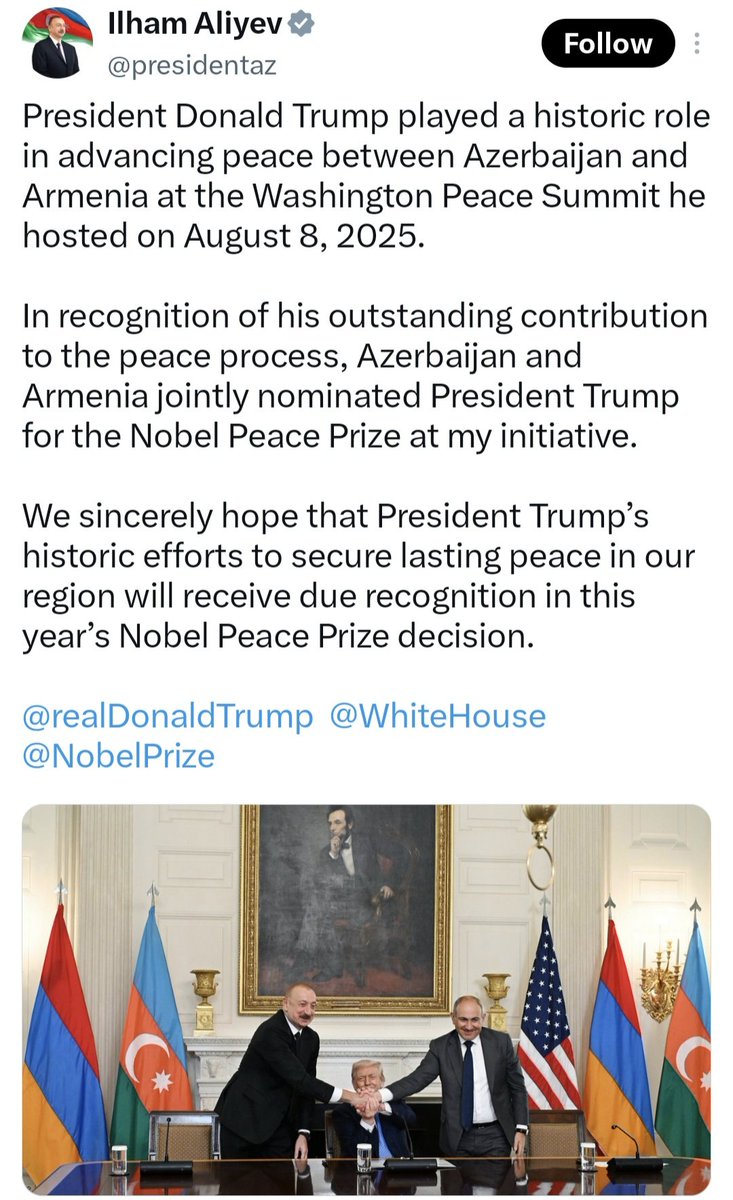

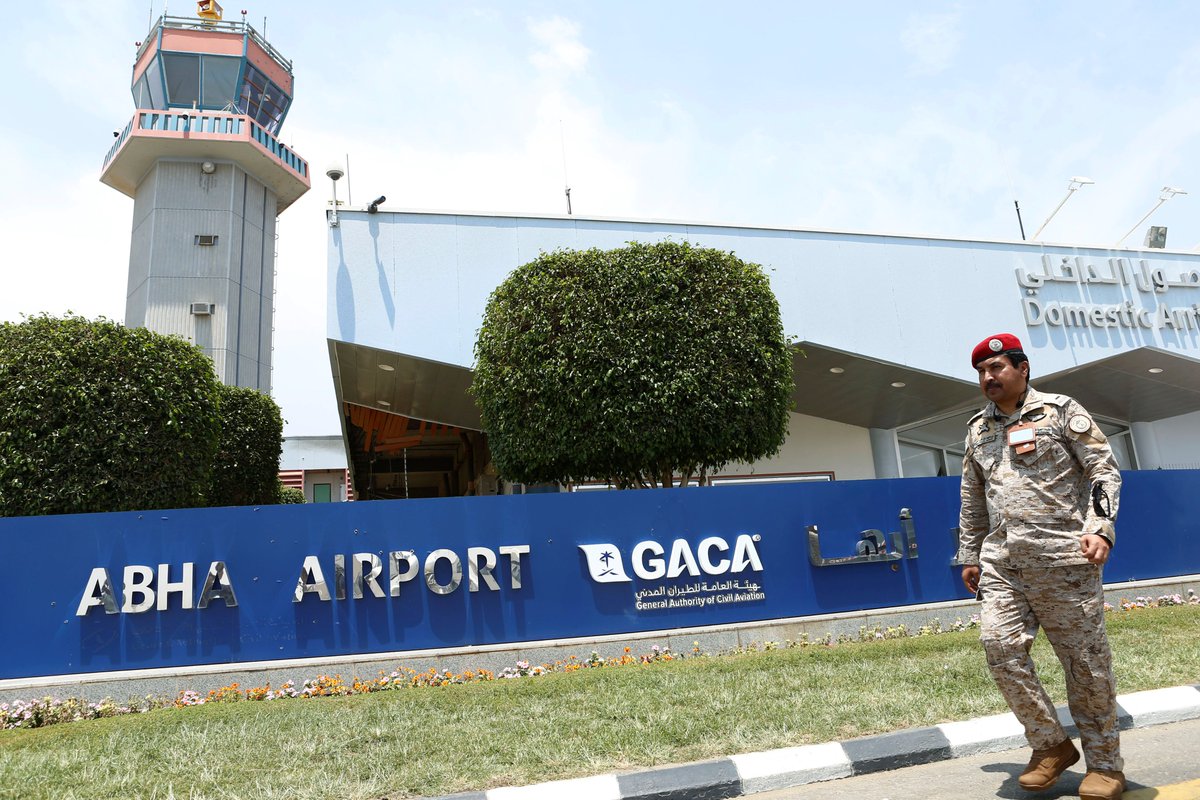

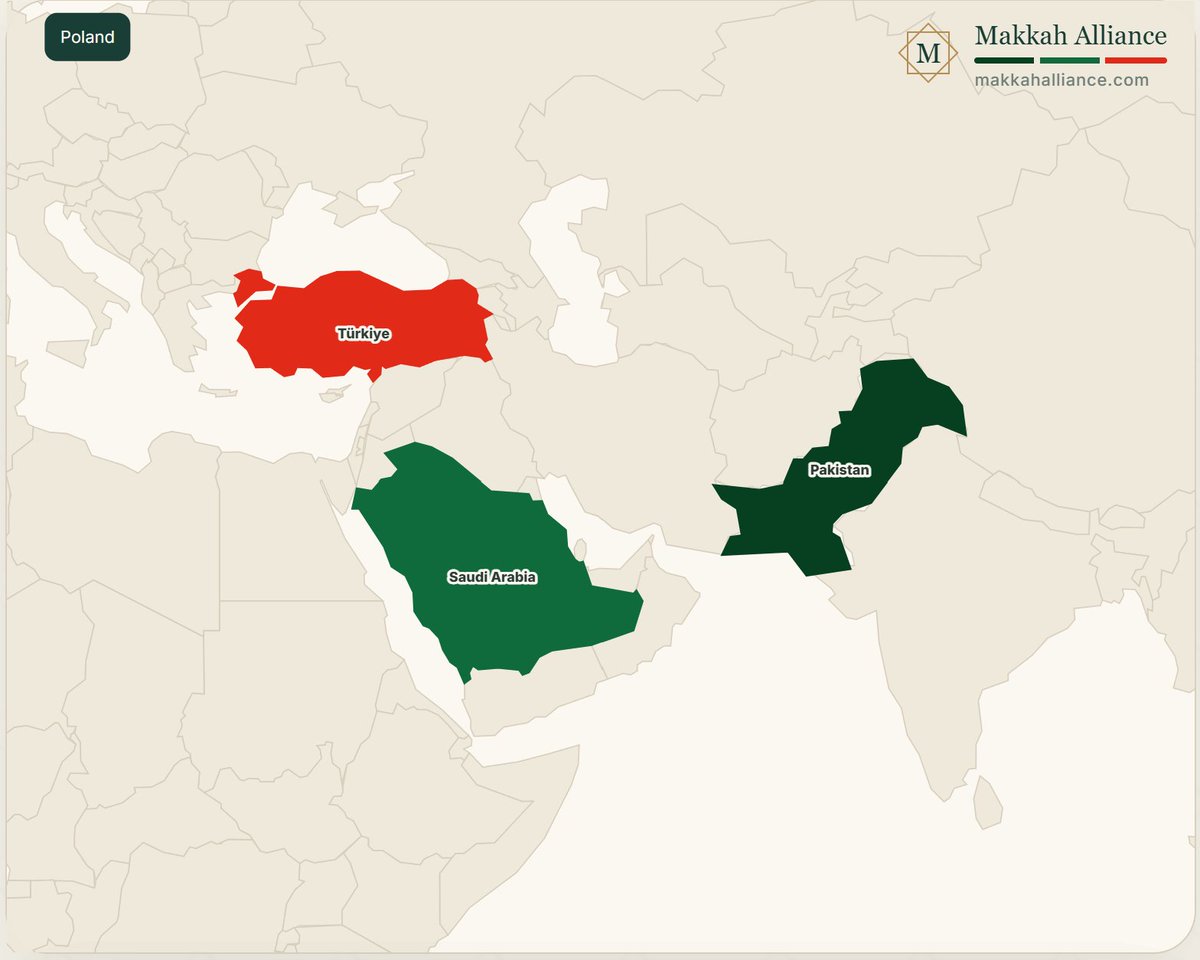


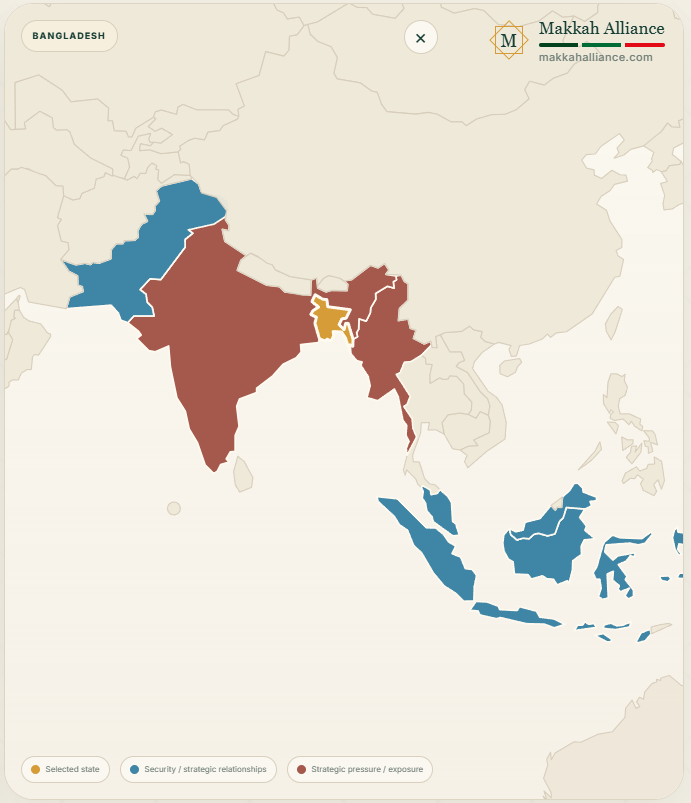
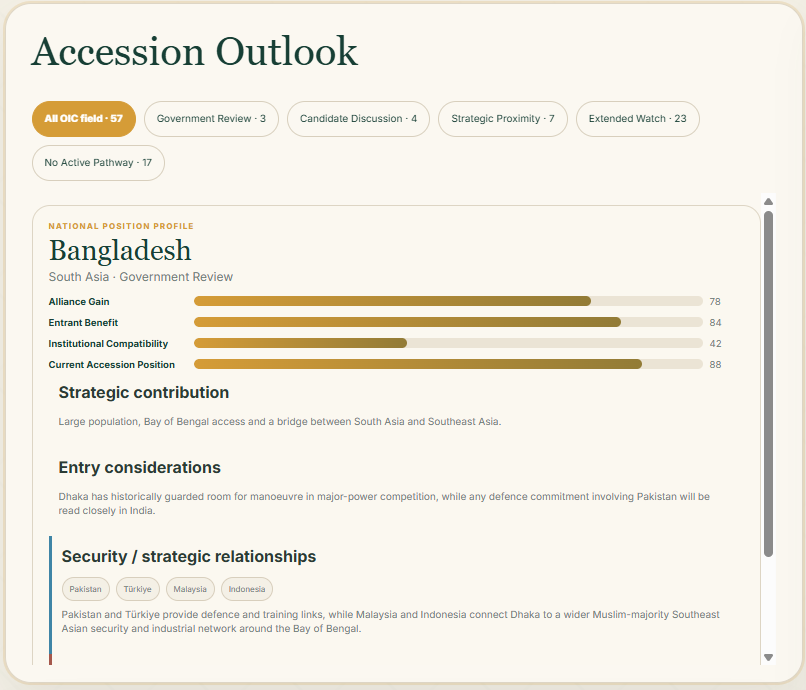


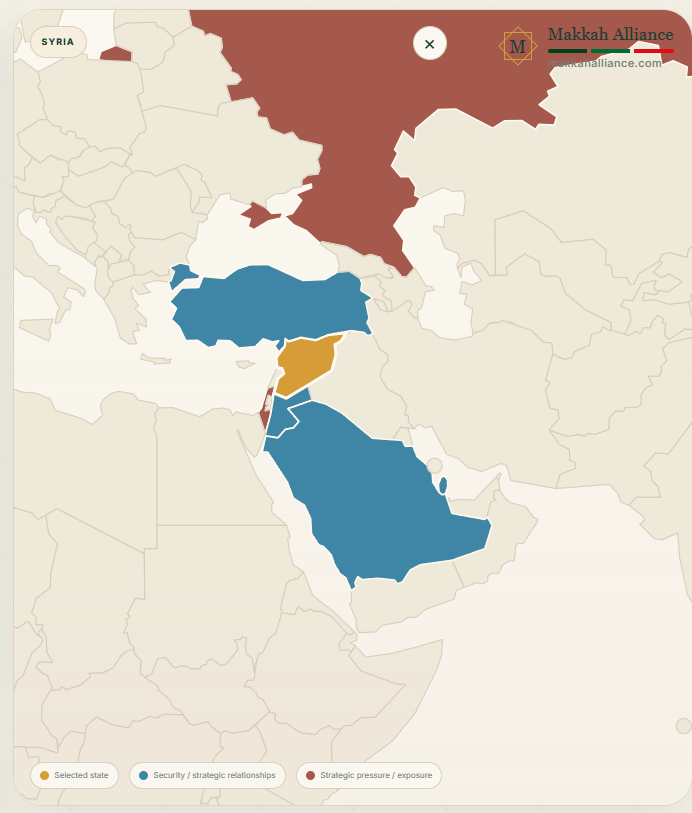
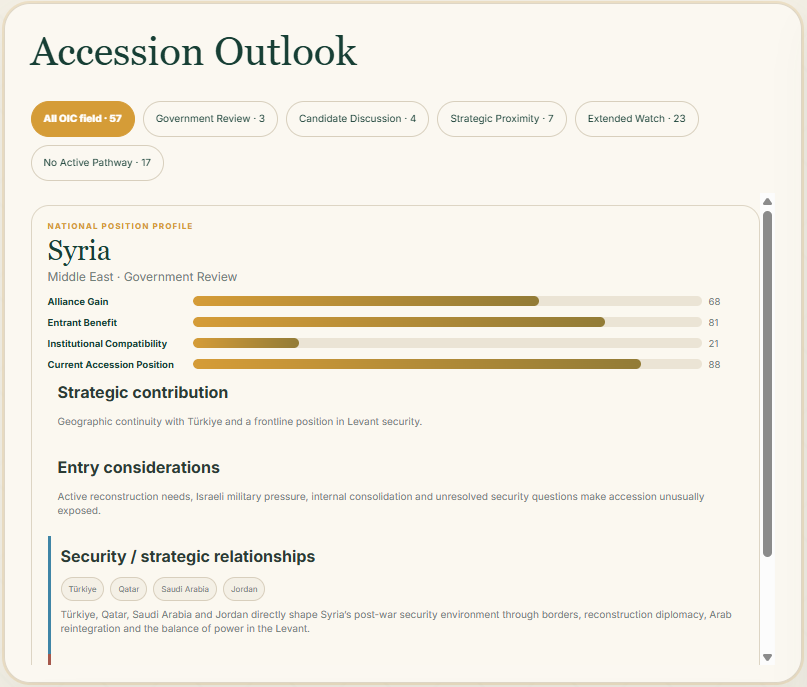
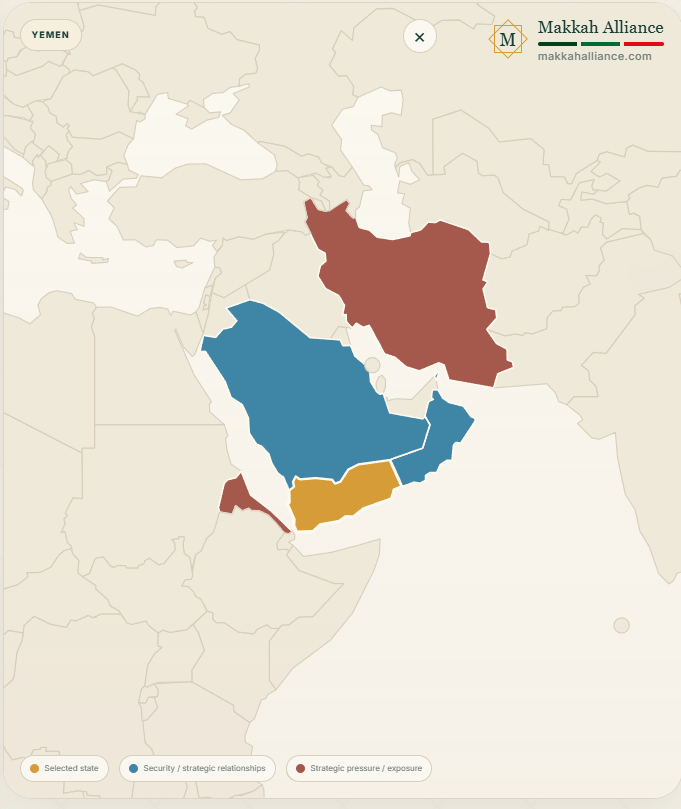
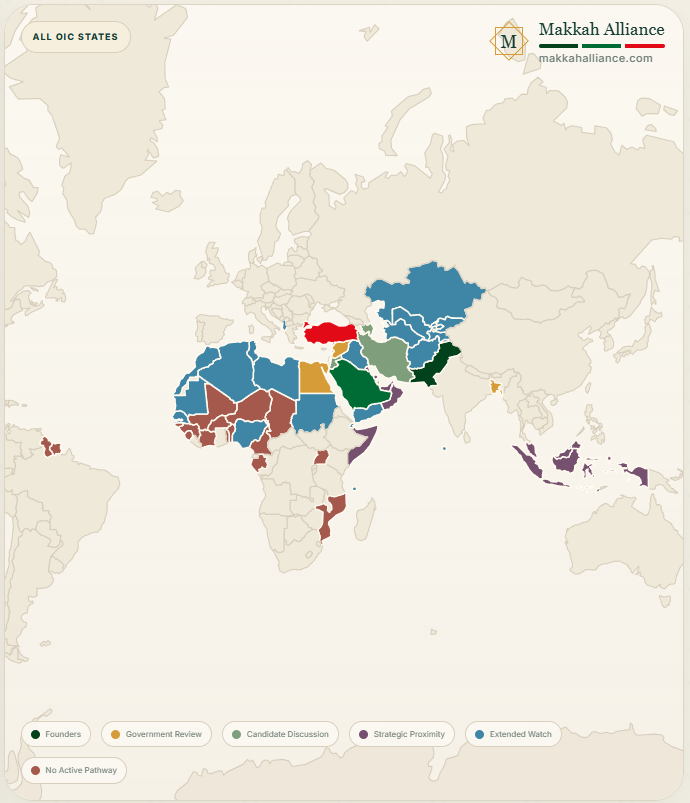
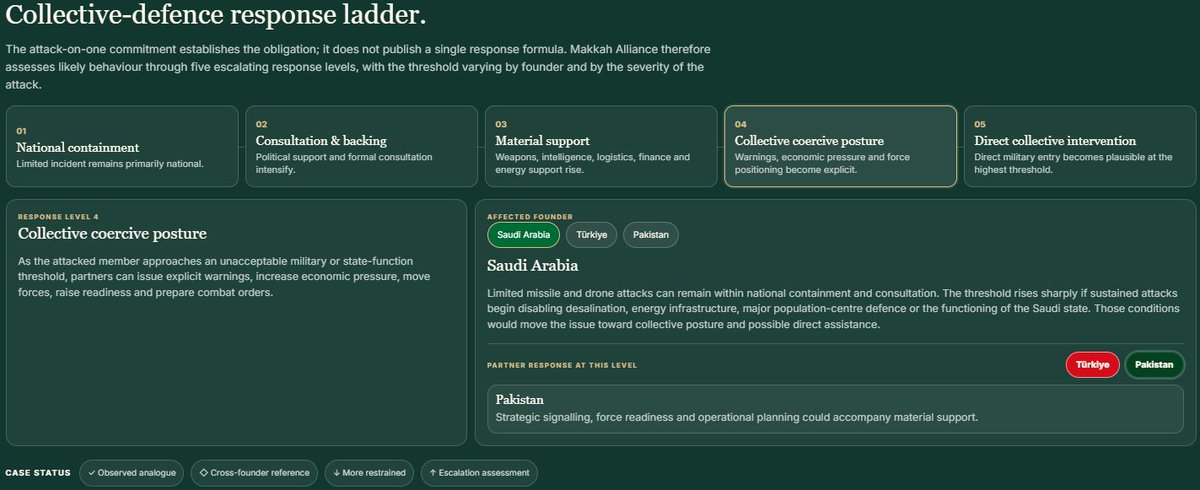
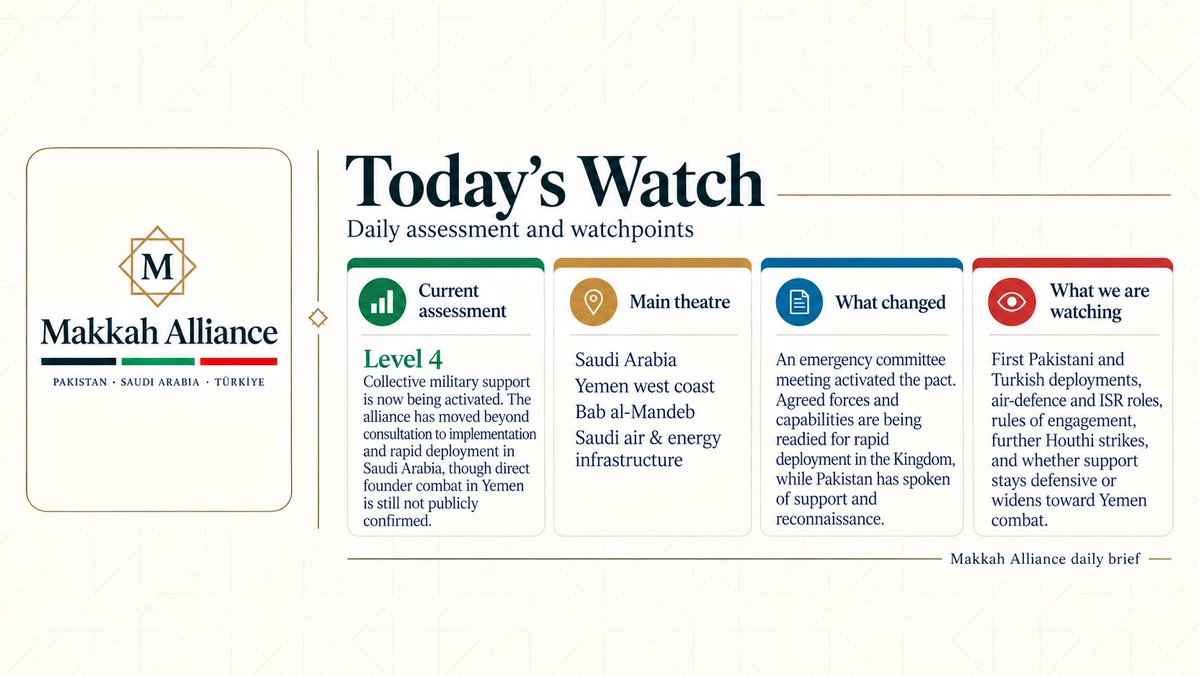

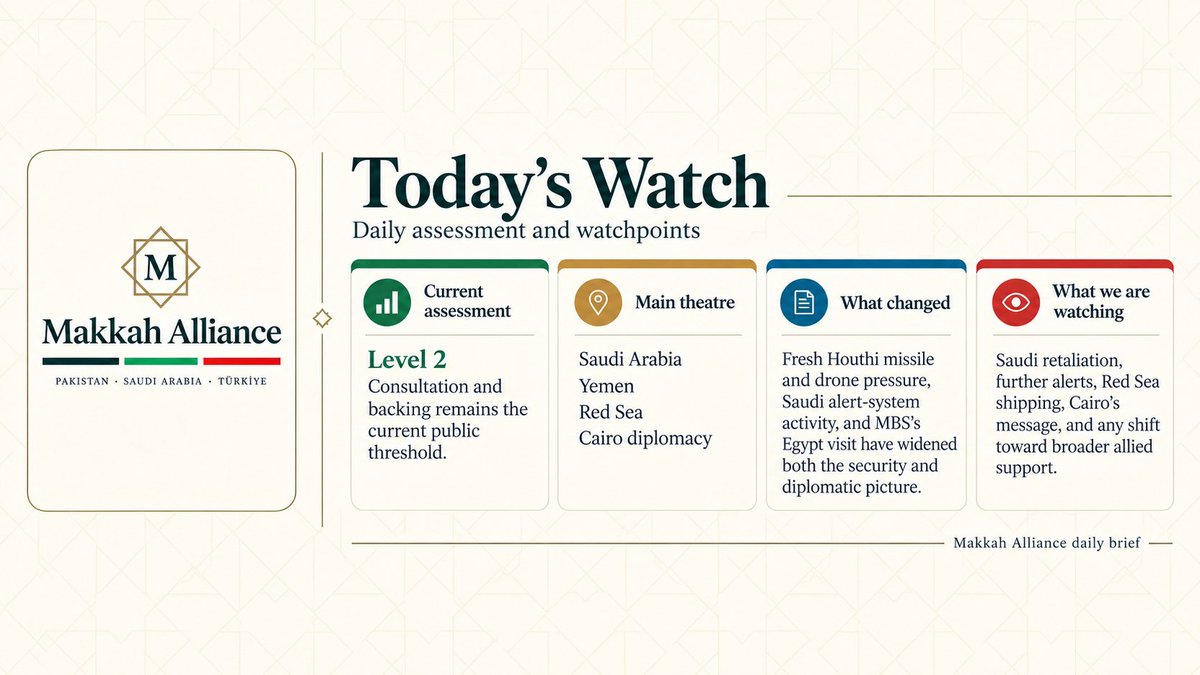

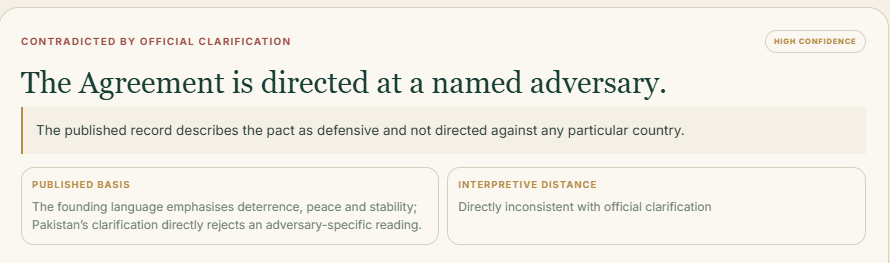
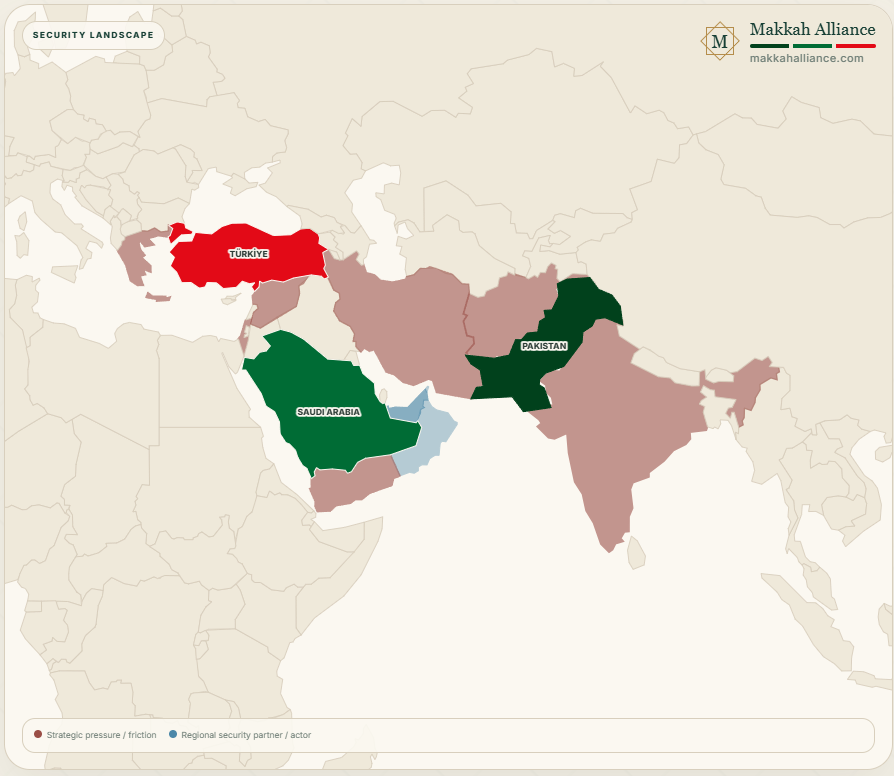
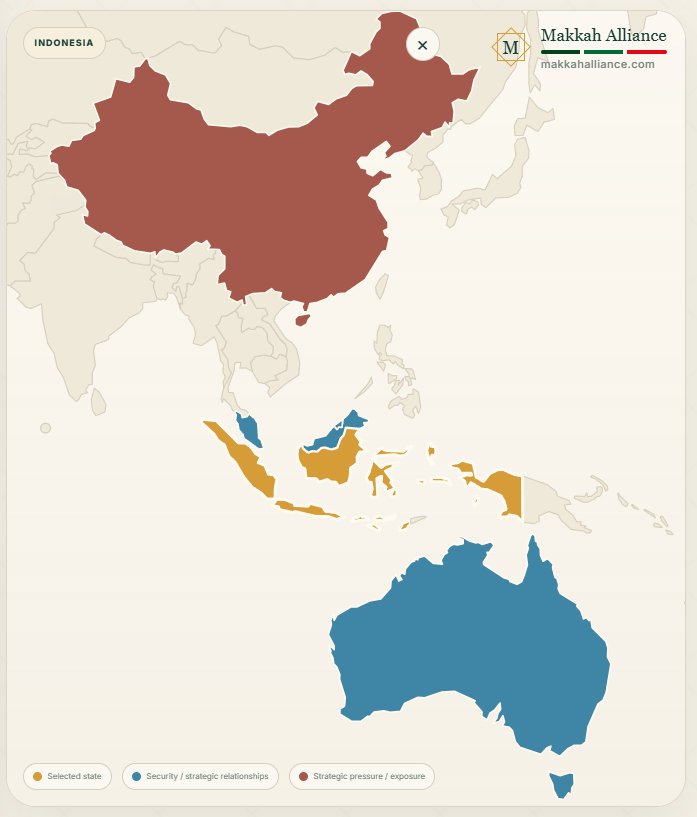
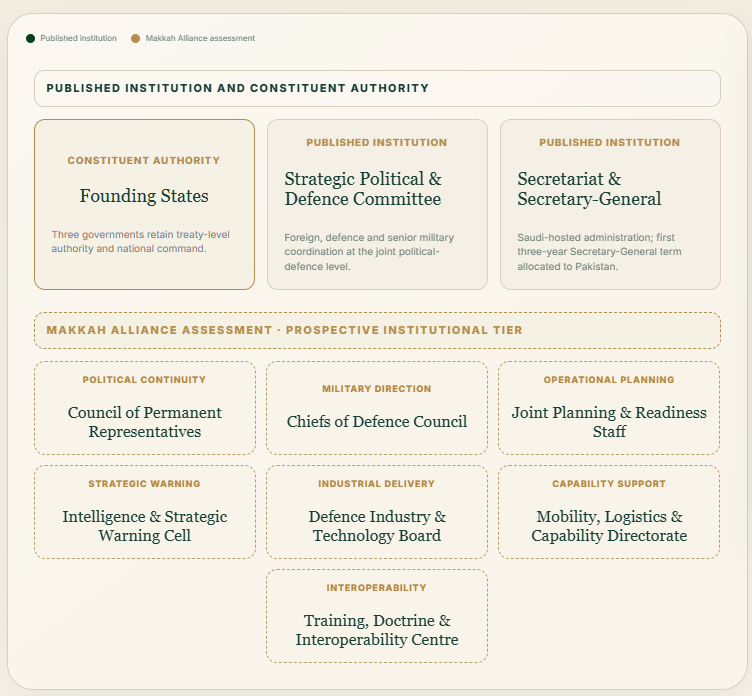
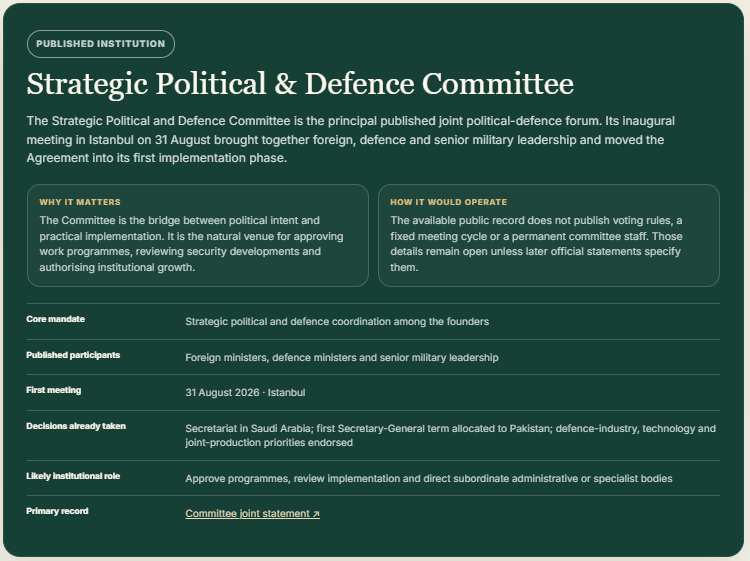
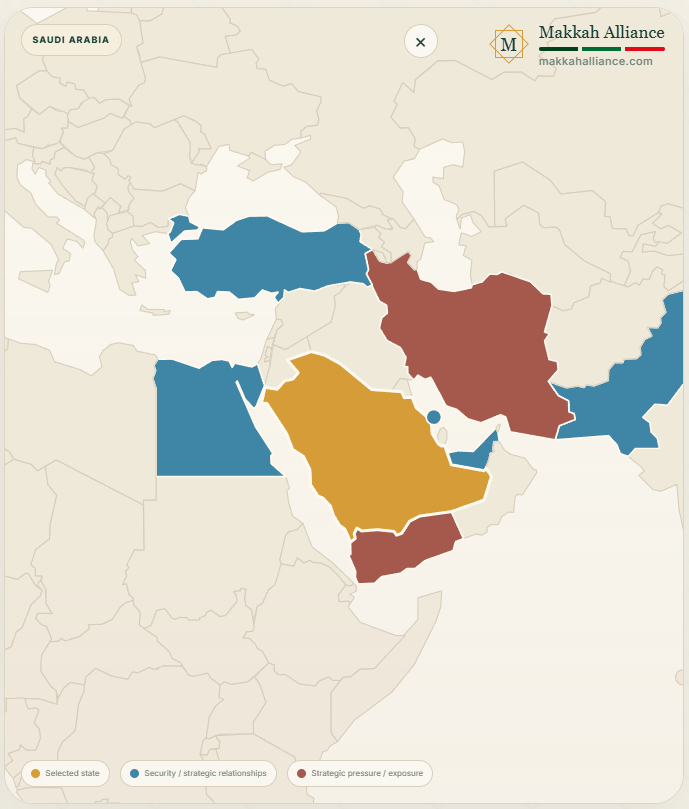
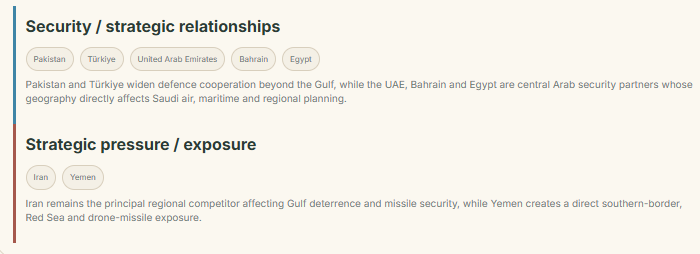
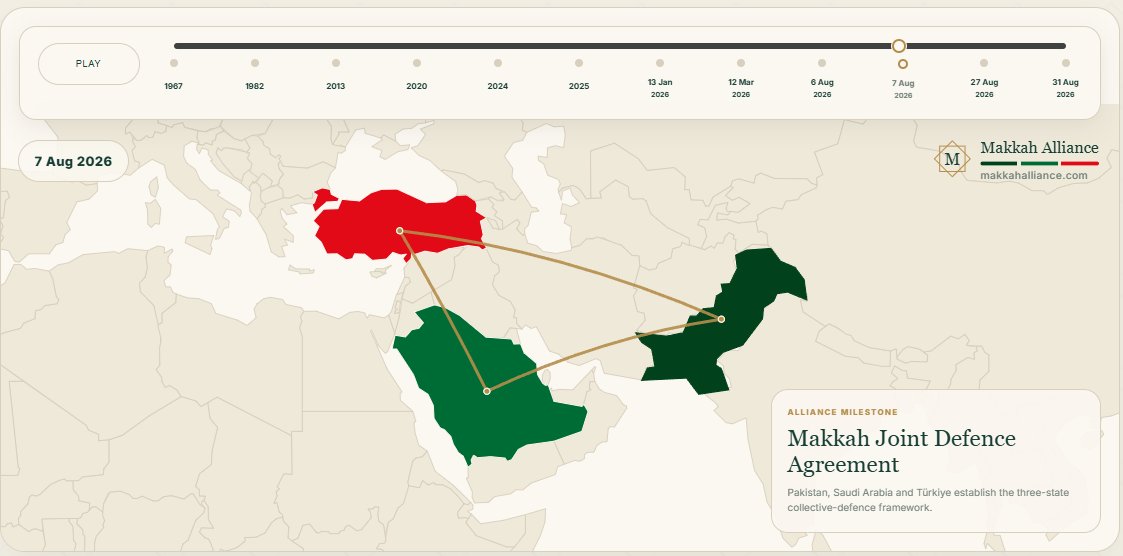
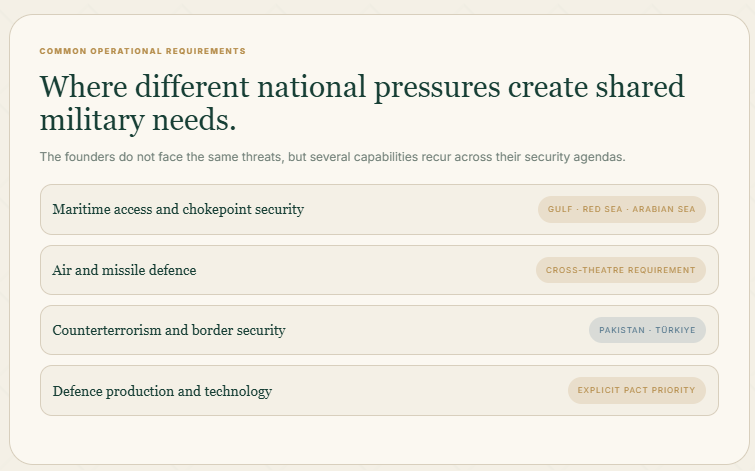
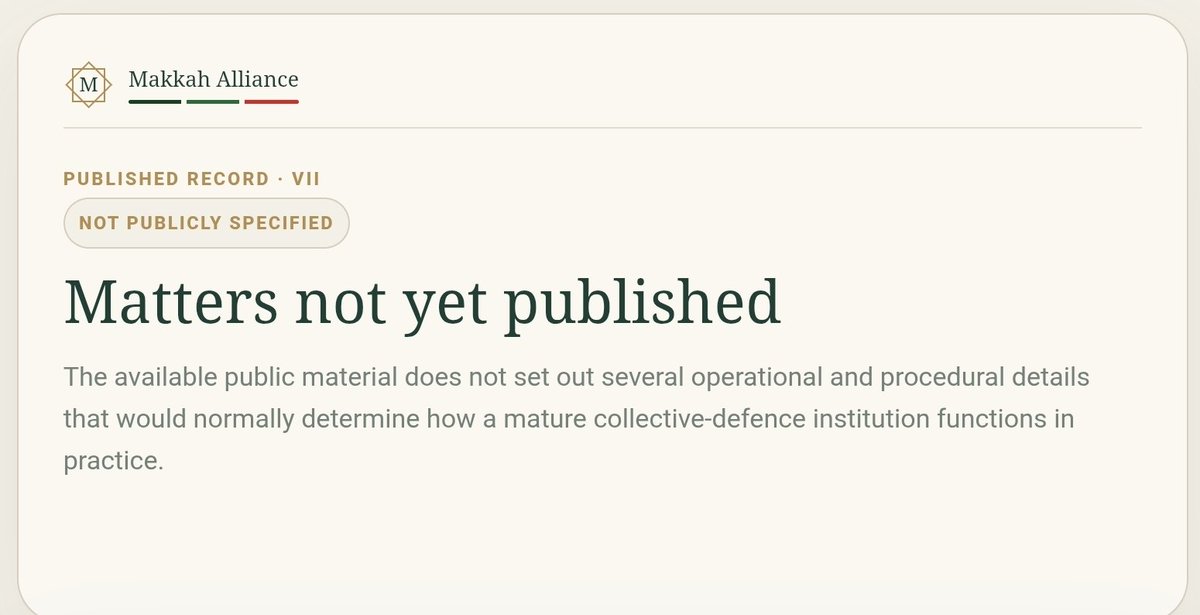
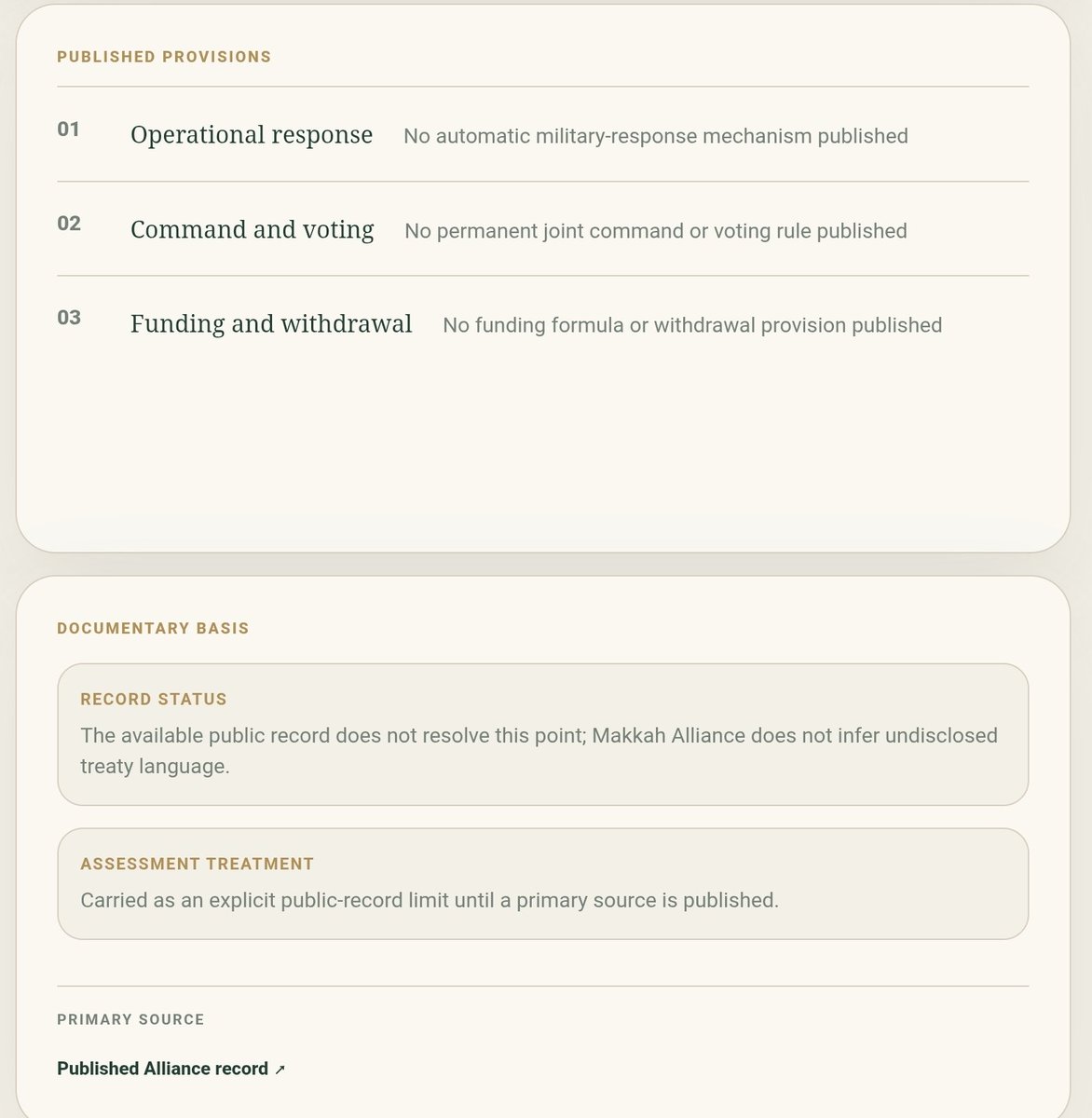


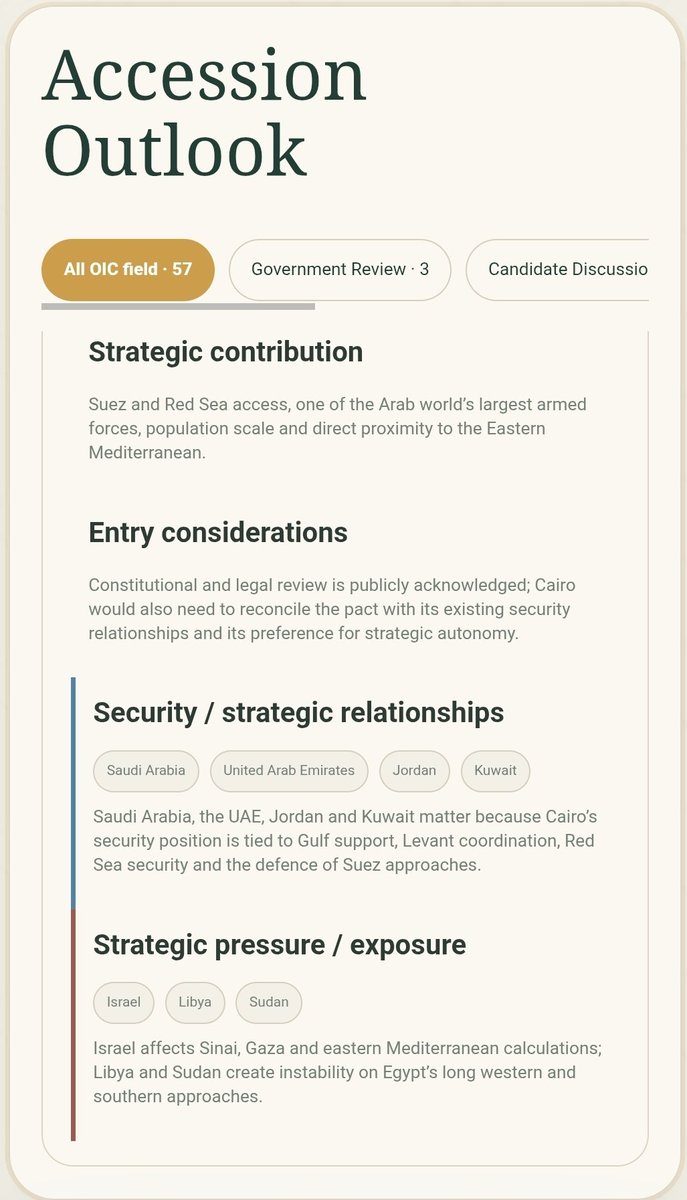

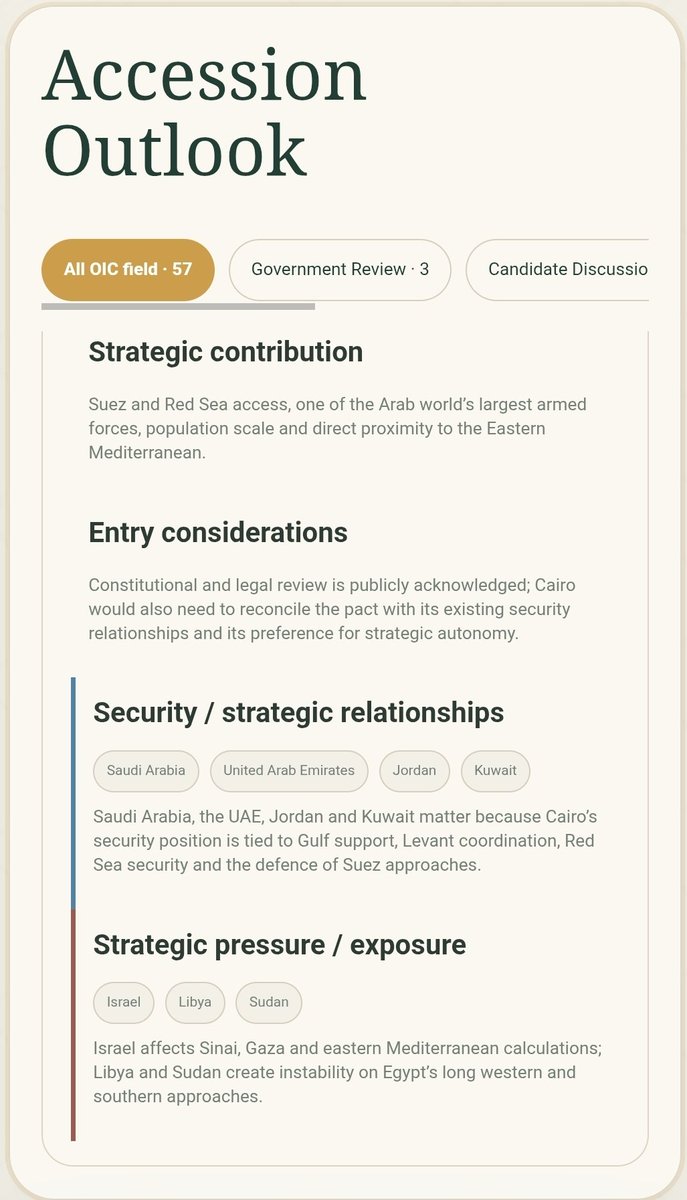


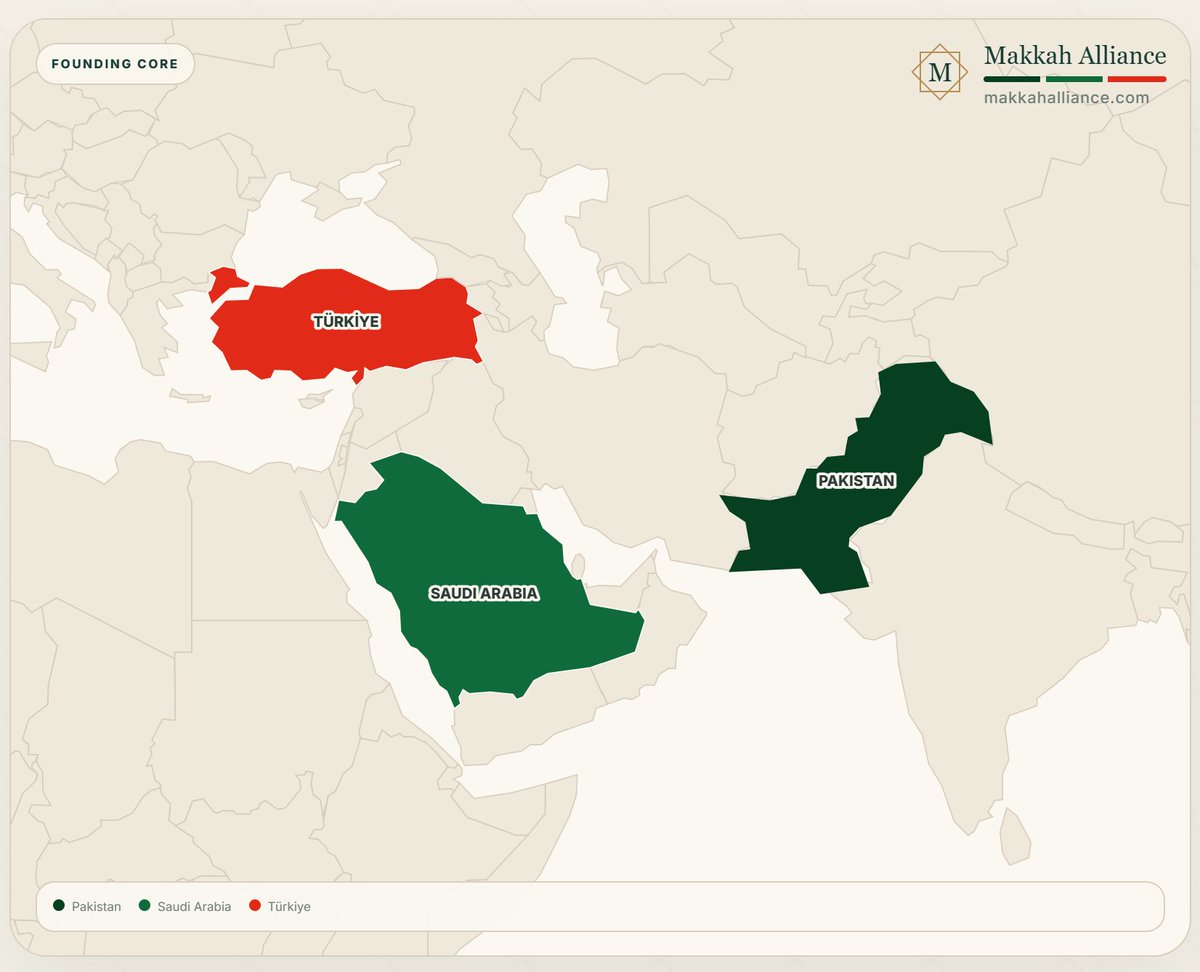
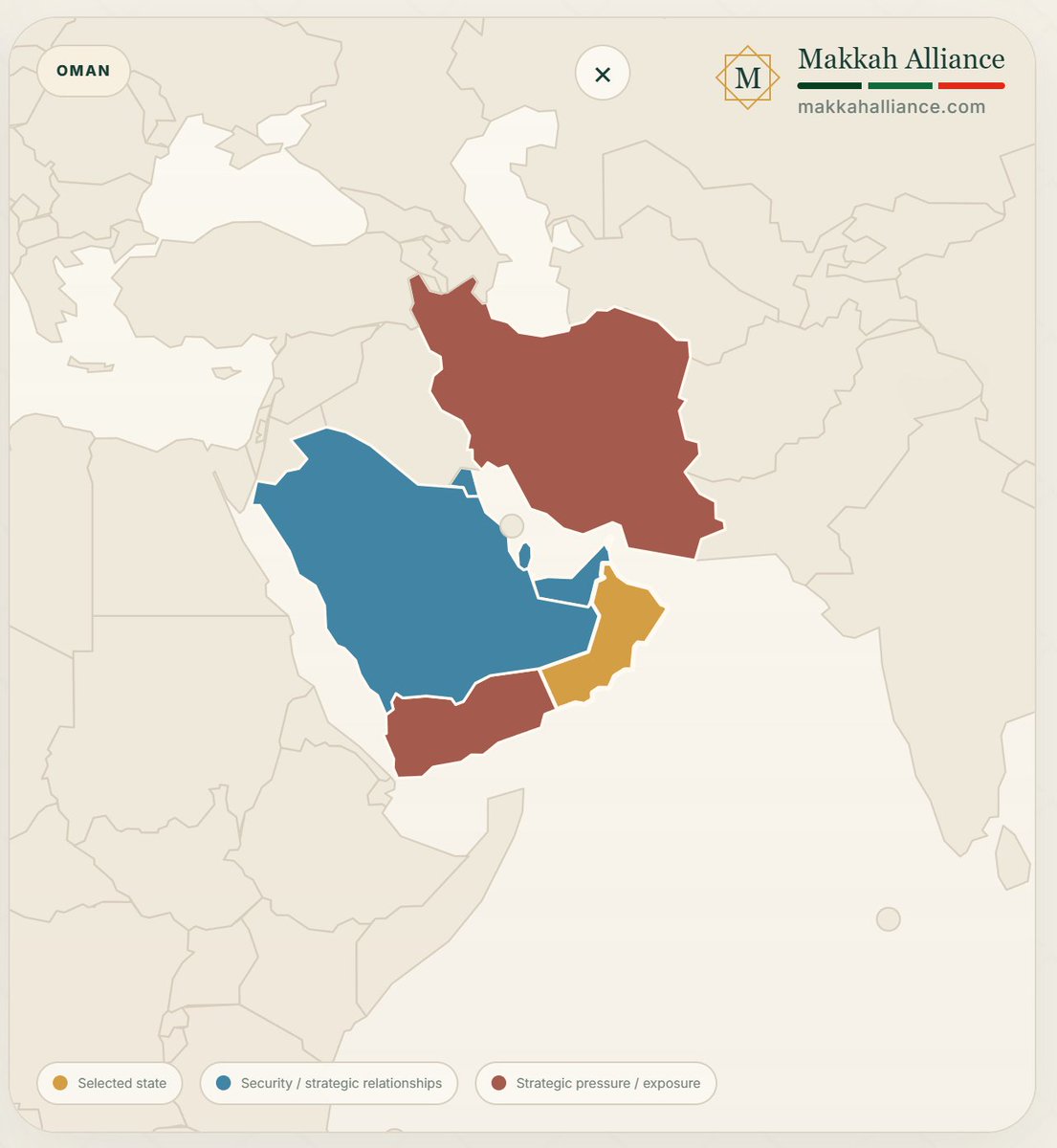


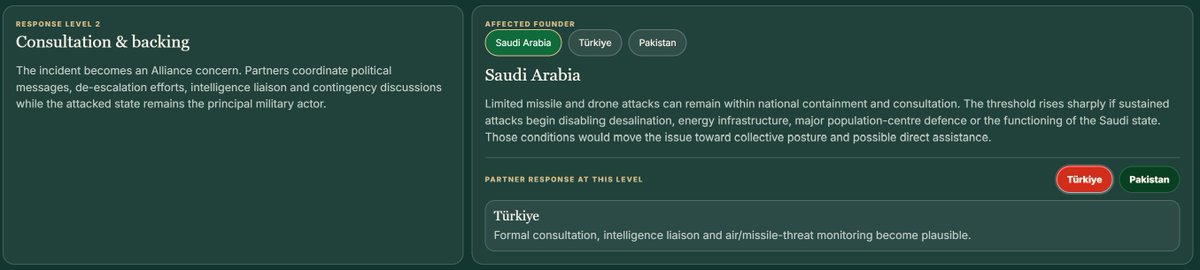

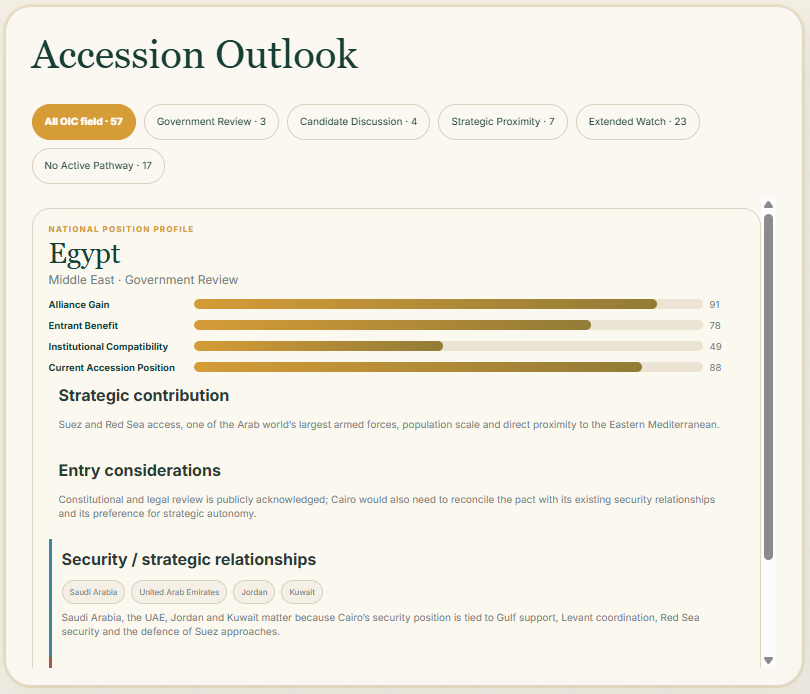
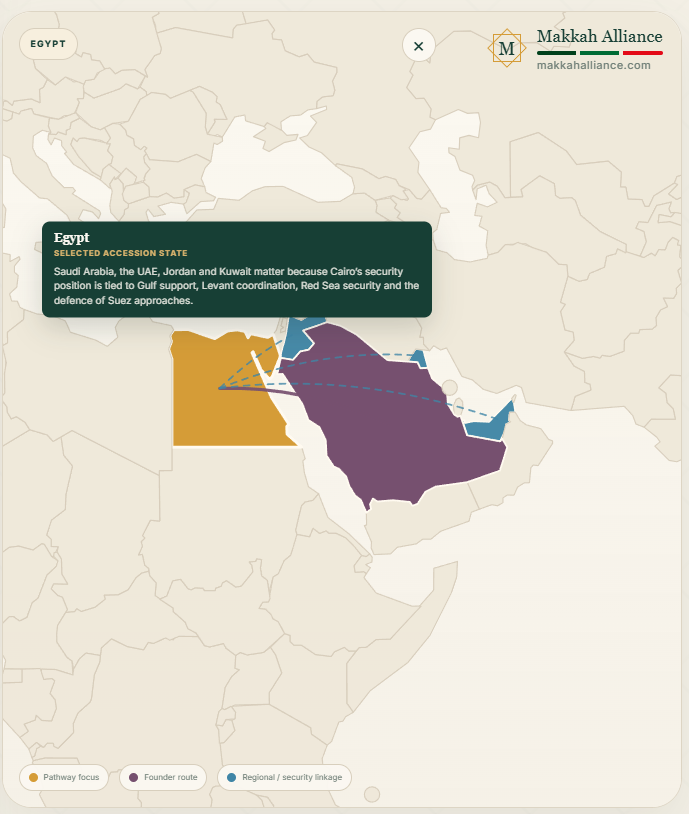
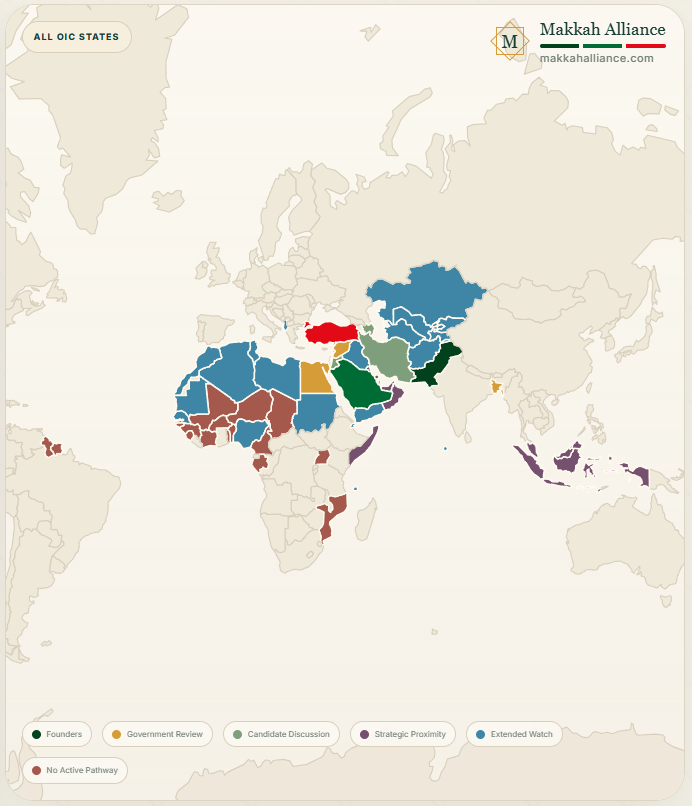
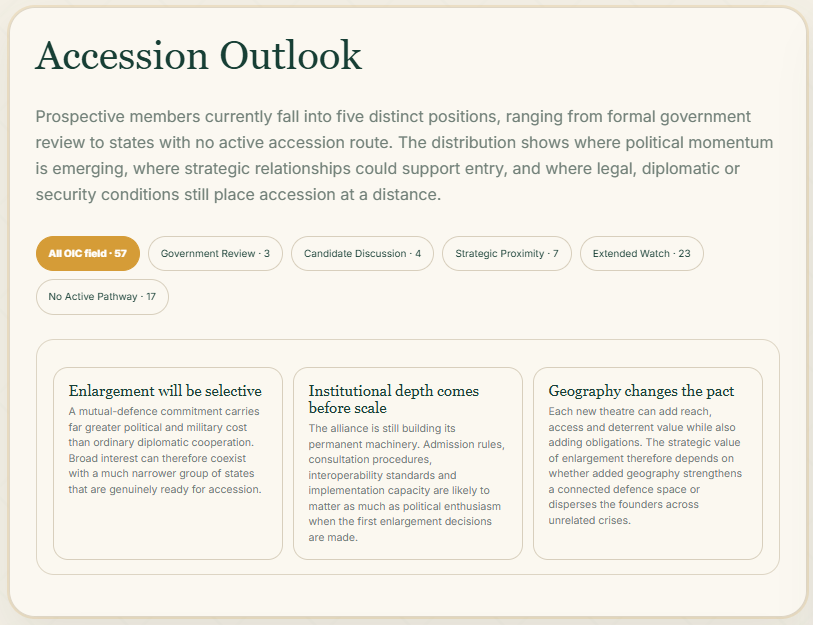
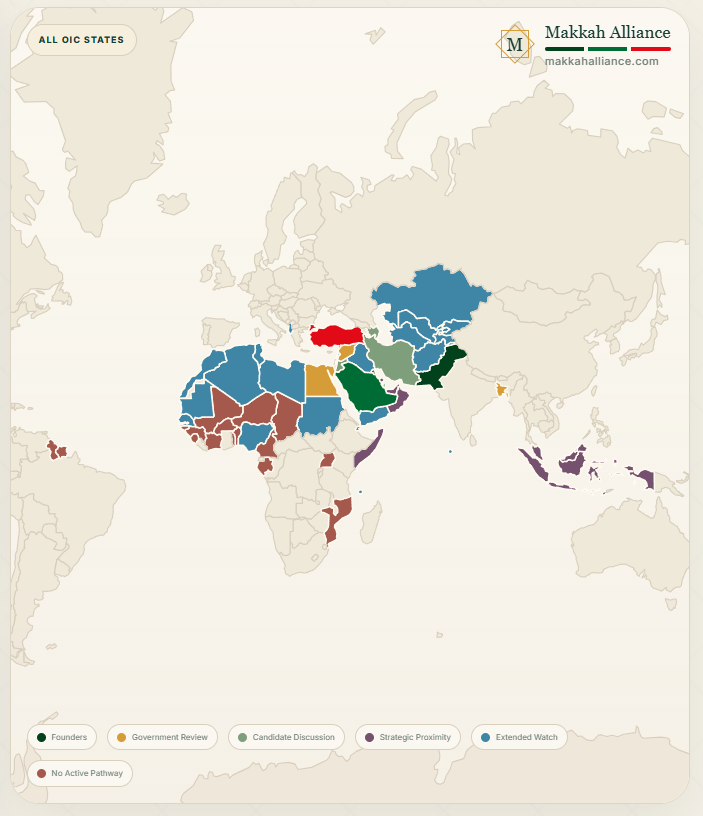
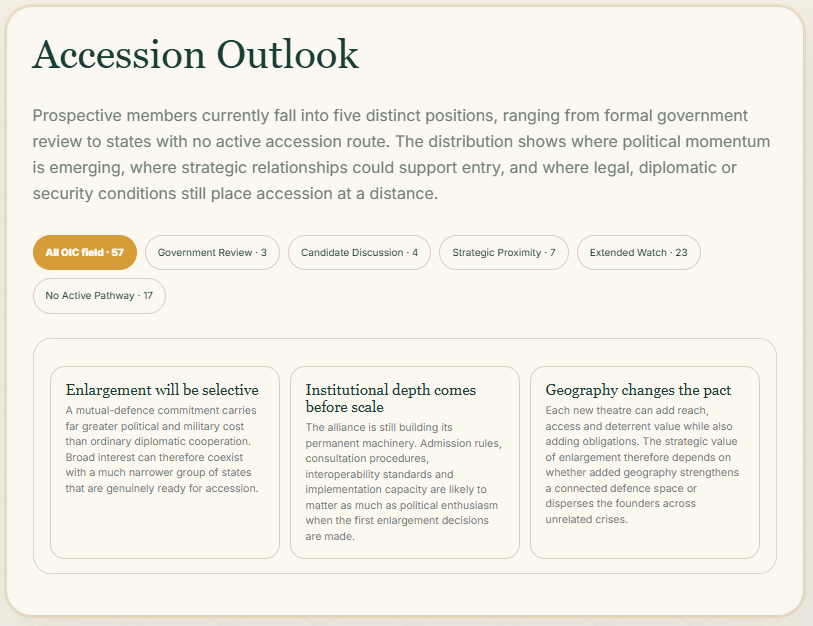
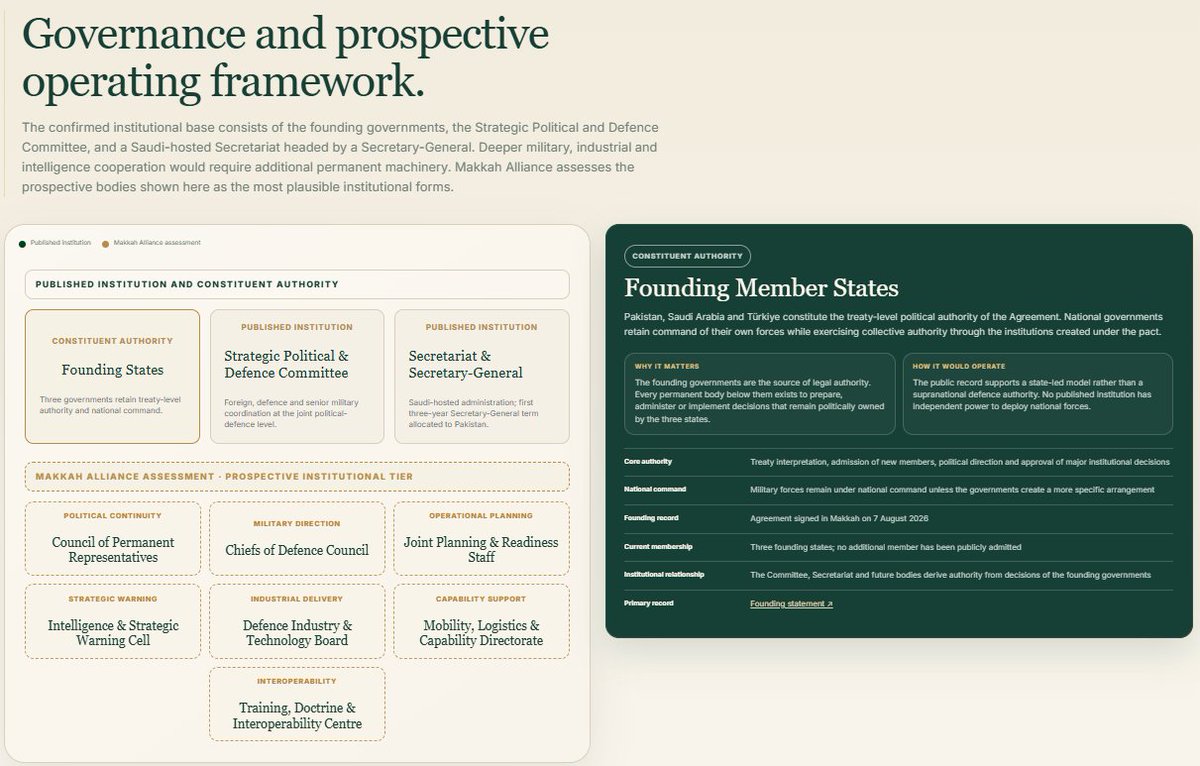
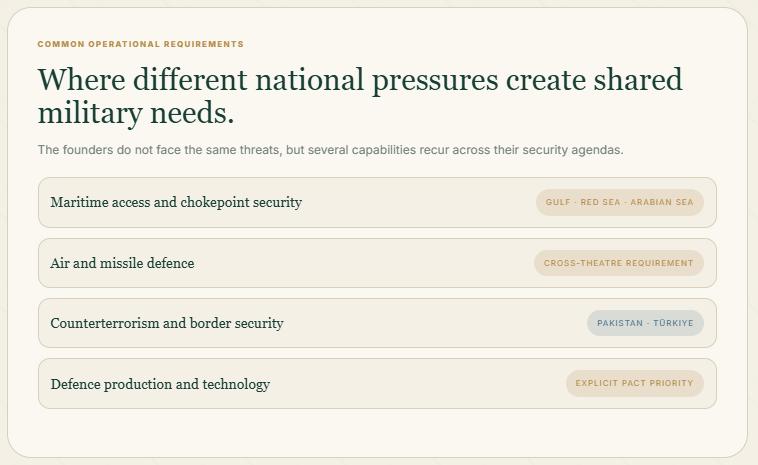
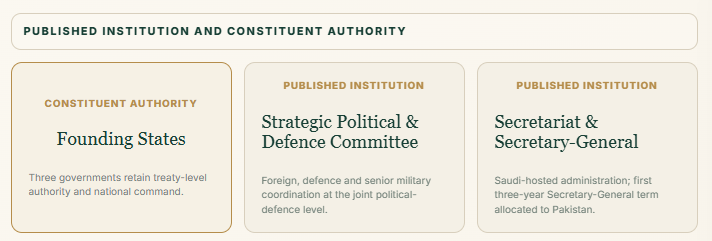
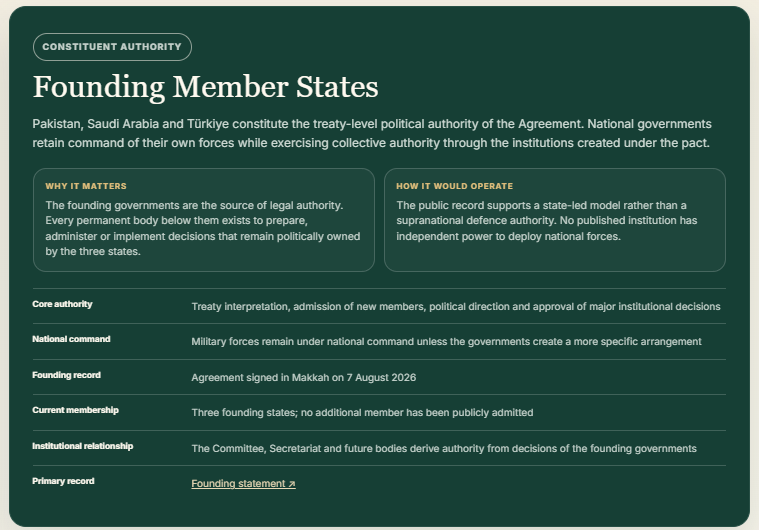
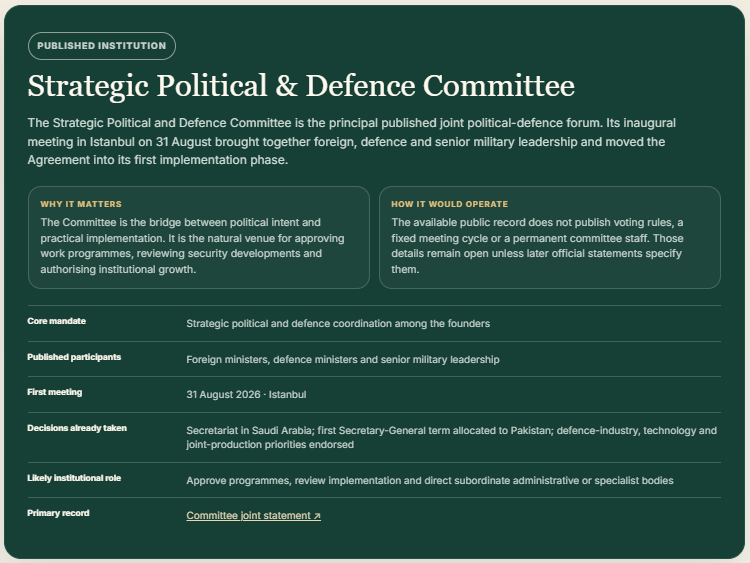
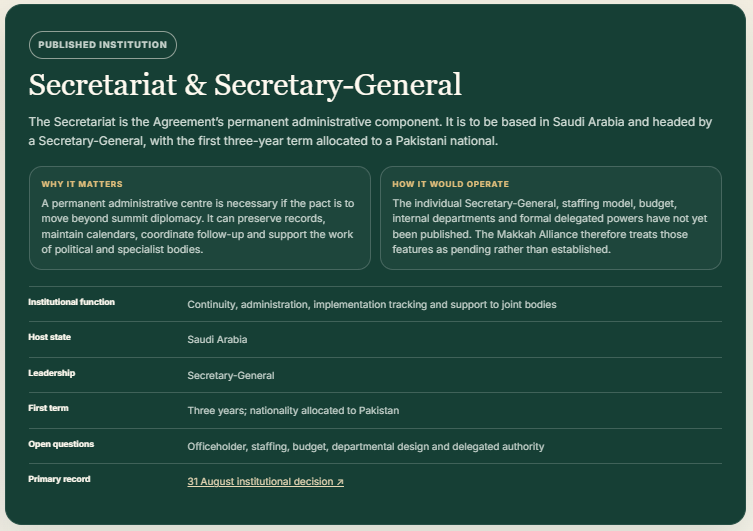

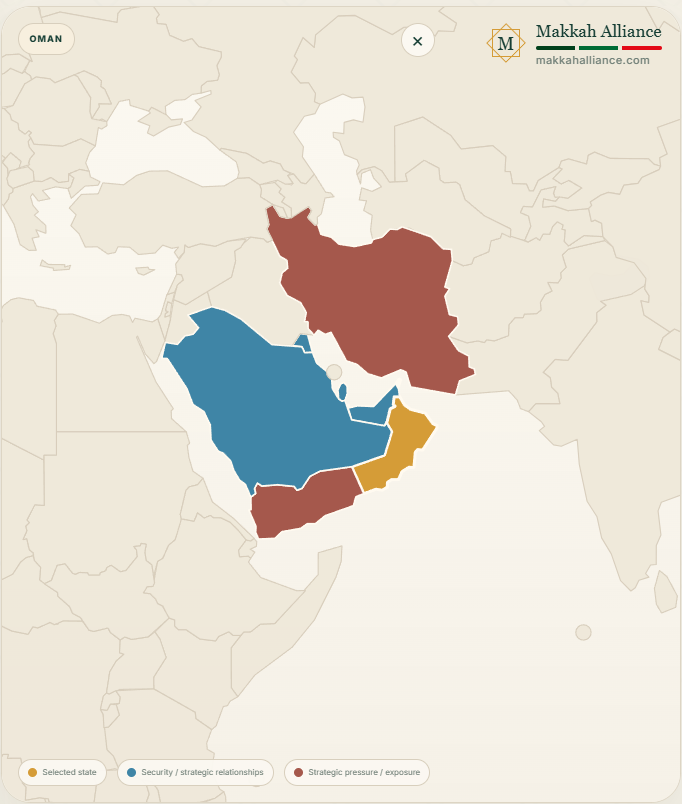


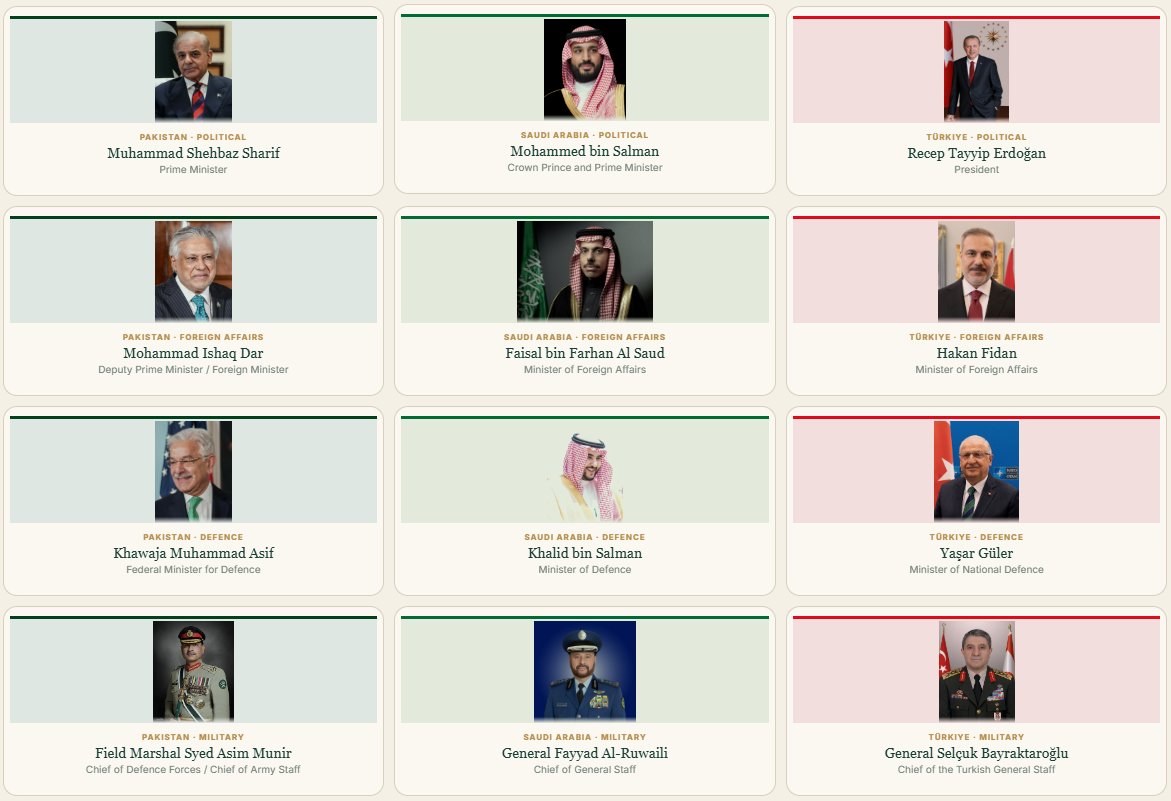


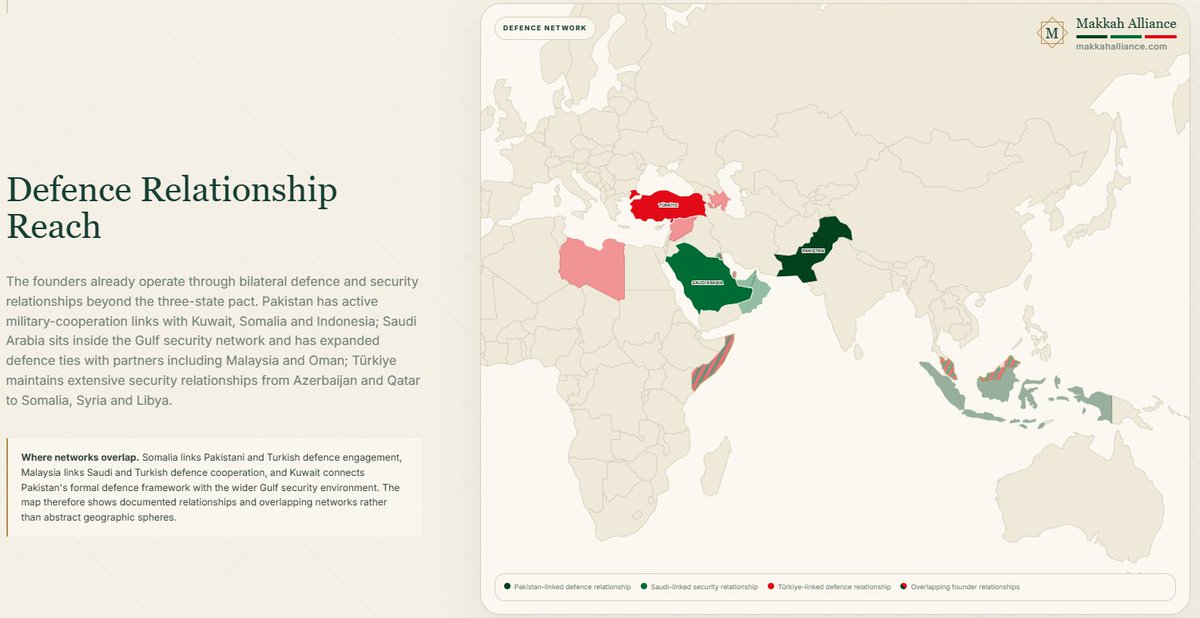


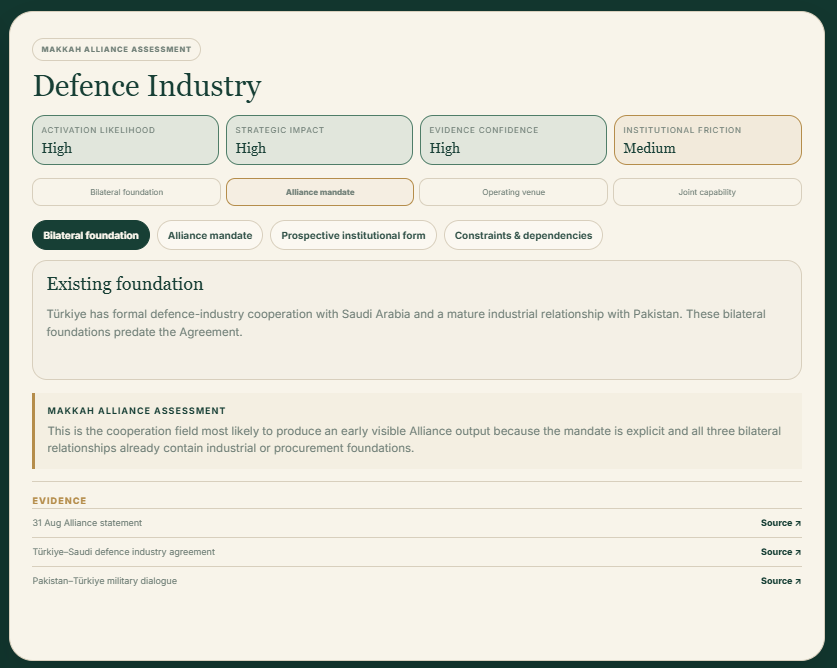
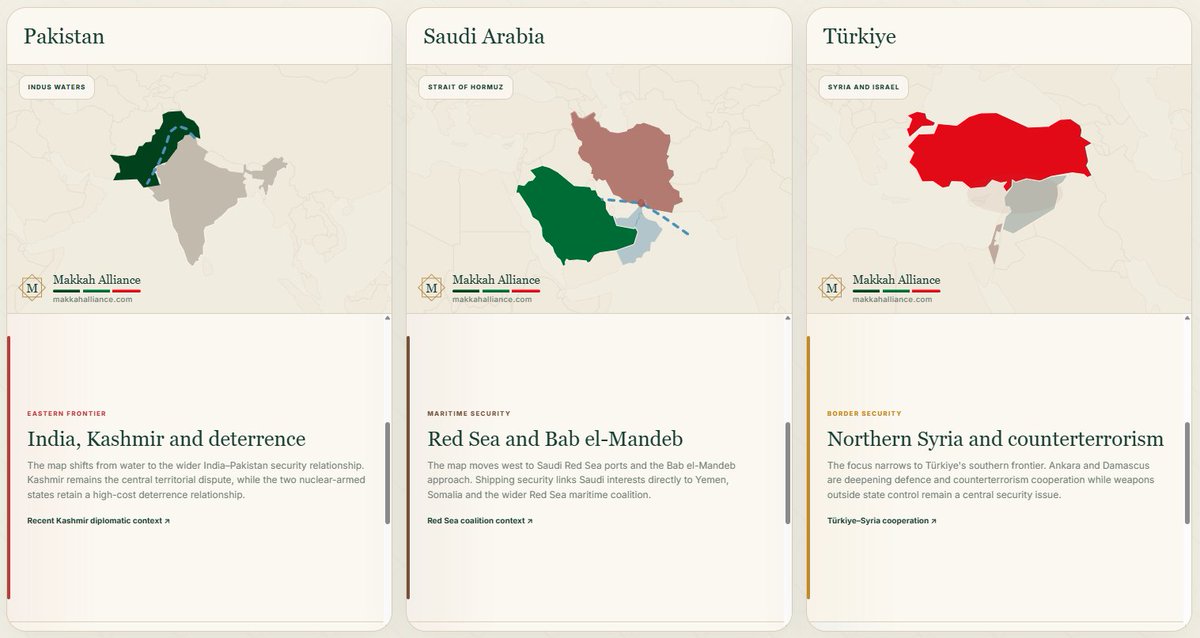


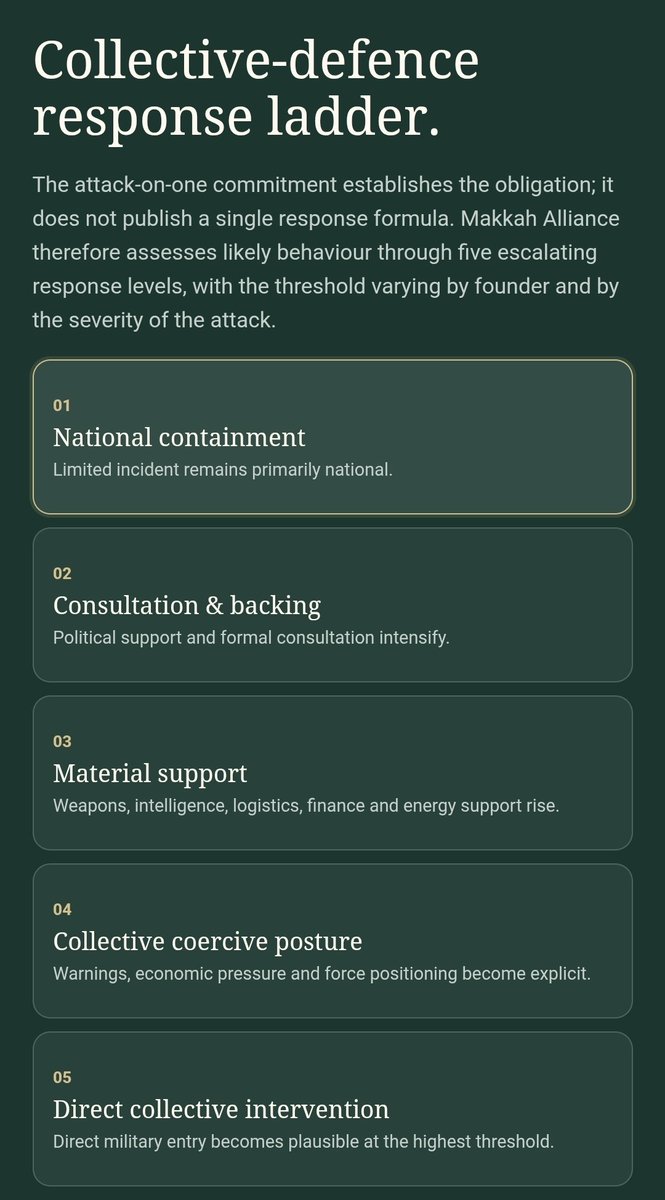
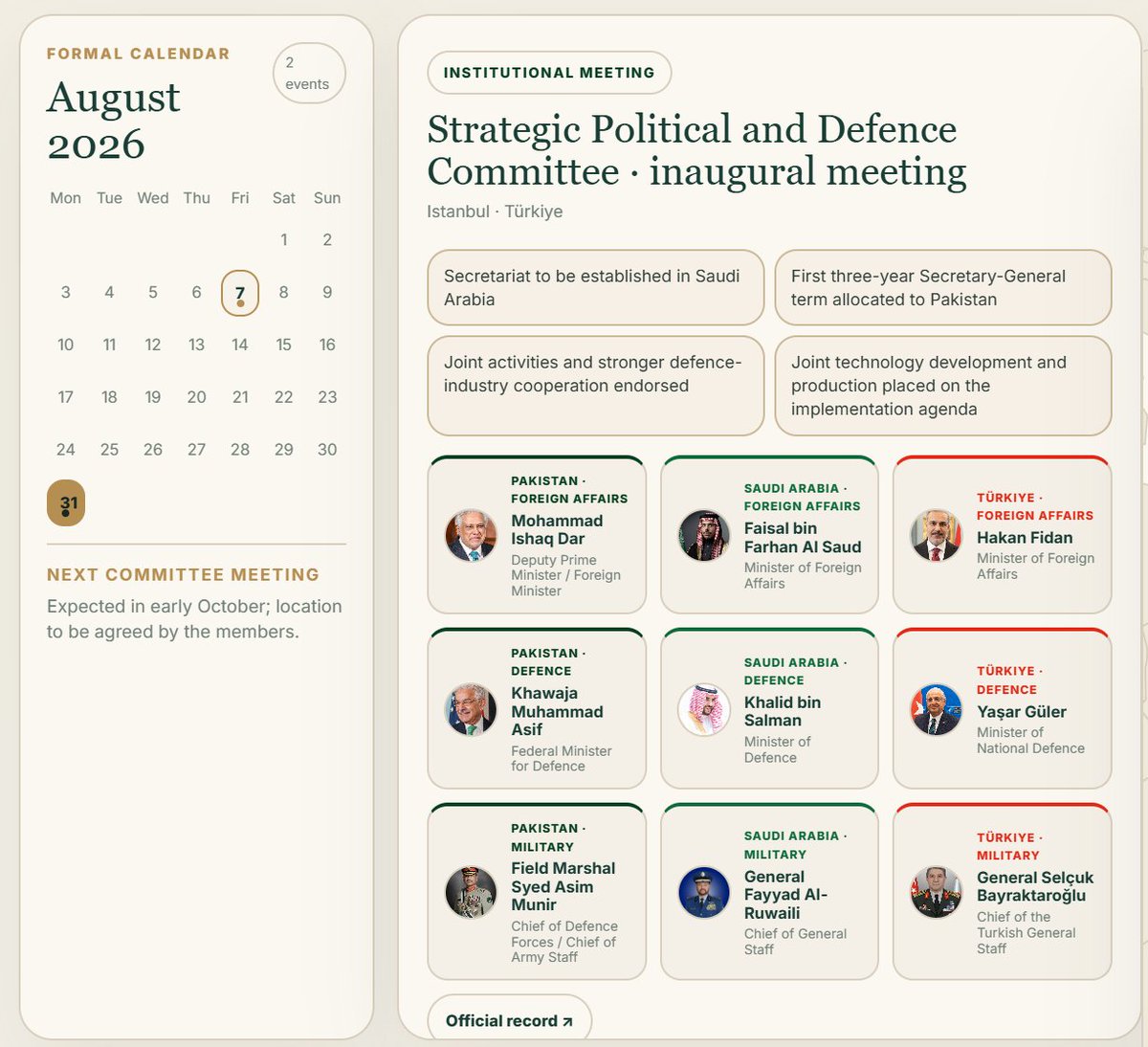


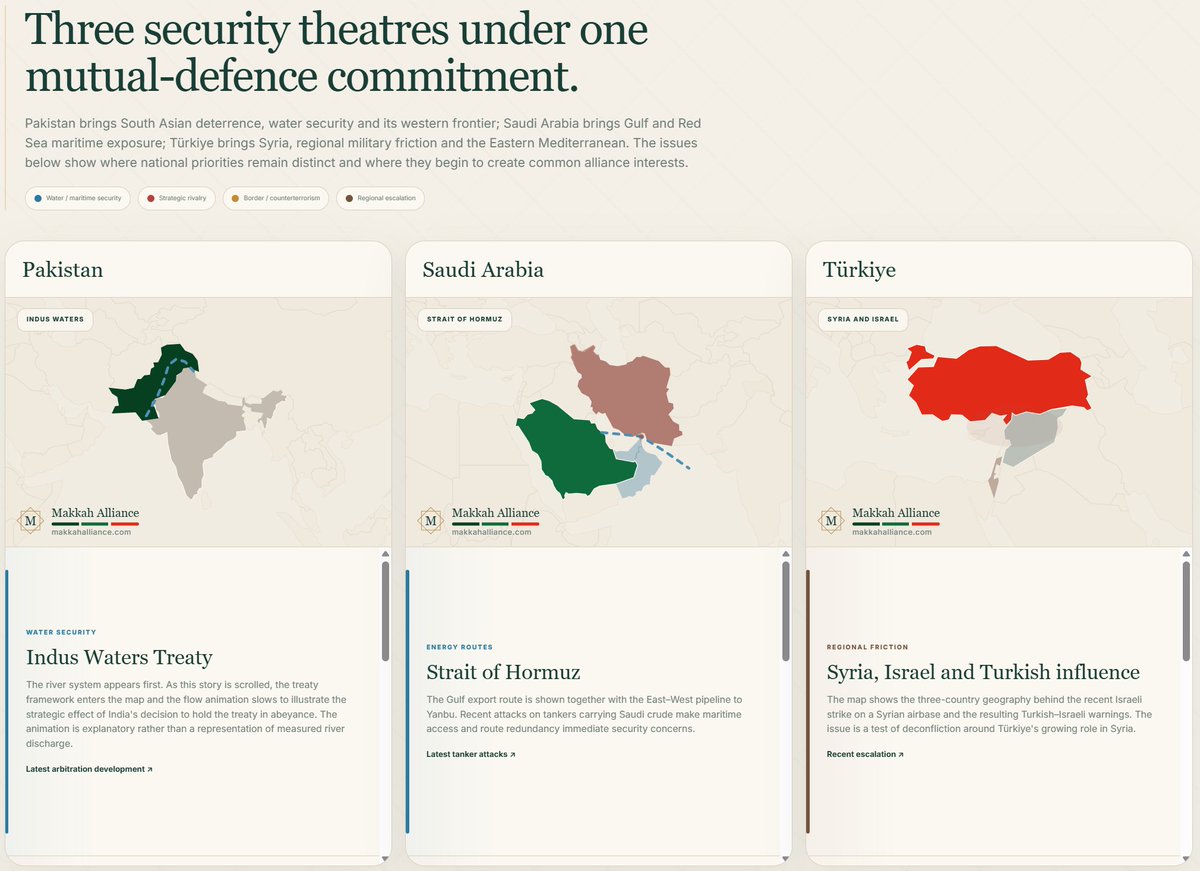


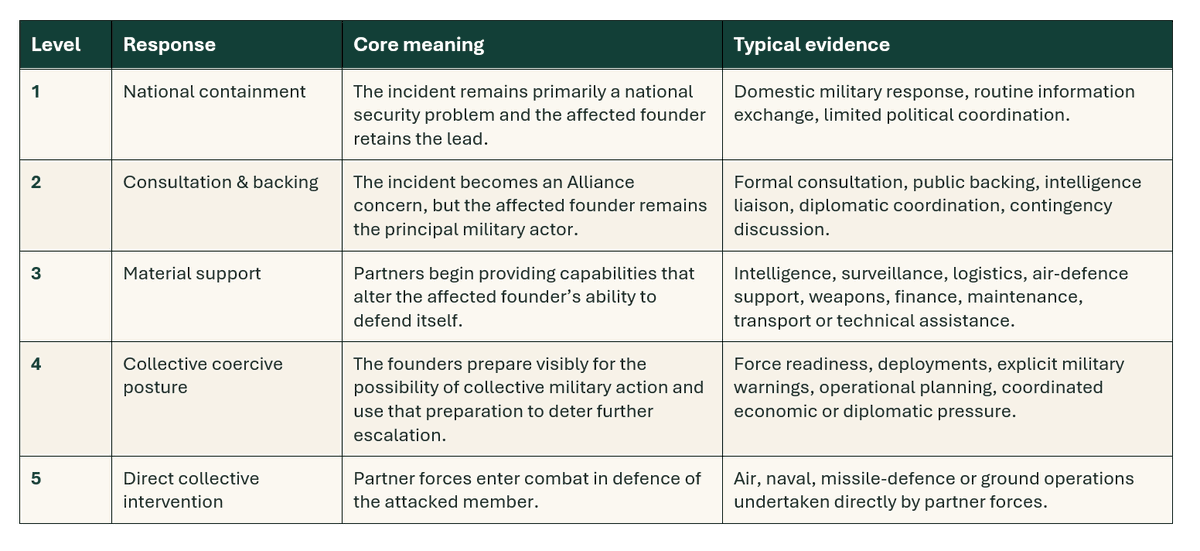


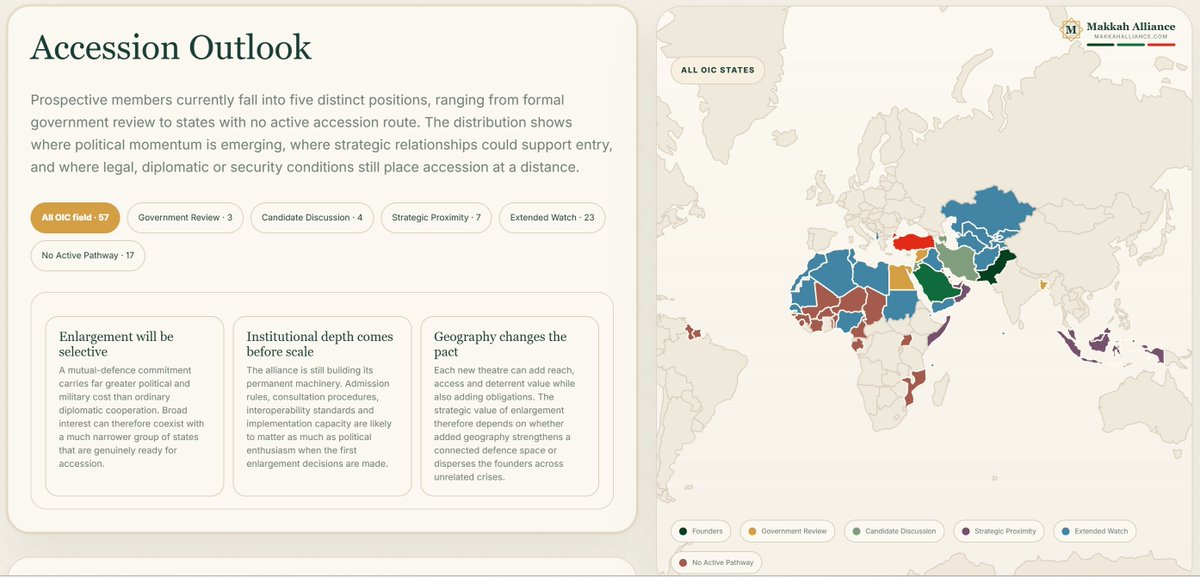



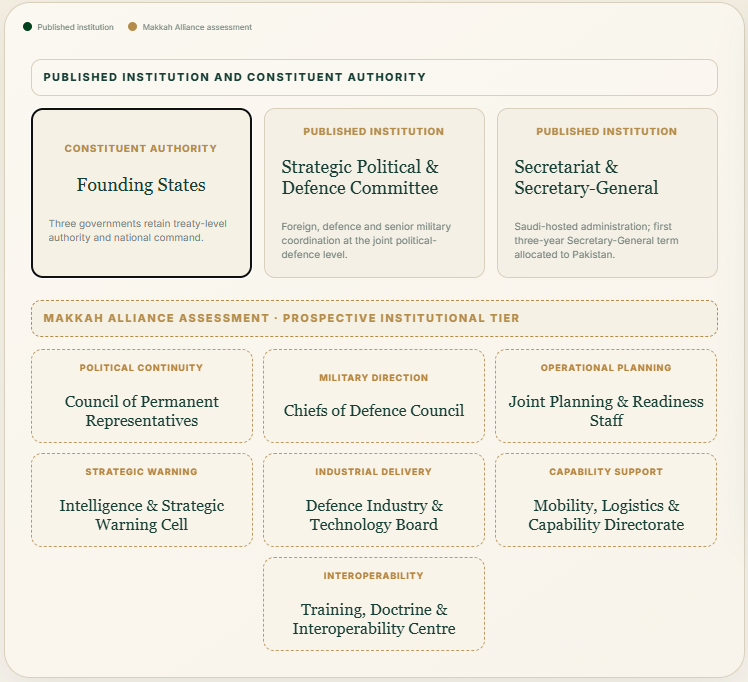

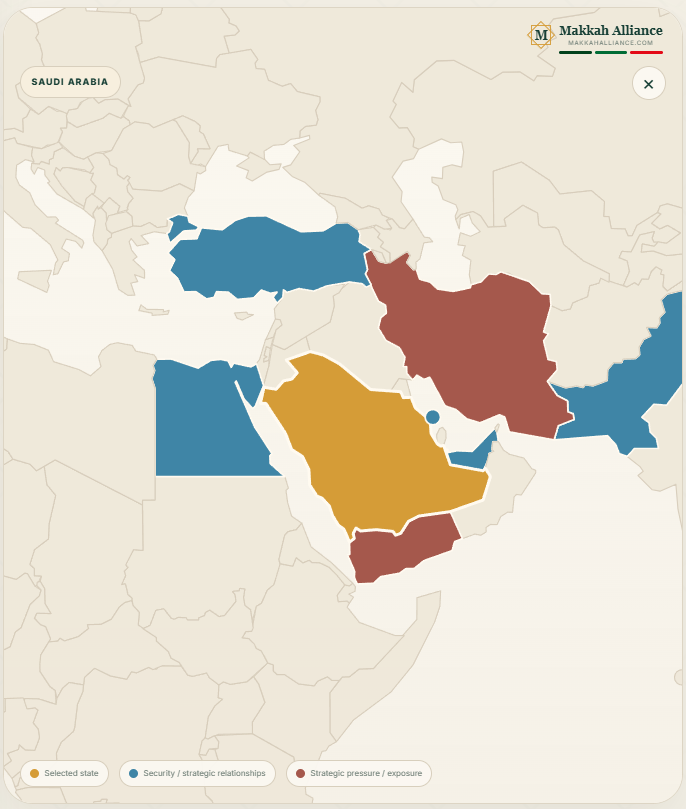
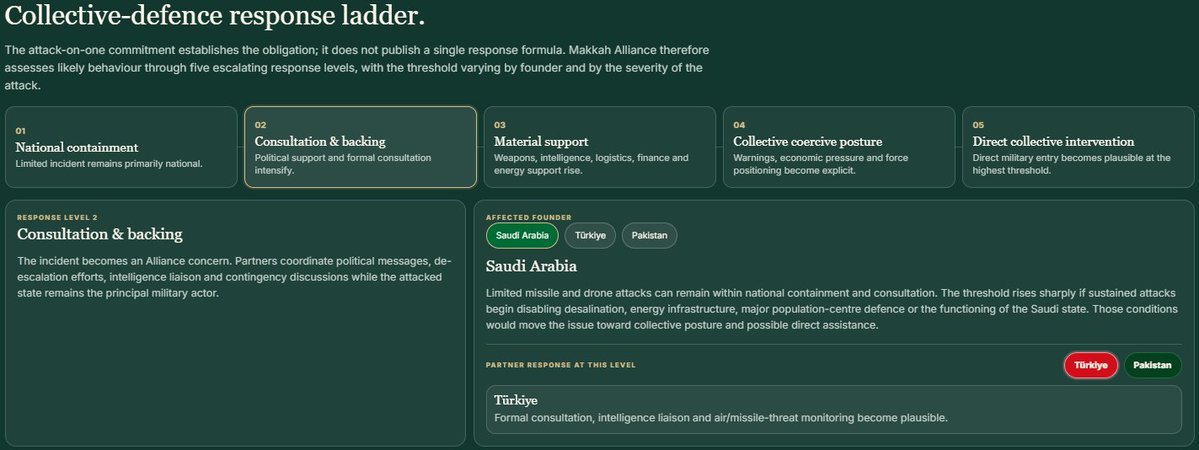
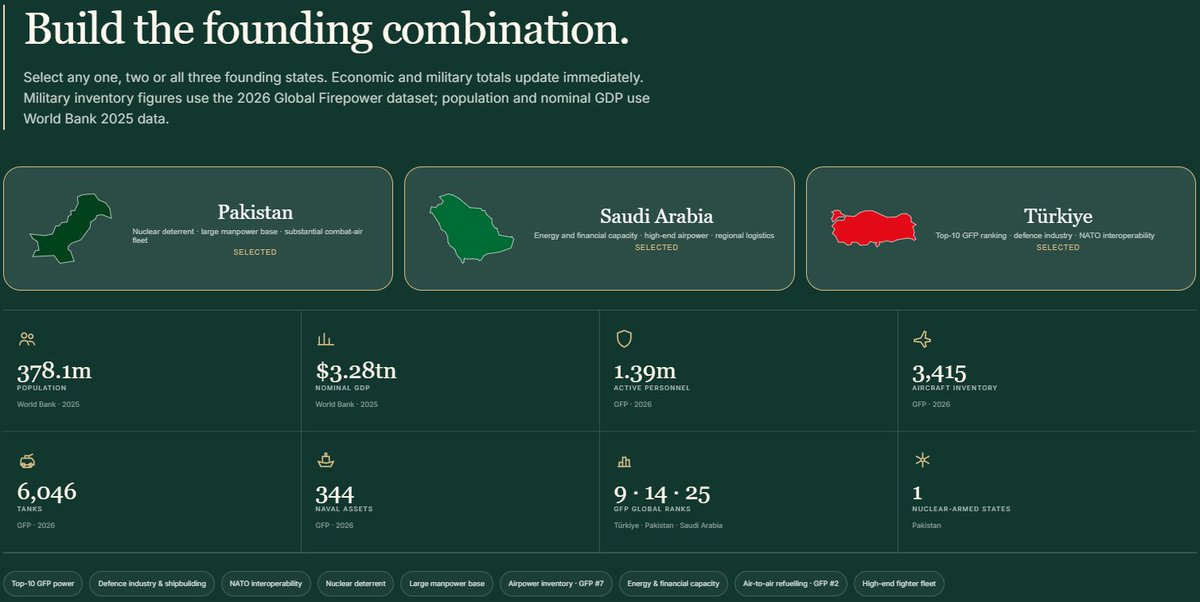


Commentary Archive
A chronological record of Makkah Alliance analysis, responses and published commentary on the Joint Defence Agreement, its founding states, prospective expansion, diplomacy and regional security.